


TS EAMCET · Maths · Sequences and Series
If \(x=1+\frac{3}{1 !} \times \frac{1}{6}+\frac{3 \times 7}{2 !}\left(\frac{1}{6}\right)^2\) \(+\frac{3 \times 7 \times 11}{3 !}\left(\frac{1}{6}\right)^3+\ldots\), then \(x^4\) equals
- A 81
- B 54
- C 27
- D 8
Answer & Solution
Correct Answer
(C) 27
Step-by-step Solution
Detailed explanation
\begin{aligned} & \because x=1+\frac{3}{1 !} \times \frac{1}{6}+\frac{3 \times 7}{2 !}\left(\frac{1}{6}\right)^2 \\ &+\frac{3 \times 7 \times 11}{3 !}\left(\frac{1}{6}\right)^3+\ldots \ldots \\ & \therefore \quad(1-\alpha)^{-p / q} \\ &= 1+\left(\frac{p}{q}\right) \frac{1}{1…
See the Complete Solution
Get step-by-step explanations for this and 2.5 Lakh+ more JEE, NEET & CET questions.
- Unlock all solutions
- Practice the full chapter
- Track accuracy across PYQs
4.8 rated on Google Play · 14,000+ reviews
More questions from Maths
- If \(A, B\) are two non singular matrices of order \(3,|B|=k\), a positive integer, then match the items of list-I with the items of list-II.
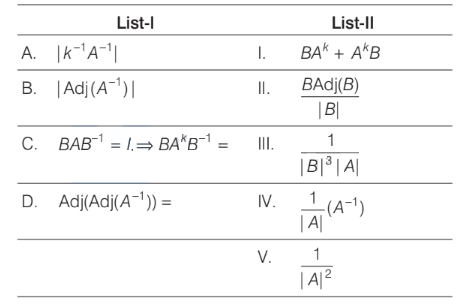
The correct match is
\(\begin{array}{llll}
A & B & C & D
\end{array}\)TS EAMCET 2020 Medium - The value of \(\lim _{\substack{n \rightarrow \infty}} \frac{1}{n^3} \sum_{k=1}^n\left(k^2 x\right)\) isTS EAMCET 2004 Hard
- When the origin is shifted to the point \((h, k)\) by translati:g the coordinate axes, the equation \(S=2 x^2-x y+y^2+2 x\) \(+3 y+1=0\) is changed to \(S^{\prime}=a x^2+2 h x y+b y^2-3\) \(=0\). Again by rotating the coordinate axes about the new origin through the angle \(\theta\) in the positive direction, \(\mathrm{S}^{\prime}=0\) is changed to \(\mathrm{Ax}^2+\mathrm{By}^2+\mathrm{C}=0\). Then \(\mathrm{h}+\mathrm{k}+\tan 2 \theta=\)TS EAMCET 2023 Hard
- In a quadrilateral \(\mathrm{ABCD}, \measuredangle \mathrm{A}=\frac{2 \pi}{3}\) and AC is the bisector of angle \(\lfloor\mathrm{A}\). If \(15|\stackrel{\rightharpoonup}{\mathrm{AC}}|=5|\stackrel{\rightharpoonup}{\mathrm{AD}}|=3|\stackrel{\rightharpoonup}{\mathrm{AB}}|\), then angle between \(\overline{\mathrm{AB}}\) and \(\overline{\mathrm{BC}}\) isTS EAMCET 2025 Medium
- If \(\frac{(x+1)}{(2 x-1)(3 x+1)}=\frac{A}{(2 x-1)}+\frac{B}{(3 x+1)}\), then \(16 A+9 B\) is equal toTS EAMCET 2004 Easy
- Let \(\vec{a}=2 \hat{i}-\hat{j}+\hat{k}\) be the position vector of a point \(\mathrm{A}\). Let \(\vec{b}=\hat{i}+2 \hat{j}-\hat{k}\) and \(\vec{c}=\hat{i}+\hat{j}-2 \hat{k}\) be two vectors and \(\vec{r}\) be a vector passing through the point \(A(\vec{a})\) and parallel to the vector \(\vec{b}\). If the projection of \(\vec{r}\) on \(\vec{c}\) is \(\frac{9}{\sqrt{6}}\) then \(|\vec{r}|=\)TS EAMCET 2023 Easy
More PYQs from TS EAMCET
- If , thenTS EAMCET 2018 Hard
- If \(\alpha, \beta, \gamma, \delta\) are the roots of the equation \(x^4+x^2+1=0\), then \(\frac{\alpha^3+\beta^3+\gamma^3+\delta^3}{\alpha^6+\beta^6+\gamma^6+\delta^6}=\)TS EAMCET 2020 Medium
- A galvanometer coil has a resistance of and the meter shows full scale deflection for a current of What resistance needs to be connected to convert the meter into a voltmeter of range toTS EAMCET 2021 Medium
- Among the following \(\mathrm{Cr}(\mathrm{III})\) complexes, which one will have the highest octahedral crystal field splitting?TS EAMCET 2020 Medium
- The coefficient of variation for the following data is
 TS EAMCET 2019 Easy
 - Observe the following statements
I. \(f(x)=a x^{41}+b x^{-40} \Rightarrow \frac{f^{\prime \prime}(x)}{f(x)}=1640 x^{-2}\)
II. \(\frac{d}{d x} \tan ^{-1}\left(\frac{2 x}{1-x^2}\right)=\frac{1}{1+x^2}\)
Which of the following is correct?TS EAMCET 2005 Hard