


TS EAMCET · Maths · Quadratic Equation
If the roots of the equation \((p-3) x^2+2(p-3) x+2 p-5=0\) are real and distinct for \(\alpha < p < \beta\) and \((\beta-\alpha)\) is maximum, then the extreme value of the quadratic expression \(-(\alpha+\beta) x^2+\alpha \beta x+(\alpha-\beta)\) is
- A \(-\frac{4}{5}\)
- B 5
- C -1
- D \(\frac{4}{5}\)
Answer & Solution
Correct Answer
(D) \(\frac{4}{5}\)
Step-by-step Solution
Detailed explanation
Given, \((p-3) x^2+2(p-3) x+2 p-5=0\) has real and distinct roots for…
See the Complete Solution
Get step-by-step explanations for this and 2.5 Lakh+ more JEE, NEET & CET questions.
- Unlock all solutions
- Practice the full chapter
- Track accuracy across PYQs
4.8 rated on Google Play · 14,000+ reviews
More questions from Maths
- Match the items of List-I to the items of List-II
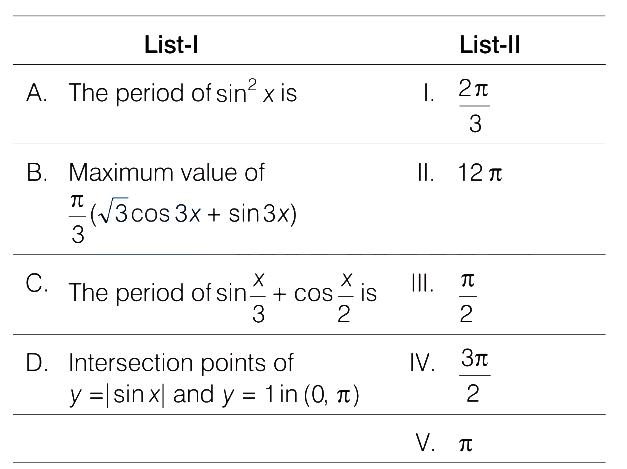
The correct match is \(\begin{array}{llll}A & B & C & D\end{array}\)TS EAMCET 2020 Medium - The area (in sq. units) of the triangle formed by the lines \(x^2-3 x y+y^2=0\) and \(x+y+1=0\), isTS EAMCET 2014 Medium
- The locus of the centre of the circle, which cuts the circle \(x^2+y^2-20 x+4=0\) orthogonally and touches the line \(x=2\), isTS EAMCET 2014 Medium
- \(\int_0^{\frac{\pi}{4}} \frac{\sec x}{1+2 \sin ^2 x} d x=\)TS EAMCET 2023 Medium
- Let be three real numbers. If the function
is continuous everywhere, thenTS EAMCET 2021 Easy - If \(\left|\begin{array}{lll}a_1 & b_1 & c_1 \\ a_2 & b_2 & c_2 \\ a_3 & b_3 & c_3\end{array}\right|=0\), then the lines \(a_i x+b_i y+c_i=0(i=1,2,3)\) representTS EAMCET 2020 Medium
More PYQs from TS EAMCET
- \(\mathrm{CH}_4\) diffuses two times faster than a gas \(X\). The number of molecules present in \(32 \mathrm{~g}\) of gas \(X\) is ( \(N\) is Avogadro number)TS EAMCET 2010 Easy
- The solution of the differential equation \(\frac{d y}{d x}=\frac{x y+y}{x y+x}\) isTS EAMCET 2008 Medium
- Reaction of 2-methylbuta-1, 3-diene with \(\mathrm{O}_3\) and \(\mathrm{Zn}-\mathrm{H}_2 \mathrm{O}\), givesTS EAMCET 2020 Medium
- If is the number of all even divisors and is the number of all odd divisors of the number , thenTS EAMCET 2018 Medium
- A cylindrical vessel, open at the top, contains 15 litres of water. Water drains out through a small opening at the bottom. 5 litre of water comes out in time \(t_1\), the next 5 litre in further time \(t_2\), and the last 5 litre in further time \(t_3\), ThenTS EAMCET 2023 Easy
- The role of copper diaphragm in Whytlaw-Gray's method isTS EAMCET 2013 Medium