


TS EAMCET · Maths · Binomial Theorem
If \(n\) is a positive integer and the coefficient of \(x^{10}\) in the expansion of \((1+x)^{15}\) is equal to the coefficient of \(x^5\) in the expansion of \((1-x)^{-n}\), then \(n=\)
- A 15
- B 12
- C 11
- D 10
Answer & Solution
Correct Answer
(C) 11
Step-by-step Solution
Detailed explanation
In the expansion of \((1+x)^{15}\) the coefficient of \[ x^{10}={ }^{15} C_{10} \text {. } \] And the expansion of \[ (1-x)^{-n}=1+n x+\frac{n(n+1)}{2 !} x^2+\frac{n(n+1)(n+2) x^3}{3 !}+\ldots \] So, coefficient of \(x^5=\frac{n(n+1)(n+2)(n+3)(n+4)}{5 !}\) According to the…
See the Complete Solution
Get step-by-step explanations for this and 2.5 Lakh+ more JEE, NEET & CET questions.
- Unlock all solutions
- Practice the full chapter
- Track accuracy across PYQs
4.8 rated on Google Play · 14,000+ reviews
More questions from Maths
- If the function \(f(x)= \begin{cases}\frac{\tan a(x-1)}{x-1}, & \text { if } 0 \lt x \lt 1 \ \frac{x^3-125}{x^2-25}, & \text { if } 1 \leq x \leq 4 \ \frac{b^x-1}{x}, & \text { if } x\gt4\end{cases}\) is continuous in its domain, then \(6 a+9 b^4=\)TS EAMCET 2024 Easy
- The coordinates of any point, in the parametric form, on the ellipse whose foci are \((-2,0),(8,0)\) and eccentricity \(\frac{1}{\sqrt{2}}\), isTS EAMCET 2021 Medium
- A bag contains 5 black balls, 4 white balls and 3 red balls. If a ball is selected at random, the probability that it is a black or a red ball, isTS EAMCET 2002 Medium
- \(1 \mathrm{f}\left|\begin{array}{ccc}x^2+3 x & x+1 & x-3 \\ x-1 & 2-x & x+4 \\ x-3 & x-3 & 3 x\end{array}\right|=a_0\) \(+a_3 x^3+a_4 x^4\), then \(\left(a_1+a_3\right)+2\left(a_0+a_2+a_4\right)=\)TS EAMCET 2019 Medium
- If the equation of the circle whose radius is \(\sqrt{10}\) and which touches the circle \(x^2+y^2+2 x+8 y-23=0\) externally at the point \((1,2)\) is \(x^2+y^2+a x+b y+c=0\), then \(|a+b+c|=\)TS EAMCET 2023 Easy
- If \(f(x)=\int\left[\tan ^2 x+\cot ^2 x+\frac{4\left(\sin ^3 x+\cos ^3 x\right)}{\sin ^2 2 x}\right] d x\) and \(f\left(\frac{\pi}{4}\right)=0\), then \(3\left[f\left(\frac{\pi}{6}\right)+2\right]=\)TS EAMCET 2022 Hard
More PYQs from TS EAMCET
- A solenoid of length \(2 \mathrm{~m}\) carries a current of \(20 \mathrm{~A}\). The diameter of the solenoid is \(3 \mathrm{~cm}\). If the magnetic field inside the solenoid is \(20 \mathrm{mT}\), then the length of wire forming the solenoid is (assume, \(\mu_0=4 \pi \times 10^{-7} \mathrm{H} / \mathrm{m}\) )TS EAMCET 2020 Easy
- In the preparation of chlorine by the electrolysis of brine, the reaction taking place at the anode isTS EAMCET 2019 Medium
- The major product of the following synthetic reactions is
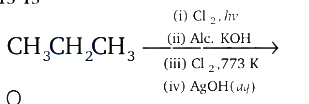 TS EAMCET 2021 Medium
 - The curves \(y=x^2+9 x+20\) and \(y=x^2+b x+c\) intersect the \(X\)-axis at the points \(\left(\alpha_i, 0\right),(i=1,2,3,4)\). If \(\alpha_1 < \alpha_2 < \alpha_3 < \alpha_4\) be such that \(\left|\alpha_1-\alpha_3\right|=\left|\alpha_2-\alpha_4\right|=8\), then the sum of all possible values of \(b\) and \(c\) isTS EAMCET 2020 Medium
- The indicator used during the estimation of of a water sample isTS EAMCET 2021 Easy
- A car is moving with a speed of \(72 \mathrm{~km} / \mathrm{h}\) towards a hill. Car blows horn at a distance of \(1800 \mathrm{~m}\) from the hill. If echo is heard after \(10 \mathrm{~s}\), the speed of sound (in \(\mathrm{m} / \mathrm{s}\) ) isTS EAMCET 2008 Easy