


TS EAMCET · Maths · Indefinite Integration
If \(I_n=\int x^n \cdot e^{c x} d x\) for \(n \geq 1, \quad\) then \(c \cdot I_n+n \cdot I_{n-1}\) is equal to
- A \(x^n e^{c x}\)
- B \(x^n\)
- C \(e^{c x}\)
- D \(x^n+e^{c x}\)
Answer & Solution
Correct Answer
(A) \(x^n e^{c x}\)
Step-by-step Solution
Detailed explanation
Given that, \[ \begin{aligned} & I_n=\int x^n \cdot e^{c x} d x \\ & I_n=\frac{e^{c x}}{c} \cdot x^n-\int \frac{e^{c x}}{c} \cdot n x^{n-1} d x \\ & \Rightarrow \quad I_n=\frac{e^{c x} \cdot x^n}{c}-\frac{n}{c} I_{n-1} \\ & \end{aligned} \]…
See the Complete Solution
Get step-by-step explanations for this and 2.5 Lakh+ more JEE, NEET & CET questions.
- Unlock all solutions
- Practice the full chapter
- Track accuracy across PYQs
4.8 rated on Google Play · 14,000+ reviews
More questions from Maths
- If \(\alpha, \beta, \gamma\) are real numbers such that \(\left(\frac{7}{3}+\beta\right) \bar{i}-\bar{j}+(\alpha+\gamma) \bar{k}=\frac{5}{3}(\alpha \bar{i}+\bar{j}-\bar{k})+\beta(2 \bar{j}+\bar{k})+(\bar{i}+\gamma \bar{j}+3 \bar{k}), \text { then } 5 \alpha-9 \beta+13 \gamma=\)TS EAMCET 2022 Easy
- Let a function be continuous in an interval . Let be a very small real number. Let be such that and for every . Let and . ThenTS EAMCET 2022 Medium
- If \(f: \mathbf{R} \rightarrow \mathbf{R}\) and \(g: \mathbf{R} \rightarrow \mathbf{R}\) be defined by \(\begin{aligned} & f(x)=\left\{\begin{array}{cc} x+2, & x>0 \ 2-x, & x \leq 0 \end{array}\right. \text { and } \ & g(x)=\left\{\begin{array}{cc} x^2-2 x-2, & 1 \leq x < 2 \ x-7 & x \geq 2 \ x+5, & x < 1 \end{array} \text { then } \lim _{x \rightarrow 0} g \circ f(x)\right. \end{aligned}\)TS EAMCET 2020 Medium
- If \(f(x)=\frac{\cos x}{\sin ^2 x+\cos ^4 x}\), for \(x \in R\), then \(f(2002)\) is equal toTS EAMCET 2002 Medium
- The quadratic equation whose roots are \(\ell=\lim _{\theta \rightarrow 0}\left(\frac{3 \sin \theta-4 \sin ^3 \theta}{\theta}-\right)\) and \(\mathrm{m}=\lim _{\theta \rightarrow 0}\left(\frac{2 \tan \theta}{\theta\left(1-\tan ^2 \theta\right)}\right)\) isTS EAMCET 2023 Medium
- If the roots of the equation, \(8 x^3+6 p x^2+3 q x-27=0\) are in a geometric progression, then \(q^2+9 p^2+6 p q+q / p=\)TS EAMCET 2020 Easy
More PYQs from TS EAMCET
- The line among the following which touches the parabola \(y^2=4 a x\), isTS EAMCET 2005 Medium
- The lines \(x-y-2=0, x+y-4=0\) and \(x+3 y=6\) meet in the common point :TS EAMCET 2006 Easy
- The correct IUPAC name of the structure given below is
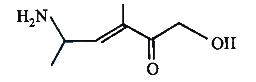 TS EAMCET 2024 Medium
 - If a line L passing through the point \(\mathrm{A}(-2,4)\) makes an angle of \(60^{\circ}\) with the positive direction of X -axis in anti-clockwise direction and \(\mathrm{B}(p, q)\) lying in the \(3^{\text {rd }}\) quadrant is a point on L at the distance of 6 units from the point A, then \(\sqrt{p^2+q^2-8 q}=\)TS EAMCET 2025 Medium
- The locus of a point on the argand plane represented by the complex number \(z\), when \(z\) satisfies the condition \(\left|\frac{z-1+i}{z+1-i}\right|=\left|\operatorname{Re}\left(\frac{z-1+i}{z+1-i}\right)\right|\) isTS EAMCET 2019 Medium
- One Debye is equal to how many coulomb meter?TS EAMCET 2021 Medium