


TS EAMCET · Maths · Quadratic Equation
If \(\alpha, \beta, \gamma\) are the roots of the equation \(x^3-6 x^2+11 x-6=0\) and if \(a=\alpha^2+\beta^2+\gamma^2\), \(b=\alpha \beta+\beta \gamma+\gamma \alpha\) and \(c=(\alpha+\beta)(\beta+\gamma)(\gamma+\alpha)\), then the correct inequality among the following is
- A \(a < b < c\)
- B \(b < a < c\)
- C \(b < c < a\)
- D \(c < a < b\)
Answer & Solution
Correct Answer
(B) \(b < a < c\)
Step-by-step Solution
Detailed explanation
Given equation \(x^3-6 x^2+11 x-6=0\) has the roots \(\alpha, \beta \gamma\). Given, \(\quad a=\alpha^2+\beta^2+\gamma^2\) ...(i) \(b=\alpha \beta+\beta \gamma+\gamma \alpha\) ...(ii) \(c=(\alpha+\beta)(\beta+\gamma)(\gamma+\alpha)\) ...(iii) In cubic equation the sum of the…
See the Complete Solution
Get step-by-step explanations for this and 2.5 Lakh+ more JEE, NEET & CET questions.
- Unlock all solutions
- Practice the full chapter
- Track accuracy across PYQs
4.8 rated on Google Play · 14,000+ reviews
More questions from Maths
- If \(\mathrm{A}\) is a symmetric matrix with real entries, thenTS EAMCET 2023 Medium
- The roots of the cubic equation are diminished by and a cubic equation with these diminished roots is formed. If the transformed equation does not contain term, then the roots of the transformed equation areTS EAMCET 2021 Medium
- If and the angle between and is then the area of the triangle (in square units) with and as two of its sides isTS EAMCET 2021 Easy
- A bag contains \(n\) white and \(n\) black balls. Pairs of balls are drawn at random without replacement successively, until the bag is empty. If the number of ways in which each pair consists of one white and one black ball is 14400 , then \(n\) is equal toTS EAMCET 2011 Medium
- If the vectors \(\overline{B C}=2 \bar{i}+\bar{j}+\bar{k}\) and \(\overline{C D}=\bar{i}+2 \bar{j}-2 \bar{k}\) represent two adjacent sides of a parallelogram \(\mathrm{ABCD}\) and \(\theta\) is the angle between its diagonals \(\overline{A C}\) and \(\overline{B D}\) then \(\tan \theta=\)TS EAMCET 2023 Medium
- Two straight lines are drawn through the point \((0,2)\) such that the length of the perpendiculars from the point \((4,4)\) to these lines are each equal to 2 mits. The equation of the line joining the feet of these perpendiculars isTS EAMCET 2019 Medium
More PYQs from TS EAMCET
- A long straight wire carrying current \(16 \mathrm{~A}\) is bent at \(90^{\circ}\) such that half of the wire lies along the positive \(x\)-axis and other half lies along the positive \(y\)-axis. What is the magnitude of the magnetic field at the point, \(\mathbf{r}=(-2 \hat{\mathbf{i}}+0 \hat{\mathbf{j}}) \mathrm{mm}\) ? (Assume, \(\frac{\mu_0}{4 \pi}=10^{-7} \mathrm{H} \mathrm{m}^{-1}\) )TS EAMCET 2019 Easy
- A bar of mass resting on a smooth horizontal plane starts moving due to force . The magnitude of the force remains constant with time. The force vector makes an angle with the horizontal which varies with the distance covered as . If the constant then the speed of the bar, when becomes equal to for the first time, is (Assume )TS EAMCET 2019 Medium
- In the circuit shown in the figure, the current ' \(T\) ' is
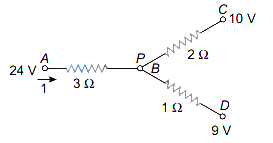 TS EAMCET 2013 Easy
 - The two curves \(x=y^2, \quad x y=a^3 \quad\) cut orthogonally at a point, then \(a^2\) is equal toTS EAMCET 2002 Medium
- The energy of a photon is equal to the kinetic energy of a proton. If \(\lambda_1\) is the de-Broglie wavelength of a proton, \(\lambda_2\) the wavelength associated with the proton and if the energy of the photon is \(E\), then \(\left(\lambda_1 / \lambda_2\right)\) is proportional toTS EAMCET 2014 Hard
- The solutions of the equation \(z^2\left(1-z^2\right)=16\), \(z \in \mathbf{C}\), lie on the curveTS EAMCET 2020 Medium