


TS EAMCET · Maths · Circle
If \(\alpha\) and \(\beta\) are the roots of \(x^2+2 x-3=0\) and \(\gamma, \delta\) are the roots of \(y^2-y-4=0\), then the equation of the circle having \((\alpha, \gamma)\) and \((\beta, \delta)\) as ends of a diameter is
- A \(x^2+y^2+4 x-3 y+2=0\)
- B \(x^2+y^2+2 x-y+7=0\)
- C \(x^2+y^2-3 x+4 y+1=0\)
- D \(x^2+y^2-2 x+y-1=0\)
Answer & Solution
Correct Answer
(B) \(x^2+y^2+2 x-y+7=0\)
Step-by-step Solution
Detailed explanation
Given, data is incorrect because \(y^2-y+4=0\) has imaginary discriminant and never gives equal to zero.
See the Complete Solution
Get step-by-step explanations for this and 2.5 Lakh+ more JEE, NEET & CET questions.
- Unlock all solutions
- Practice the full chapter
- Track accuracy across PYQs
4.8 rated on Google Play · 14,000+ reviews
More questions from Maths
- The approximate value of upto decimal places isTS EAMCET 2021 Easy
- The equation of the tangent to the curve at isTS EAMCET 2021 Easy
- Assertion : The curves \(y^2=4 x\) and \(x^2=-2 y\) intersect at \((1,2)\) orthogonally. Reason : If the product of the slopes of the tangents drawn to two curves at their point of intersection is -1 , then the curves are said to cut each other orthogonally. The correct option among the following isTS EAMCET 2022 Medium
- If a circle has its centre on the line and passes through the points of intersection of the two circles and then the centre of that circle isTS EAMCET 2021 Easy
- \(\lim _{n \rightarrow \infty}\left[\left(1+\frac{1}{n^2}\right)\left(1+\frac{4}{n^2}\right)\left(1+\frac{9}{n^2}\right) \ldots(2)\right]^{1 / n}=\)TS EAMCET 2024 Medium
- The equation of the pair of lines passing through the origin whose sum and product of slopes are respectively the arithmetic mean and geometric mean of 4 and 9 isTS EAMCET 2013 Medium
More PYQs from TS EAMCET
- At \(\mathrm{T}(\mathrm{K})\), copper (atomic mass \(=63.5 \mathrm{u}\) ) has fcc structure with an edge length of \(\mathrm{x} Å\). The density of copper (in \(\mathrm{g} \mathrm{cm}^{-3}\) ) at that temperature approximately is \(\left(\mathrm{N}_{\mathrm{A}}=6.0 \times 10^{23} \mathrm{~mol}^{-1}\right)\)TS EAMCET 2023 Medium
- A moving coil galvanometer of resistance 100 \(\Omega\) shows full scale deflection when a current of 100 micro-amperes passes through it. If it is intended to show full scale deflection when a current of 1 milliampere passes through it, the value of shunt resistance in ohms to be connected to the galvanometer is.TS EAMCET 2002 Medium
- If \(a \neq p, b \neq q, c \neq r\) and \(\left|\begin{array}{ccc}p & b & c \\ p+a & q+b & 2 c \\ a & b & r\end{array}\right|=0\), then \(\frac{p}{p-a}+\frac{q}{q-b}+\frac{r}{r-c}\) is equal to :TS EAMCET 2003 Easy
- The reactivity of alkyl bromides.
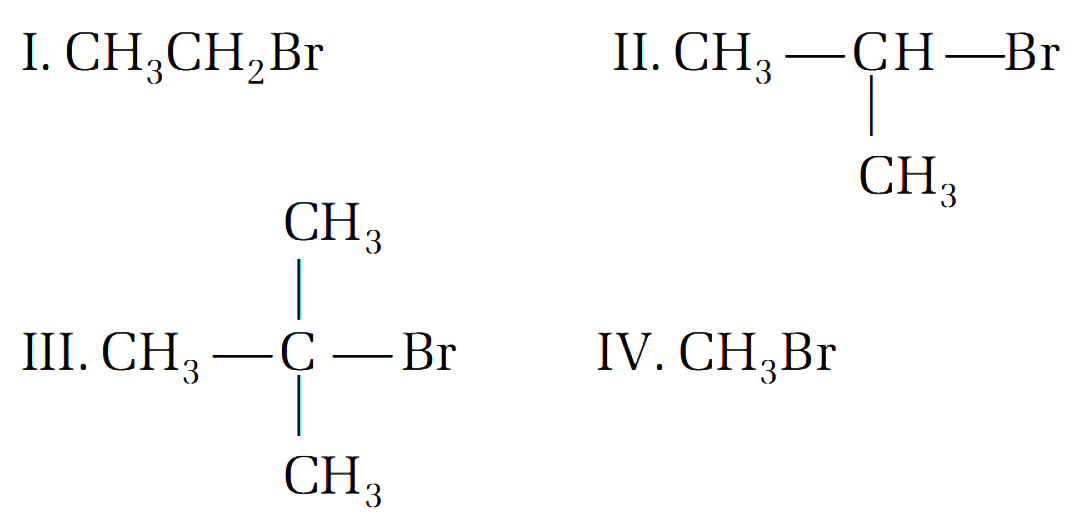
Towards iodide ion in dry acetone decrease in the orderTS EAMCET 2017 Medium - \(\int e^x\left(\frac{2+\sin 2 x}{1+\cos 2 x}\right) d x\) is equal toTS EAMCET 2013 Hard
- In which of the following reactions at equilibria, the position of the equilibrium shifts towards the products, if the total pressure is increased? (i) \(\mathrm{X}_2(\mathrm{~g})+3 \mathrm{Y}_2(\mathrm{~g}) \rightleftharpoons 2 \mathrm{XY}_3(\mathrm{~g})\) (ii) \(\mathrm{X}_2(\mathrm{~g})+\mathrm{Y}_2(\mathrm{~g}) \rightleftharpoons 2 \mathrm{XY}(\mathrm{g})\) (iii) \(\mathrm{X}_2(\mathrm{~g})+\mathrm{Z}_2(\mathrm{~g}) \rightleftharpoons 2 \mathrm{XZ}(\mathrm{g})\) (iv) \(\mathrm{X}_2(\mathrm{~g})+\mathrm{Y}_4(\mathrm{~g}) \rightleftharpoons 2 \mathrm{XY}_2(\mathrm{~g})\)TS EAMCET 2022 Easy