


TS EAMCET · Maths · Basic of Mathematics
If \(2^{4 n+3}+3^{3 n+1}\) is divisible by P for all natural numbers \(n\), then P is
- A an even integer
- B an odd integer, not a prime
- C an odd prime integer
- D an integer less than 9
Answer & Solution
Correct Answer
(C) an odd prime integer
Step-by-step Solution
Detailed explanation
\( f(n) = 2^{4n+3}+3^{3n+1} \) \( f(1) = 2^{4(1)+3}+3^{3(1)+1} = 2^7+3^4 = 128+81 = 209 \) \( 209 = 11 \cdot 19 \) \( 2^{4n+3}+3^{3n+1} = 8 \cdot (2^4)^n + 3 \cdot (3^3)^n = 8 \cdot 16^n + 3 \cdot 27^n \) \( \equiv 8 \cdot 5^n + 3 \cdot 5^n \pmod{11} \)…
See the Complete Solution
Get step-by-step explanations for this and 2.5 Lakh+ more JEE, NEET & CET questions.
- Unlock all solutions
- Practice the full chapter
- Track accuracy across PYQs
4.8 rated on Google Play · 14,000+ reviews
More questions from Maths
- \(\left\{x \in R: \cos 2 x+2 \cos ^2 x=2\right\}\) is equal toTS EAMCET 2008 Easy
- In the interval \((-3,3)\) the function \(f(x)=\frac{x}{3}+\frac{3}{x}, x \neq 0\) is :TS EAMCET 2006 Easy
- If one root of the equation \(4 x^2-2 x+k-4=0\) is the reciprocal of the other, then the value of \(k\) isTS EAMCET 2023 Easy
- The lengths of tangent, subtangent, normal and subnormal for the curve \(y=x^2+x-1\) at \((1,1)\) are \(A, B, C\) and \(D\) respectively, then their increasing order isTS EAMCET 2007 Easy
- \(\int_{-\pi / 8}^{\pi / 8} \frac{\sin ^4(4 x)}{1+e^{4 x}} d x=\)TS EAMCET 2024 Easy
- Match the following
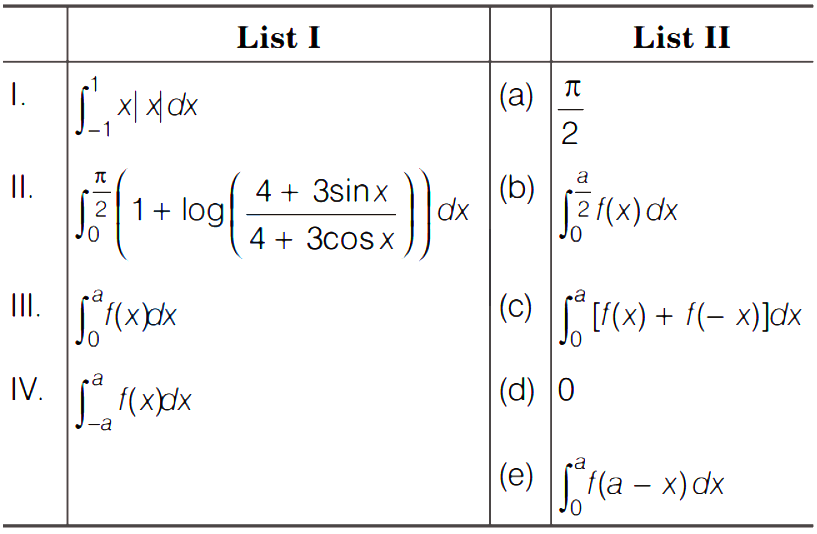 0
0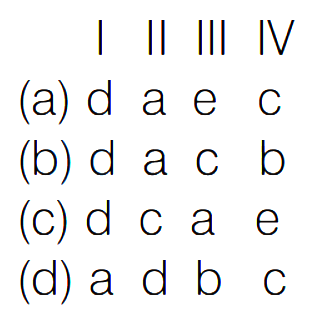 TS EAMCET 2017 Medium
More PYQs from TS EAMCET
- The centre of the circle \(r^2-4 r(\cos \theta+\sin \theta)-4=0\) in cartesian coordinates isTS EAMCET 2004 Medium
- \(\frac{d}{d x}\left[\left(x^{\frac{5}{2}}-x^{\frac{3}{2}}+1\right)\left(x^2-3 x+5\right)\right]=\)TS EAMCET 2022 Hard
- The system of equations \(x+3 b y+b z=0, x+2 a y+a z=\) 0 and \(x+4 c y+c z=0\) hasTS EAMCET 2024 Easy
- The general solution of \(\frac{d y}{d x}+\mathrm{y} f^{\prime}(\mathrm{x})-f(\mathrm{x}) f^{\prime}(\mathrm{x})=0, \mathrm{y}\) \(\neq f(x)\) isTS EAMCET 2023 Hard
- If and represent the energies, and represent the times, in which of the following is dimensionally correct relation?TS EAMCET 2020 Hard
- If \(z=\sqrt{2} \sqrt{1+\sqrt{3 i}}\) represents a point \(P\) in the argand plane and \(P\) lies in the third quadrant, then the polar form of \(z\) isTS EAMCET 2019 Easy