


TS EAMCET · Maths · Straight Lines
For \(a \neq b \neq c\), if the lines \(x+2 a y+a=0\), \(x+3 b y+b=0\) and \(x+4 c y+c=0\) are concurrent, then \(a, b, c\) are in
- A Arithmetic progression
- B Geometric progression
- C Harmonic progression
- D Arithmetico geometric progression
Answer & Solution
Correct Answer
(C) Harmonic progression
Step-by-step Solution
Detailed explanation
Lines \[ \begin{aligned} & x+2 a y+a=0 \\ & x+3 b y+b=0 \end{aligned} \] and \(x+4 c y+c=0\) are concurrent. If \(\left|\begin{array}{lll}1 & 2 a & a \\ 1 & 3 b & b \\ 1 & 4 c & c\end{array}\right|=0\) Applying \(R_1 \rightarrow R_1-R_2, R_2 \rightarrow R_2-R_3\), we get…
See the Complete Solution
Get step-by-step explanations for this and 2.5 Lakh+ more JEE, NEET & CET questions.
- Unlock all solutions
- Practice the full chapter
- Track accuracy across PYQs
4.8 rated on Google Play · 14,000+ reviews
More questions from Maths
- The height of the cone of maximum volume inscribed in a sphere of radius \(R\) isTS EAMCET 2010 Medium
- For \(n>1\) and \(n \in \mathbf{N}\), if \(z_1, z_2, \ldots, z_n\) are the roots of the equation \((z+1)^n=z^n\), then \(\sum_{i=1}^n \frac{\cot ^{-1}\left(2\left|\operatorname{Im} z_i\right|\right)-1}{2 \operatorname{Re} z_i}=\)TS EAMCET 2020 Hard
- If \(f(x)=\left(p-x^n\right)^{1 / n}, p>0\) and \(n\) is a positive integer, then \(f[f(x)]\) is equal toTS EAMCET 2013 Medium
- \(\lim _{x \rightarrow 0} \frac{\cos 4 x-4 \cos 2 x+3}{x^4}=\)TS EAMCET 2018 Easy
- If \(f: R \rightarrow R\) and is defined by \(f(x)=\frac{1}{2-\cos 3 x}\) for each \(x \in R\), then the range of \(f\) isTS EAMCET 2007 Medium
- The equation of the common tangent to the parabola \(y^2=8 x\) and the circle \(x^2+y^2=2\) is \(a x+b y+2=0\). If \(-\frac{a}{b}\gt0\), then \(3 a^2+2 b+1=\)TS EAMCET 2024 Medium
More PYQs from TS EAMCET
- The number of all four digit numbers that can be formed with the digits \(0,1,2,3,4,5\) when the repetition of the digits is not allowed, isTS EAMCET 2023 Easy
- An infinite number of masses are placed on a frictionless table and they are connected via massless strings. Their masses follow the sequence, \(m, \frac{m}{2}, \frac{m}{6}, \ldots \ldots \ldots . . . \frac{m}{n !}, \ldots \ldots . .\). and they are further connected to a mass \(m\) that hangs over a massless pulley. The acceleration of the hanging mass is
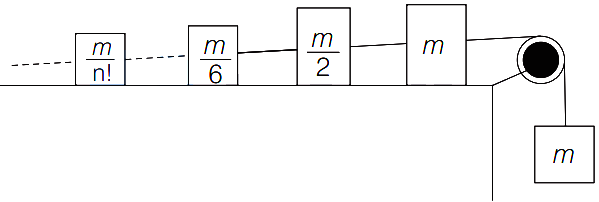 TS EAMCET 2020 Hard
 - Three masses \(700 \mathrm{~g}, 500 \mathrm{~g}\) and 400 \(\mathrm{g}\) are suspended at the end of a spring shown in figure and are in equilibrium. When the \(700 \mathrm{~g}\) mass is removed, the system oscillates with a time period of \(3 \mathrm{~s}\). If \(500 \mathrm{~g}\) mass is further removed, then it will oscillate with a period of
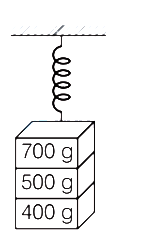 TS EAMCET 2020 Hard
 - \(\mathrm{C}_3 \mathrm{H}_4+\mathrm{H}_2 \mathrm{O} \underset{\mathrm{Hg}^{2+} / H^*}{333 \mathrm{~K}}[\mathrm{X}] \stackrel{\text { Tautomerisation }}{\rightleftharpoons} Y\) \(\mathrm{X}\) and \(\mathrm{Y}\) are respectivelyTS EAMCET 2023 Medium
- Assertion (A) : \(\mathrm{NaCl}\) is less soluble in heavy water than in ordinary water. Reason (R) : Dielectric constant of ordinary water is more than that of heavy water. The correct answer isTS EAMCET 2007 Easy
- Amphoteric hydroxide from the following isTS EAMCET 2021 Easy