


TS EAMCET · Maths · Probability
Box \(A\) contains 2 black and 3 red balls, while Box \(B\) contains 3 black and 4 red balls. Out of these two boxes one is selected at random; and the probability of choosing Box \(A\) is double that of Box \(B\). If a red ball is drawn from the selected box, then the probability that it has come from Box \(B\), is
- A \(\frac{21}{41}\)
- B \(\frac{10}{31}\)
- C \(\frac{12}{31}\)
- D \(\frac{13}{41}\)
Answer & Solution
Correct Answer
(B) \(\frac{10}{31}\)
Step-by-step Solution
Detailed explanation
Let \(P(B)=p\) according to given condition \(\begin{aligned} P(A) & =2 P(B)=2 p \\ P\left(\frac{R}{A}\right) & =\frac{{ }^3 C_1}{{ }^5 C_1}=\frac{3}{5} \end{aligned}\) and \(P\left(\frac{R}{B}\right)=\frac{{ }^4 C_1}{{ }^7 C_1}=\frac{4}{7}\) Using Baye's theorem…
See the Complete Solution
Get step-by-step explanations for this and 2.5 Lakh+ more JEE, NEET & CET questions.
- Unlock all solutions
- Practice the full chapter
- Track accuracy across PYQs
4.8 rated on Google Play · 14,000+ reviews
More questions from Maths
- Match the differential equations in List I to their integrating factors in List II.
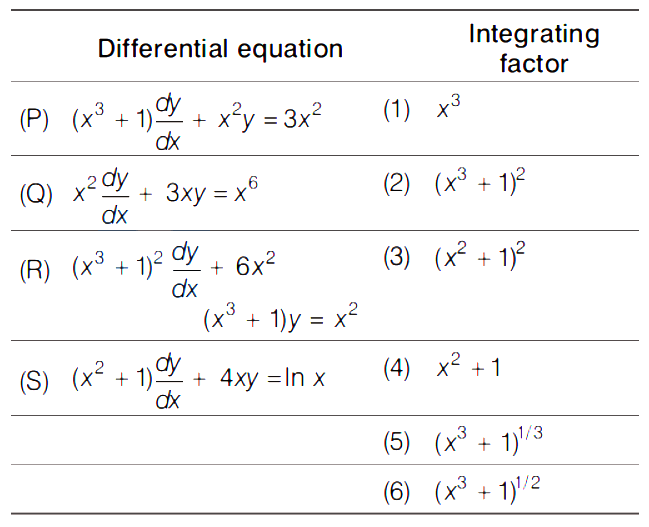
The correct match isTS EAMCET 2015 Easy - If tangents are drawn from any point on the circle \(x^2+y^2=25\) to the ellipse \(\frac{x^2}{16}+\frac{y^2}{9}=1\), then the angle between the tangents isTS EAMCET 2014 Easy
- The middle term in the expansion of \(\left(4 x^3-\frac{15}{4 x}\right)^8\) isTS EAMCET 2021 Medium
- If thenTS EAMCET 2021 Easy
- If one of the diameter of the circle \(x^2+y^2-2 x-6 y+6=0\) is a chord to the circle with centre \((2,1)\), then the radius of the bigger circle isTS EAMCET 2019 Medium
- The sum of the series \(1+\frac{2}{3}\left(\frac{1}{8}\right)+\frac{2 \times 5}{3 \times 6}\left(\frac{1}{8}\right)^2+\frac{2 \times 5 \times 8}{3 \times 6 \times 9}\left(\frac{1}{8}\right)^3+\ldots\) isTS EAMCET 2016 Medium
More PYQs from TS EAMCET
- A child is on a merry-go-round, standing at a distance \(2 \mathrm{~m}\) from the centre. The coefficient of static friction between the child and the surface of merry-go-round is 0.8 . At what maximum angular velocity can the merry-go-round be rotated before the child slips? (Talse, \(g=10 \mathrm{~m} / \mathrm{s}^2\) )TS EAMCET 2018 Medium
- Two wires \(A\) and \(B\) of same length, same radius and same Young's modulus are heated to same range of temperatures. If the coefficient of linear expansion of A is \(\frac{3}{2}\) times that of \(\mathrm{B}\), then the ratio of the thermal stresses produced in the two wires A and B isTS EAMCET 2023 Medium
- Observe the following statements
Statement - I: \(\quad\) Both LiF and CsI have low solubility in water
Statement - II: \(\quad\) Low solubility of LiF in water is due to smaller hydration enthalpy of ions and that of CsI is due to its high lattice enthalpy
The correct answer isTS EAMCET 2025 Medium - The point on the line which is equidistant from the points and is-TS EAMCET 2021 Easy
- From the pole of the earth, a body of mass \(m\) is imparted a velocity \(v_0\) directed vertically up. If \(M\) is the mass of the earth, \(R\) its radius and \(g\) is the free-fall acceleration on its surface, then the height \(h\) to which the body will ascent is (neglect air resistance)TS EAMCET 2018 Medium
- The reagent ' X ' used in the following reaction to obtain good yield of the product is
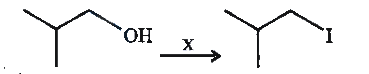 TS EAMCET 2024 Easy