


TS EAMCET · Maths · Straight Lines
A line \(\mathrm{L}\) has intercepts \(\mathrm{a}\) and \(\mathrm{b}\) on the coordinate axes. When the coordinate axes are rotated through an angle \(\alpha\) keeping the origin fixed, the same line \(\mathrm{L}\) has intercepts \(\mathrm{p}\) and \(q\) on the new axes. Then
- A \(a^2+b^2=p^2+q^2\)
- B \(a^2+p^2=b^2+q^2\)
- C \(\frac{1}{a^2}+\frac{1}{p^2}=\frac{1}{b^2}+\frac{1}{q^2}\)
- D \(\frac{1}{a^2}+\frac{1}{b^2}=\frac{1}{p^2}+\frac{1}{q^2}\)
Answer & Solution
Correct Answer
(D) \(\frac{1}{a^2}+\frac{1}{b^2}=\frac{1}{p^2}+\frac{1}{q^2}\)
Step-by-step Solution
Detailed explanation
When axes are rotated through \(\alpha\), new co-ordinates \((x \cos \alpha-y \sin \alpha, x \sin \alpha+y \cos \alpha)\) Original equation of \(L: \frac{x}{a}+\frac{y}{b}=1\) With shifted coordinates,…
See the Complete Solution
Get step-by-step explanations for this and 2.5 Lakh+ more JEE, NEET & CET questions.
- Unlock all solutions
- Practice the full chapter
- Track accuracy across PYQs
4.8 rated on Google Play · 14,000+ reviews
More questions from Maths
- If \(\int \frac{2 d x}{\sqrt{\cot ^2 x-\tan ^2 x}}=-\sqrt{f(x)}+c\), then \(f(x)=\)TS EAMCET 2018 Easy
- \(x=\frac{1}{2}\left(\sqrt{3}+\frac{1}{\sqrt{3}}\right)\), then \(\frac{\sqrt{x^2-1}}{x-\sqrt{x^2-1}}\) is equal toTS EAMCET 2005 Medium
- If \(\vec{a}+\vec{b}+\vec{c}=\overrightarrow{0},|\vec{a}|=3,|\vec{b}|=5,|\vec{c}|=7\), then the angle between \(\vec{a}\) and \(\vec{b}\) isTS EAMCET 2023 Easy
- If \(m\) and \(\mathrm{M}\) are respectively the smallest and greatest rational roots of the equation \(6 x^6-25 x^5+31 x^4-31 x^2+25 x-6=0\), then \(\mathrm{M}-m=\)TS EAMCET 2022 Easy
- If \(F_1\) and \(F_2\) are the focii of the ellipse \(16 x^2+25 y^2=400\) and \(P\) is any point on it, then the value of the product \(P F_1 \cdot P F_2\) lie in the intervalTS EAMCET 2021 Easy
- For a binomial variate \(X\) with \(n=6\), if \(P(X=2)=9 P(X=4)\), then its variance isTS EAMCET 2005 Easy
More PYQs from TS EAMCET
- Catalysts in the following reactions are I) II) III) IV)TS EAMCET 2022 Hard
- \(\operatorname{Arg}\left(\sin \frac{6 \pi}{5}+i\left(1+\cos \frac{6 \pi}{5}\right)\right)=\)TS EAMCET 2023 Medium
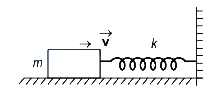
- A block of mass \(m=25 \mathrm{~kg}\) sliding on a smooth horizontal surface with a velocity \(v=3 \mathrm{~ms}^{-1}\) meets the spring of spring constant \(k=100 \mathrm{~N} / \mathrm{m}\) fixed at one end as shown in figure. The maximum compression of the spring and velocity of block as it returns to the original position respectively are
 TS EAMCET 2007 Medium
 - Consider a steady flow of oil in a pipeline. The cross-sectional radius of the pipeline decreases gradually as \(r=r_0 e^{-\alpha x}\), where \(\alpha=\frac{1}{3} \mathrm{~m}^{-1}\) and \(x\) is the distance from the pipeline inlet. If \(R_1\) is the Reynold's number for a certain pipeline cross-section at a distance \(x_1\) metre from the inlet and \(R_2\) is for distance \(\left(x_1+3\right)\) metre, then the ratio \(\frac{R_1}{R_2}\) isTS EAMCET 2020 Medium
- If first ionization enthalpy \(\left(\Delta_i \mathrm{H}\right)\) values of \(\mathrm{Na}, \mathrm{Mg}\) and Si are respectively 496,737 and \(786 \mathrm{~kJ} \mathrm{~mol}^{-1}\), the first ionization enthalpy value of Al (in \(\mathrm{kJ} \mathrm{mol}^{-1}\) ) will beTS EAMCET 2024 Easy
- \(\mathrm{KMnO}_4\) reacts with \(\mathrm{KI}\), in basic medium to form \(\mathrm{I}_2\) and \(\mathrm{MnO}_2\). When \(250 \mathrm{~mL}\) of \(0.1 \mathrm{M} \mathrm{KI}\) solution is mixed with \(250 \mathrm{~mL}\) of \(0.02 \mathrm{M}\) \(\mathrm{KMnO}_4\) in basic medium, what is the number of moles of \(\mathrm{I}_2\) formed?TS EAMCET 2014 Medium