


TS EAMCET · Chemistry · Electrochemistry
The potential of hydrogen electrode of \(\mathrm{pH}=10\) with respect to standard hydrogen electrode is
- A \(-0.0591 \mathrm{~V}\)
- B \(-0.591 \mathrm{~V}\)
- C \(0.2 \mathrm{~V}\)
- D 0
Answer & Solution
Correct Answer
(B) \(-0.591 \mathrm{~V}\)
Step-by-step Solution
Detailed explanation
For, hydrogen electrode \[ \mathrm{pH}=10 \quad\left[\mathrm{H}^{+}\right]=10^{-10} \mathrm{M} \quad \mathrm{H}^{+}+e^{-}=\frac{1}{2} \mathrm{H}_2 \]…
See the Complete Solution
Get step-by-step explanations for this and 2.5 Lakh+ more JEE, NEET & CET questions.
- Unlock all solutions
- Practice the full chapter
- Track accuracy across PYQs
4.8 rated on Google Play · 14,000+ reviews
More questions from Chemistry
- Match the following:
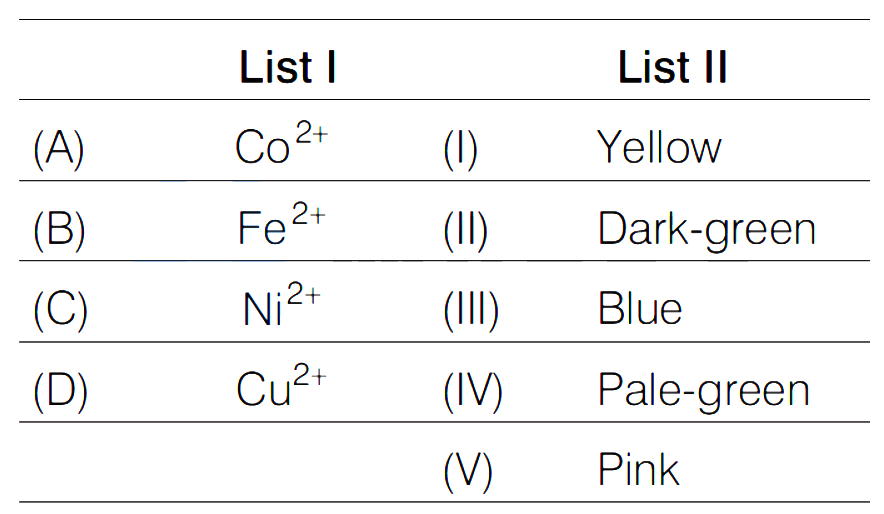
The correct answer is: TS EAMCET 2019 Easy
 - Identify the non-narcotic analgesic from the followingTS EAMCET 2010 Easy
- In the following reaction sequence, the compound isTS EAMCET 2021 Medium
- Identify the incorrect match from the following:TS EAMCET 2023 Medium
- The dihedral angles in gaseous and solid phases of \(\mathrm{H}_2 \mathrm{O}_2\) molecule respectively areTS EAMCET 2024 Medium
- The structure of PCC isTS EAMCET 2013 Hard
More PYQs from TS EAMCET
- The number of common tangents to the circles \(x^2+y^2+4 x=0\) and \(x^2+y^2-2 x=0\) isTS EAMCET 2018 Easy
- Let \(\mathrm{D}\) be the foot of the perpendicular drawn from the point \(\mathrm{A}(2,0,3)\) to the line joining the points \(\mathrm{B}(0,4,1)\) and \(\mathrm{C}(-2,0,4)\). Then the ratio in which \(\mathrm{D}\) divides \(\mathrm{BC}\) isTS EAMCET 2022 Easy
- Let \(A=\left[\begin{array}{rrr}-1 & -2 & -3 \\ 3 & 4 & 5 \\ 4 & 5 & 6\end{array}\right], B=\left[\begin{array}{cr}1 & -2 \\ -1 & 2\end{array}\right] \quad\) and \(C=\left[\begin{array}{lll}2 & 0 & 0 \\ 0 & 2 & 0 \\ 0 & 0 & 2\end{array}\right]\), if \(a, b\) and \(c\) respectively, denote the ranks of \(A, B\) and \(C\), then the correct order of these number isTS EAMCET 2012 Easy
- At \(298 \mathrm{~K}\) the molar conductivities at infinite dilution \(\left(\Lambda_m^{\circ}\right)\) of \(\mathrm{NH}_4 \mathrm{Cl}, \mathrm{KOH}\) and \(\mathrm{KCl}\) are 152.8, 272.6 and \(149.8 \mathrm{~S} \mathrm{~cm} \mathrm{cmol}^{-1}\) respectively. The \(\Lambda_m^{\circ}\) of \(\mathrm{NH}_4 \mathrm{OH}\) in \(\mathrm{S} \mathrm{cm}^2 \mathrm{~mol}^{-1}\) and \(\%\) dissociation of \(0.01 \mathrm{M} \mathrm{NH}_4 \mathrm{OH}\) with \(\Lambda_m=25.1 \mathrm{~S} \mathrm{~cm}^2 \mathrm{~mol}^{-1}\) at the same temperature areTS EAMCET 2014 Easy
- If \(\alpha\) and \(\beta\) are the roots of \(x^2+2 x-3=0\) and \(\gamma, \delta\) are the roots of \(y^2-y-4=0\), then the equation of the circle having \((\alpha, \gamma)\) and \((\beta, \delta)\) as ends of a diameter isTS EAMCET 2021 Easy
- \(\sin 20^{\circ}\left(4+\sec 20^{\circ}\right)=\)TS EAMCET 2024 Medium