


TS EAMCET · Chemistry · Coordination Compounds
The oxidation number of central metal in and respectively, are
- A
- B
- C
- D
Answer & Solution
Correct Answer
(C)
Step-by-step Solution
Detailed explanation
PtNH32ClNO2 :- Let the oxidation number of platinum = x Ammonia is a neutral ligand and chloride is having the -1 oxidation number and nitrate has the -1 oxidation number. x+2×0+-1+-1=0x-2=0x=+2 Hence, the oxidation state of platinum is +2. CoCl2(en)2⊕:- Let the…
See the Complete Solution
Get step-by-step explanations for this and 2.5 Lakh+ more JEE, NEET & CET questions.
- Unlock all solutions
- Practice the full chapter
- Track accuracy across PYQs
4.8 rated on Google Play · 14,000+ reviews
More questions from Chemistry
- Identify the correct pairs in which the chemical substance given is correctly matched with its use \begin{array}{ll} Chemical substance & use \ (A) \mathrm{Cl}_2 & Preparation of phosgene \ (B) \mathrm{I}_2 \mathrm{O}_5 & estimation of \mathrm{CO} \ (C) \mathrm{O}_3 & disinfectant \end{array}TS EAMCET 2023 Easy
- The atomic radius of gallium is less than that of aluminium. This is due toTS EAMCET 2023 Easy
- For a hypothetical reaction, \(A \rightarrow C\) \[ \begin{aligned} & A \underset{k_2}{\stackrel{k_1}{\rightleftharpoons}} B(\text { Fast }) \ & A+B \stackrel{k_1}{\underset{k_2}{\rightleftharpoons}} C \text { (Slow) } \end{aligned} \] Rate law for this reaction isTS EAMCET 2021 Medium
- The successive ionisation energy values for an element ' \(X\) ' are given below : (i) lst ionisation energy \(=410 \mathrm{~kJ} \mathrm{~mol}^{-1}\) (ii) \(2 \mathrm{nd}\) ionisation energy \(=820 \mathrm{~kJ} \mathrm{~mol}^{-1}\) iii) \(3 \mathrm{rd}\) ionisation energy \(=1100 \mathrm{~kJ} \mathrm{~mol}^{-1}\) (iv) 4 th ionisation energy \(=1500 \mathrm{~kJ} \mathrm{~mol}^{-1}\) (v) 5 th ionisation energy \(=3200 \mathrm{~kJ} \mathrm{~mol}^{-1}\)TS EAMCET 2020 Easy
- Assertion (A): is stable while is not.
Reason (R) : Fluorine stabilises the higher oxidation state due to its higher bond enthalpy.
The correct option among the following isTS EAMCET 2021 Easy - Match the reactants in List-I with the products in List-II.
List - I List - II (a) (i) (b) (ii) (c) (iii) (d) (iv) (v) (vi) (vii) (viii) TS EAMCET 2018 Medium
More PYQs from TS EAMCET
- \(\operatorname{Lim}_{n \rightarrow \infty} \frac{\pi}{2 n}\left[\sin \frac{\pi}{2 n}+\sin \frac{2 \pi}{2 n}+\ldots+\sin \frac{\pi}{2}\right]=\)TS EAMCET 2020 Medium
- Consider the parabola \(y^2+2 x+2 y-3=0\) and match the items of List-I with those of the List-II.
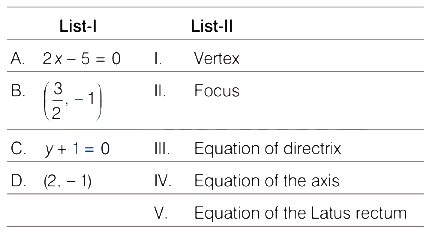
The correct match is \(A \quad B \quad C \quad D\)TS EAMCET 2020 Easy - The approximate molarity of a solution in \(\mathrm{mol} \mathrm{L}^{-1}\) that contains \(13.50 \mathrm{~g}\) of \(\mathrm{NaCl}\) dissolved in \(452 \mathrm{~mL}\) of water isTS EAMCET 2019 Easy
- Let \(A=\left[\begin{array}{ccc}2 & -2 & -4 \\ -1 & 3 & 4 \\ 1 & -2 & x\end{array}\right]\) and \(A^2=A\). If \(r\) is the rank of \(A\), then \(r+x=\)TS EAMCET 2020 Medium
- A tension of \(22 \mathrm{~N}\) is applied to a copper wire of cross-sectional area \(0.02 \mathrm{~cm}^2\) Young's modulus of copper is \(1.1 \times 10^{11} \mathrm{~N} / \mathrm{m}^2\) and Poisson's ratio 0.32 . The decrease in cross-sectional area will beTS EAMCET 2012 Medium
- Toluene on reaction with reagent A gives X. This \((\mathrm{X})\) forms 2,4-dinitrophenylhydrazone and reduces ammonical silver nitrate solution. Reaction of toluene with another reagent B forms Y, which dissolves in \(\mathrm{NaHCO}_3\) with evolution of \(\mathrm{CO}_2\). What are A and B respectively?TS EAMCET 2025 Medium