


TS EAMCET · Chemistry · p Block Elements (Group 15, 16, 17 & 18)
Assertion (A): is stable while is not.
Reason (R) : Fluorine stabilises the higher oxidation state due to its higher bond enthalpy.
The correct option among the following is
- A is true, is true and is the correct explanation for
- B is true, is true but is not the correct explanation for
- C is true but is false
- D is false but is true
Answer & Solution
Correct Answer
(A) is true, is true and is the correct explanation for
Step-by-step Solution
Detailed explanation
We know that fluorine atom can stabilise the higher oxidation state due to its higher melting point, higher bond enthalpy and small size and that is the reason with vanadium it forms VF5 whereas VCl5 is unstable due to the large size of chlorine atom such that there is no place…
See the Complete Solution
Get step-by-step explanations for this and 2.5 Lakh+ more JEE, NEET & CET questions.
- Unlock all solutions
- Practice the full chapter
- Track accuracy across PYQs
4.8 rated on Google Play · 14,000+ reviews
More questions from Chemistry
- Mustard gas among the following isTS EAMCET 2021 Medium
- Identify the alkyne in the following sequence of reactions,
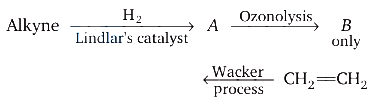 TS EAMCET 2009 Hard
 - ' X ' is a polymer, which is mainly used for making unbreakable cups and laminated sheets. The monomers of ' X ' areTS EAMCET 2025 Easy
- isTS EAMCET 2020 Easy
- Assertion (A): Alkali metals and their salts impart characteristic flame colours. Reason (R): Alkali metals have low ionization enthalpy values. So, electron excitation is possible. The correct option among the following isTS EAMCET 2023 Medium
- A sample of argon of \(1 \mathrm{~atm}\) pressure and \(300 \mathrm{~K}\) expands reversibly and adiabatically from \(1.25 \mathrm{dm}^3\) to \(2.5 \mathrm{dm}^3\). Calculate the approximate enthalpy (in J) change (i) \(C_V\) for argon is \(12.48 \mathrm{JK}^{-1}\) (ii) Assume argon to be an ideal gas (iii) \(\Delta T=111.5 \mathrm{~K}\)TS EAMCET 2018 Hard
More PYQs from TS EAMCET
- If a balloon lying at an altitude of 30 m from an observer at a particular instant is moving horizontally at the rate of \(1 \mathrm{~m} / \mathrm{s}\) away from him, then the rate at which the balloon is moving away directly from the observer at the \(40^{\text {th }}\) second is (in \(\mathrm{m} / \mathrm{s}\) )TS EAMCET 2025 Medium
- The general solution of the equation \(\sqrt{6-5 \cos x+7 \sin ^2 x}-\cos x=0\) also satisfies the equationTS EAMCET 2025 Medium
- \(L_1\) is a line passing through the points with position vectors \(\hat{\mathbf{i}}-2 \hat{\mathbf{j}}-\hat{\mathbf{k}}\) and \(4 \hat{\mathbf{i}}-3 \hat{\mathbf{k}}\). \(L_2\) is a line passing through the points with position vectors \(\hat{\mathbf{i}}+2 \hat{\mathbf{j}}-\hat{\mathbf{k}}\) and \(2 \hat{\mathbf{i}}-4 \hat{\mathbf{j}}-5 \hat{\mathbf{k}}\). Then the distance between \(L_1\) and \(L_2\) isTS EAMCET 2020 Medium
- Pure water would have a BOD value ofTS EAMCET 2018 Easy
- If \(\sin \mathrm{h} x=\frac{-1}{2}\) then \(\tan \mathrm{h} 2 x=\)TS EAMCET 2022 Easy
- \(\int \frac{\log x}{(1+x)^3} d x=\)TS EAMCET 2025 Medium