


TS EAMCET · Chemistry · General Organic Chemistry
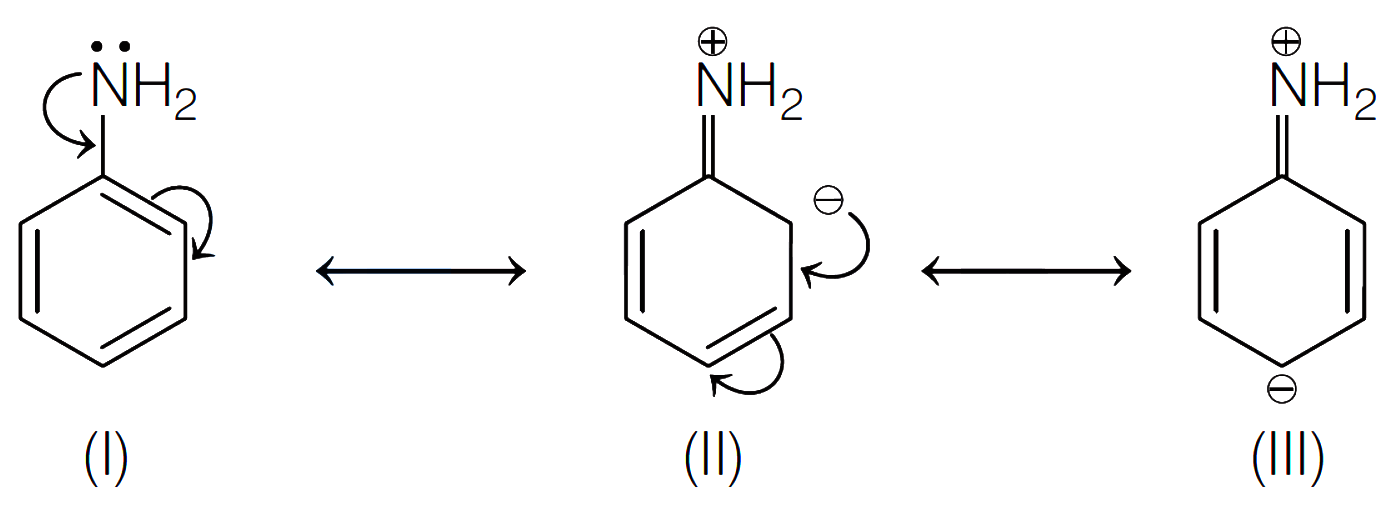
The order of stability of below resonance structures is:
- A II \(>\) I \(>\) III
- B I \(>\) II \(>\) III
- C II \(>\) II \(>\) I
- D I \(>\) III \(>\) II
Answer & Solution
Correct Answer
(B) I \(>\) II \(>\) III
Step-by-step Solution
Detailed explanation
Non-charged molecular species are most stable. Therefore, (I) structure gives maximum stability. In II, III resonating structure, stability depends on distance between positive and negative charge. Minimum distance between both charge give maximum coluombic attraction. Thus,…
See the Complete Solution
Get step-by-step explanations for this and 2.5 Lakh+ more JEE, NEET & CET questions.
- Unlock all solutions
- Practice the full chapter
- Track accuracy across PYQs
4.8 rated on Google Play · 14,000+ reviews
More questions from Chemistry
- Which of the following can form ionic micelles in water?TS EAMCET 2023 Easy
- Covalent bond length of a chlorine molecule is . Covalent radius (in ) of chlorine atom is _________TS EAMCET 2018 Easy
- Identify the molecule / ion in which the ratio of \(\sigma\) to \(\pi\) bonds is \(3: 2\)TS EAMCET 2025 Medium
- In the process of formation of nitronium ion, nitric acid acts asTS EAMCET 2018 Medium
- Match the following:
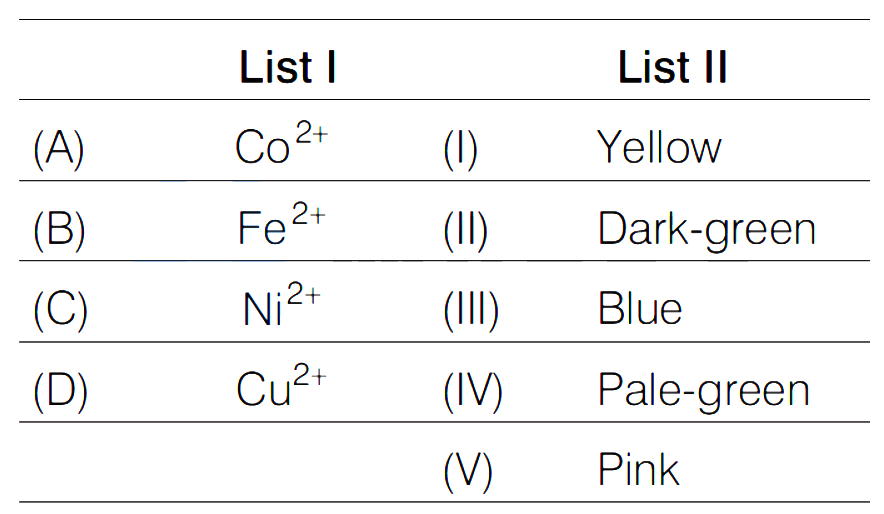
The correct answer is: TS EAMCET 2019 Easy
 - The angle between (100) and (110) planes of FCC lattice isTS EAMCET 2020 Easy
More PYQs from TS EAMCET
- An integrating factor of the equation \(\left(1+y+x^2 y\right) d x+\left(x+x^3\right) d y=0\) isTS EAMCET 2013 Easy
- The correct order of bond angles of the following compounds isTS EAMCET 2021 Medium
- One mole of alkene \(\underline{X}\) on ozonolysis gave one mole of acetaldehyde and one mole of acetone. The IUPAC name of \(\underline{X}\) isTS EAMCET 2009 Easy
- \(\bar{a}, \bar{b}, \bar{c}\) are three unit vectors such that \(x \bar{a}+y \bar{b}+z \bar{c}=p(\bar{b} \times \bar{c})+q(\bar{c} \times \bar{a})+r(\bar{a} \times \bar{b})\). If \((\bar{a}, \bar{b})=(\bar{b}, \bar{c})=(\bar{c}, \bar{a})=\frac{\pi}{3},(\bar{a}, \bar{b} \times \bar{c})=\frac{\pi}{6}\) and \(\bar{a}, \bar{b}, \bar{c}\) form a right-handed system, then \(\frac{x+y+z}{p+q+r}=\)TS EAMCET 2025 Hard
- If is the probability density function of a discrete random variable thenTS EAMCET 2021 Easy
- If two smallest squares are chosen at random on a chess board then the probability of getting these squares such that they do not have a side in common isTS EAMCET 2025 Medium