


TS EAMCET · Chemistry · p Block Elements (Group 15, 16, 17 & 18)
Ozone is obtained from oxygen
- A by oxidation at high temperature
- B by oxidation using a catalyst
- C by silent electric discharge
- D by conversion at high pressure
Answer & Solution
Correct Answer
(C) by silent electric discharge
Step-by-step Solution
Detailed explanation
In the stratosphere, ozone is created primarily by ultraviolet radiation. when, high energy ultraviolet rays strike ordinary oxygen molecules \(\left(\mathrm{O}_2\right)\), they split the molecule into two single oxygen atoms, known as atomic oxygen. A free oxygen atom then…
See the Complete Solution
Get step-by-step explanations for this and 2.5 Lakh+ more JEE, NEET & CET questions.
- Unlock all solutions
- Practice the full chapter
- Track accuracy across PYQs
4.8 rated on Google Play · 14,000+ reviews
More questions from Chemistry
- Given that \(\mathrm{N}_2(g)+3 \mathrm{H}_2(g) \longrightarrow 2 \mathrm{NH}_3(g)\); \(\Delta_r H^{\circ}=-92 \mathrm{~kJ}\), the standard molar enthalpy of formation in \(\mathrm{kJ} \mathrm{mol}^{-1}\) of \(\mathrm{NH}_3(g)\) isTS EAMCET 2016 Easy
- In the following reaction \(\mathrm{a}, \mathrm{b}, \mathrm{p}, \mathrm{q}, \mathrm{r}\) and \(\mathrm{s}\) are \(\mathrm{a} \mathrm{XeF}+\mathrm{b} \mathrm{H}_2 \mathrm{O} \longrightarrow \mathrm{p} \mathrm{Xe}+\mathrm{qXeO}_3+\mathrm{rHF}+\mathrm{s} \mathrm{O}_2\) \(\begin{array}{llllll}\mathbf{a} & \mathbf{b} & \mathbf{p} & \mathbf{q} & \mathbf{r} & \mathbf{s}\end{array}\)TS EAMCET 2022 Easy
- Which of the following is not added during the extraction of silver by cyanide process?TS EAMCET 2013 Easy
- The reactivity of alkyl bromides.
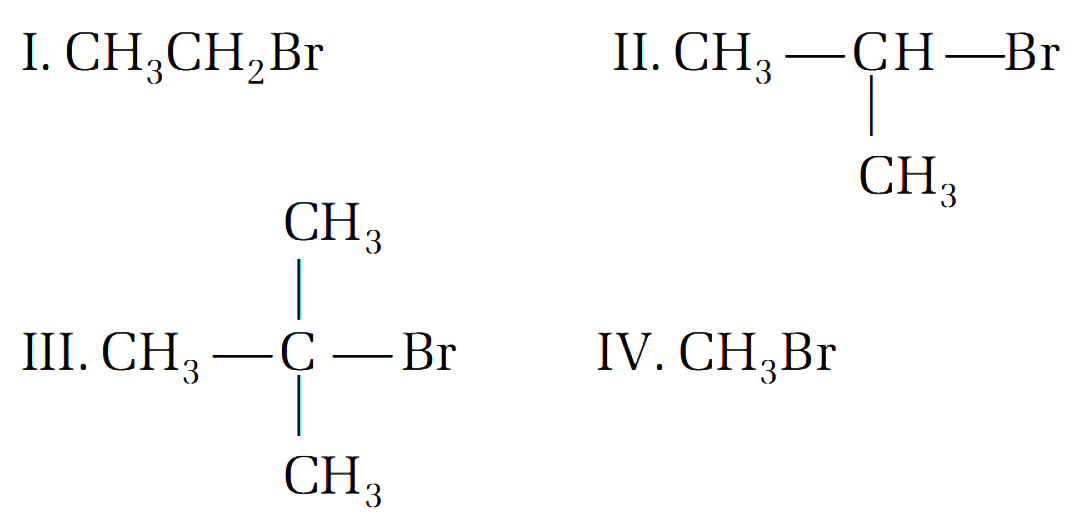
Towards iodide ion in dry acetone decrease in the orderTS EAMCET 2017 Medium - The reagent ' X ' used in the following reaction to obtain good yield of the product is
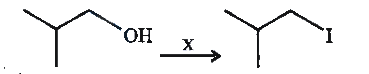 TS EAMCET 2024 Easy
 - A sample of argon of \(1 \mathrm{~atm}\) pressure and \(300 \mathrm{~K}\) expands reversibly and adiabatically from \(1.25 \mathrm{dm}^3\) to \(2.5 \mathrm{dm}^3\). Calculate the approximate enthalpy (in J) change (i) \(C_V\) for argon is \(12.48 \mathrm{JK}^{-1}\) (ii) Assume argon to be an ideal gas (iii) \(\Delta T=111.5 \mathrm{~K}\)TS EAMCET 2018 Hard
More PYQs from TS EAMCET
- The number of ways in which 6 boys and 4 girls can be arranged in a row such that between any two girls there must be exactly 2 boys isTS EAMCET 2025 Hard
- An aqueous dilute solution containing non-volatile solute boils at \(100.52^{\circ} \mathrm{C}\). What is the molality of solution? \(\left(K_b=0.52 \mathrm{~kg} \mathrm{~mol}^{-1} \mathrm{~K}\right.\), boiling temperature of water \(=100^{\circ} \mathrm{C}\) )TS EAMCET 2015 Medium
- Which of the following compounds has the highest dipole moment \((D)\) ?TS EAMCET 2019 Medium
- The elements with highest and lowest electron gain enthalpy in group 16 respectively areTS EAMCET 2019 Easy
- If \(A(2,-1)\) and \(B(6,5)\) are two points the ratio in which the foot of the perpendicular from \((4,1)\) to \(A B\) divides it, isTS EAMCET 2007 Medium
- An auditorium has volume of \(10^5 \mathrm{~m}^3\) and surface area of absorption \(2 \times 10^4 \mathrm{~m}^2\). Its average absorption coefficient is 0.2 . The reverberation time of the auditorium in seconds isTS EAMCET 2002 Easy