


TS EAMCET · Chemistry · Electrochemistry
A lead storage battery is discharged. During the charging of this battery, the reaction that occurs at anode, is
- A \(\mathrm{PbSO}_4(\mathrm{~s})+2 \mathrm{e}^{-} \longrightarrow \mathrm{Pb}(\mathrm{s})+\mathrm{SO}_4^{2-}(\mathrm{aq})\)
- B \(\mathrm{PbSO}_4(\mathrm{~s})+2 \mathrm{H}_2 \mathrm{O}(\mathrm{I}) \longrightarrow\) \(\mathrm{PbO}_2(\mathrm{~s})+\mathrm{SO}_4^{2-}(\mathrm{aq})+4 \mathrm{H}^{+}(\mathrm{aq})+2 \mathrm{e}^{-}\)
- C \(\mathrm{PbSO}_4(\mathrm{~s}) \longrightarrow \mathrm{Pb}^{2+}(\mathrm{aq})+\mathrm{SO}_4^{2-}(\mathrm{aq})\)
- D \[ \begin{array}{r} \mathrm{PbSO}_4(\mathrm{~s})+2 \mathrm{H}_2 \mathrm{O}(l)+2 \mathrm{e}^{-} \overrightarrow{\mathrm{PbO}_2(\mathrm{~s})}+\mathrm{SO}_4^{2-}(\mathrm{aq})+2 \mathrm{H}^{+}(\mathrm{aq}) \end{array} \]
Answer & Solution
Correct Answer
(B) \(\mathrm{PbSO}_4(\mathrm{~s})+2 \mathrm{H}_2 \mathrm{O}(\mathrm{I}) \longrightarrow\) \(\mathrm{PbO}_2(\mathrm{~s})+\mathrm{SO}_4^{2-}(\mathrm{aq})+4 \mathrm{H}^{+}(\mathrm{aq})+2 \mathrm{e}^{-}\)
Step-by-step Solution
Detailed explanation
During recharging, the cell is operated like an electrolytic cell. The electrode reactions are the reverse of those that occur during discharge. At cathod \[ \mathrm{PbSO}_4(s)+2 e^{-} \longrightarrow \mathrm{Pb}(s)+\mathrm{SO}_4^{2-}(\mathrm{aq}) \] At anode…
See the Complete Solution
Get step-by-step explanations for this and 2.5 Lakh+ more JEE, NEET & CET questions.
- Unlock all solutions
- Practice the full chapter
- Track accuracy across PYQs
4.8 rated on Google Play · 14,000+ reviews
More questions from Chemistry
- The reagent used in the Wolff-Kishner reduction isTS EAMCET 2011 Easy
- The \(\mathrm{pH}\) of the solution, when (i) sodium acetate is dissolved in water. (ii) ammonium chloride is dissolved in water.TS EAMCET 2020 Easy
- At 298 K, the enthalpy change (in kJ ) for the reaction given below is
\(\mathrm{CH}_4(g)+\mathrm{O}_2(g) \rightarrow \mathrm{C}(s)+2 \mathrm{H}_2 \mathrm{O}(l)\)
(Given): \(\mathrm{H}_2(g)+\frac{1}{2} \mathrm{O}_2(g) \rightarrow \mathrm{H}_2 \mathrm{O}(l) ; \Delta H^{\ominus}=-286 \mathrm{~kJ}\)
\(\mathrm{C}(s)+\mathrm{O}_2(g) \rightarrow \mathrm{CO}_2(g) ; \Delta H^{\ominus}=-394 \mathrm{~kJ}\)
\(\mathrm{CH}_4(g)+2 \mathrm{O}_2(g) \rightarrow \mathrm{CO}_2(g)+2 \mathrm{H}_2 \mathrm{O}(l) ; \Delta H^{\ominus}=-890 \mathrm{~kJ}\)TS EAMCET 2025 Medium - Which of the following pairs has the identical \(e / m\) value?TS EAMCET 2019 Easy
- Which of the following acts as antihistamine?TS EAMCET 2023 Easy
- For the following radicals, the correct order of their stability is:
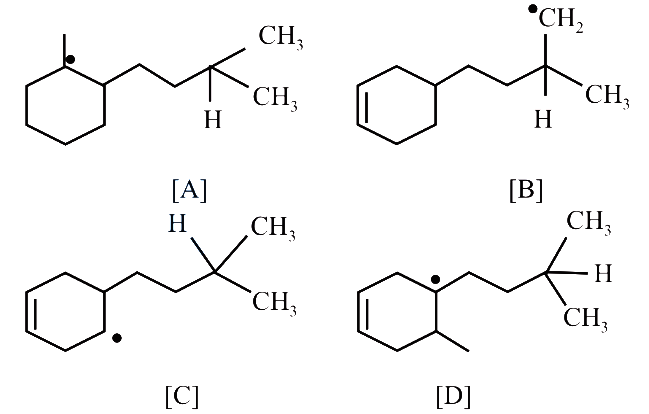 TS EAMCET 2022 Medium
More PYQs from TS EAMCET
- If \(\cos ^3 \theta+\cos ^3\left(\frac{2 \pi}{3}+\theta\right)+\cos ^3\left(\frac{4 \pi}{3}+\theta\right)\) \(=\alpha \cos 3 \theta\), then \(\alpha\) is equal toTS EAMCET 2016 Hard
- A plane passes through \((2,3,-1)\) and is perpendicular to the line having direction ratios \(3,-4,7\). The perpendicular distance from the origin to this plane isTS EAMCET 2011 Easy
- If \((x, y, z)=(\alpha, \beta, y)\) is the unique solution of the system of simultaneous linear equations \(3 x-4 y+z+7=0\), \(2 x+3 y-z=10, x-2 y-3 z=3\) then \(a=\)TS EAMCET 2024 Medium
- A parallel-plate capacitor with circular plates is being discharged. The radius of the circular plate is \(10 \mathrm{~cm}\). A circular loop of radius \(20 \mathrm{~cm}\) is concentric with the capacitor and located halfway between the plates. If the electric field between the plates is charging at the rate \(3.6 \times 10^{12} \mathrm{~V} /(\mathrm{ms})\), then the displacement current through the loop is (Assume \(\frac{1}{4 \pi \varepsilon_0}=9 \times 10^9 \mathrm{Nm}^2 / \mathrm{C}^2\) )TS EAMCET 2020 Medium
- A bird flies with a velocity ( \(\mathrm{t}-2) \mathrm{ms}^{-1}\) along a straight line, where \(t\) is the time in seconds. The distance cevered by it in a time of 4 seconds isTS EAMCET 2023 Easy
- 2, 3-dimethyl hexane contains tertiary...... secondary and primary carbon atoms, respectively:TS EAMCET 2003 Easy