


KCET · Physics · Wave Optics
What is the minimum thickness of a thin film required for constructive interference in the reflected light from it?
Given, the refractive index of the film \(=1.5\), wavelength of the light incident on the film \(=600 \mathrm{~nm}\).
- A \(100 \mathrm{~nm}\)
- B \(300 \mathrm{~nm}\)
- C \(50 \mathrm{~nm}\)
- D \(200 \mathrm{~nm}\)
Answer & Solution
Correct Answer
(A) \(100 \mathrm{~nm}\)
Step-by-step Solution
Detailed explanation
Condition for constructive interference is
\[
2 \mu \mathrm{t}=[2 \mathrm{n}+1] \frac{\lambda}{2}
\]
where, \(\quad \mathrm{n}=0,1,2,3 \ldots\)
For minimum thickness, \(\mathrm{n}=0\)
\[
\begin{gathered}
2 \mu \mathrm{t}=\frac{\lambda}{2} \\
\Rightarrow \quad \mathrm{t}=\frac{\lambda}{4 \mu}=\frac{600 \times 10^{-9}}{4 \times 1.5} \\
=100 \mathrm{~nm}
\end{gathered}
\]
\[
2 \mu \mathrm{t}=[2 \mathrm{n}+1] \frac{\lambda}{2}
\]
where, \(\quad \mathrm{n}=0,1,2,3 \ldots\)
For minimum thickness, \(\mathrm{n}=0\)
\[
\begin{gathered}
2 \mu \mathrm{t}=\frac{\lambda}{2} \\
\Rightarrow \quad \mathrm{t}=\frac{\lambda}{4 \mu}=\frac{600 \times 10^{-9}}{4 \times 1.5} \\
=100 \mathrm{~nm}
\end{gathered}
\]
See the Complete Solution
Get step-by-step explanations for this and 2.5 Lakh+ more JEE, NEET & CET questions.
- Unlock all solutions
- Practice the full chapter
- Track accuracy across PYQs
4.8 rated on Google Play · 14,000+ reviews
More questions from Physics
- An ideal choke draws a current of \(8 \mathrm{~A}\) when connected to an AC supply of \(100 \mathrm{~V}, 50 \mathrm{~Hz}\). A pure resistor draws a current of \(10 \mathrm{~A}\) when connected to the same source. The ideal choke and the resistor are connected in series and then connected to the AC source of \(150 \mathrm{~V}, 40 \mathrm{~Hz}\). The current in the circuit becomesKCET 2010 Hard
- The potential difference between and in the following figure is
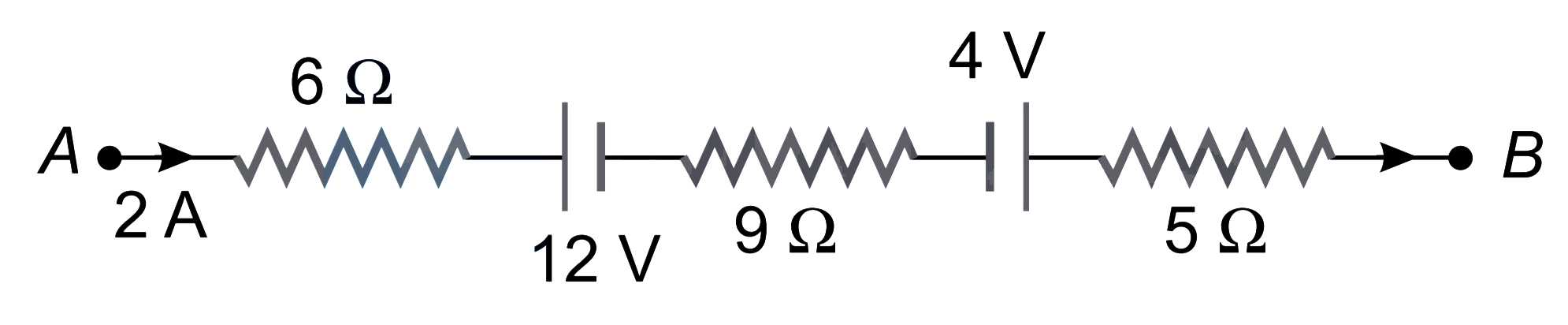 KCET 2008 Hard
 - Focal length of a convex lens is \( 20 \mathrm{~cm} \) and its (RI) is \( 1.5 \). It produces an erect, enlarged image
if the distance of the object from the lens isKCET 2016 Medium - The \(X\) and \(Y\) components of a force \(F\) acting at \(30^{\circ}\) to \(x\)-axis are respectivelyKCET 2012 Easy
- Consider three point charges \(-2Q, Q\) and \(-Q\) and three surfaces \(S_1, S_2\) and \(S_3\) as shown in the figure. Match the entries of List-I with that of List-II.

List-I List-II (a) Net flux through \(S_1\) (i) \(\dfrac{-2Q}{\varepsilon_0}\) (b) Net flux through \(S_2\) (ii) \(\dfrac{-Q}{\varepsilon_0}\) (c) Net flux through \(S_3\) (iii) Zero KCET 2026 Easy - In a series L.C.R. circuit an alternating emf (v) and current (i) are given by the equation \( v=v_{0} \sin \omega t, l=i_{0} \sin \left(\omega t+\frac{\Pi}{3}\right).\) The average power discipated in the circuit over a cycle of \( A C \) isKCET 2016 Medium
More PYQs from KCET
- If a relation \(R\) on the set \(\{1,2,3\}\) be defined by \(R=\{(1,1)\}\), then \(R\) isKCET 2020 Easy
- A ray of light passes through an equilateral glass prism in such a manner that the angle of incidence is equal to the angle of emergence and each of these angles is equal to \(\frac{3}{4}\) of the angle of the prism. The angle of deviation isKCET 2022 Medium
- \( x_{1} \) and \( x_{2} \) are susceptibility of a paramagnetic material at temperatures \( T_{1} K \) and \( T_{2} K \) respectively, thenKCET 2016 Easy
- If \( \alpha \) and \( \beta \) are two different comlex numbers with \( |\beta|=1 \), then \( \left|\frac{\beta-\alpha}{1-\bar{\alpha} \beta}\right| \) is equal toKCET 2014 Hard
- A metal wire is subjected to a constant potential difference. When the temperature of the metal wire increases, the drift velocity of the electron in itKCET 2008 Medium
- Choose the bacterium which is not a source of REN.KCET 2018 Hard