


KCET · Physics · Units and Dimensions
Two simple pendulums \( A \) and \( B \) are made to oscillate simultaneously and it is found that \( A \)
completes \( 10 \) oscillations in \( 20 \mathrm{sec} \) and \( \mathrm{B} \) completes \( 8 \) oscillations in \( 10 \mathrm{sec} \). The ratio of the
lengths of \( A \) and \( B \) is
- A \( \frac{8}{5} \)
- B \( \frac{64}{25} \)
- C \( \frac{5}{4} \)
- D \( \frac{25}{64} \)
Answer & Solution
Correct Answer
(B) \( \frac{64}{25} \)
Step-by-step Solution
Detailed explanation
Time period of oscillations of a simple pendulum is given as \( T=2 \sqrt{\frac{l}{g}} \)
where \( I \) is length of pendulum.
For pendulum A: Given, completes \( 10 \) oscillations is \( 20 \mathrm{~s} \).
Therefore, time period of single oscillation \( =\frac{20}{10}=2 \)
\(\Rightarrow T_{A}=2 \)
\(\Rightarrow 2 \pi \sqrt{\frac{I_{A}}{g}}=2 \rightarrow(1)\)
For pendulum B: Given, completes \( 8 \) oscillations in \( 10 \mathrm{~s} \).
Therefore, time period of single oscillation \( =\frac{10}{8}=\frac{5}{4} \)
\(\Rightarrow T_{B}=\frac{5}{4} \)
\(\Rightarrow 2 \Pi \sqrt{\frac{l_{B}}{g}}=\frac{5}{4} \rightarrow(2)\)
Divide Eq. (1) by Eq. (2), we get
\(\begin{aligned}& 2 \pi \sqrt{\frac{l_{A}}{g}} \\2 \pi & \sqrt{\frac{l_{B}}{g}}=\frac{\frac{2}{1}}{4} \\\Rightarrow & \sqrt{\frac{l_{A}}{l_{B}}}=\frac{2 \times 4}{5} \\\Rightarrow & \sqrt{\frac{l_{A}}{l_{B}}}=\frac{8}{5}\end{aligned}\)
where \( I \) is length of pendulum.
For pendulum A: Given, completes \( 10 \) oscillations is \( 20 \mathrm{~s} \).
Therefore, time period of single oscillation \( =\frac{20}{10}=2 \)
\(\Rightarrow T_{A}=2 \)
\(\Rightarrow 2 \pi \sqrt{\frac{I_{A}}{g}}=2 \rightarrow(1)\)
For pendulum B: Given, completes \( 8 \) oscillations in \( 10 \mathrm{~s} \).
Therefore, time period of single oscillation \( =\frac{10}{8}=\frac{5}{4} \)
\(\Rightarrow T_{B}=\frac{5}{4} \)
\(\Rightarrow 2 \Pi \sqrt{\frac{l_{B}}{g}}=\frac{5}{4} \rightarrow(2)\)
Divide Eq. (1) by Eq. (2), we get
\(\begin{aligned}& 2 \pi \sqrt{\frac{l_{A}}{g}} \\2 \pi & \sqrt{\frac{l_{B}}{g}}=\frac{\frac{2}{1}}{4} \\\Rightarrow & \sqrt{\frac{l_{A}}{l_{B}}}=\frac{2 \times 4}{5} \\\Rightarrow & \sqrt{\frac{l_{A}}{l_{B}}}=\frac{8}{5}\end{aligned}\)
See the Complete Solution
Get step-by-step explanations for this and 2.5 Lakh+ more JEE, NEET & CET questions.
- Unlock all solutions
- Practice the full chapter
- Track accuracy across PYQs
4.8 rated on Google Play · 14,000+ reviews
More questions from Physics
- A point source of light is kept below the surface of water \(\left(n_{w}=4 / 3\right)\) at a depth of \(\sqrt{7} \mathrm{~m}\). The radius of the circular bright patch of light noticed on the surface of water isKCET 2012 Medium
- The magnetic flux linked with a coil varies as \( \phi=3 t^{2}+4 t+9 . \) The magnitude of the emf
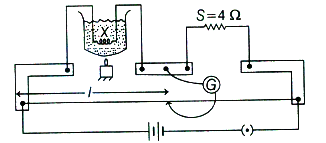
induced at \( t=2 \) seconds isKCET 2018 Easy - In an experiment to determine the temperature coefficient of resistance of a conductor, a coil of wire \(X\) is immersed in a liquid. It is heated by an external agent. A meter bridge set up is used to determine resistance of the coil \(X\) at different temperatures. The balancing points measured at temperatures \(t_1=0^{\circ} \mathrm{C}\) and \(t_2=100^{\circ} \mathrm{C}\) are 50 cm and 60 cm respectively. If the standard resistance taken out is \(S=4 \Omega\) in both trials, the temperature coefficient of the coil is
 KCET 2024 Hard
 - Find the de-Broglie wavelength of an electron with kinetic energy of \( 120 \mathrm{eV} \).KCET 2015 Medium
- The ionisation energy of \(\mathrm{Li}^{2+}\) is equal toKCET 2007 Medium
- A basic communication system consists of
(a) Transmitter
(b) Information source
(c) User of information
(d) Channel
(e) Receiver
The correct sequence of the arrangement isKCET 2017 Medium
More PYQs from KCET
- In \(\triangle \mathrm{ABC}\), if \(\mathrm{a}=2, \mathrm{~B}=\tan ^{-1} \frac{1}{2}\) and \(C=\tan ^{-1} \frac{1}{3}\), then (A, b) equalsKCET 2010 Medium
- During the fusion of organic compound with sodium metal, nitrogen present in the organic
compound is converted intoKCET 2018 Hard - The resistance of \(0.01 \mathrm{~m} \mathrm{KCl}\) solution at \(298 \mathrm{~K}\) is \(1500 \Omega\). If the conductivity of \(0.01 \mathrm{~m} \mathrm{KCl}\) solution at \(298 \mathrm{~K}\) is \(0.1466 \times 10^{-3} \mathrm{~S} \mathrm{~cm}^{-1}\). The cell constant of the conductivity cell in \(\mathrm{cm}^{-1}\) isKCET 2021 Hard
- The maximum number of possible optical isomers in 1-bromo-2-methyl cyclobutane isKCET 2011 Hard
- In series \(L C R\) circuit at resonance, the phase difference between voltage and current isKCET 2023 Easy
- If \( f: R \rightarrow R \) is defined by \( f(x)=\frac{x}{x^{2}+1} \) find \( f(f(2)) \)KCET 2015 Easy