


KCET · Physics · Gravitation
Two bodies of masses \(8 \mathrm{~kg}\) are placed at the vertices \(A\) and \(B\) of an equilateral triangle \(A B C\). A third body of mass \(2 \mathrm{~kg}\) is placed at the centroid \(G\) of the triangle. If \(A G=B G=C G=1 \mathrm{~m}\), where should a
fourth body of mass \(4 \mathrm{~kg}\) be placed, so that the resultant force on the \(2 \mathrm{~kg}\) body is zero?
- A At \(C\)
- B At a point \(P\) on the line \(C G\) such that \(P G=\frac{1}{\sqrt{2}} \mathrm{~m}\)
- C At a point \(P\) on the line \(C G\) such that \(P G=0.5 \mathrm{~m}\)
- D At a point \(P\) on the line \(C G\) such that \(P G=2 \mathrm{~m}\)
Answer & Solution
Correct Answer
(B) At a point \(P\) on the line \(C G\) such that \(P G=\frac{1}{\sqrt{2}} \mathrm{~m}\)
Step-by-step Solution
Detailed explanation
According to the question, the arrangement of the masses is as shown below,
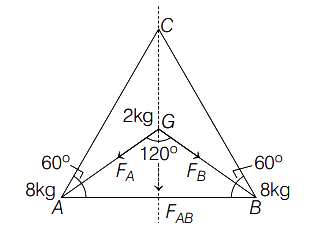
Gravitational force between two masses is given as
\(F=\frac{G m_{1} m_{2}}{r^{2}}\)
where, \(G=\) gravitational constant and \(r=\) distance between them.
From the given values, we can say that force between masses at \(A\) and \(G\). \(=\) Force between masses at \(B\) and \(G\).
\(\Rightarrow F_{A}=\frac{G m_{A} m_{G}}{A G^{2}} \text { and } F_{B}=\frac{G m_{B} m_{G}}{B G^{2}} \)
\( \text {or } F_{A}=F_{B}=\frac{G \times 8 \times 2}{1^{2}}=16 G...(i)\)
\(\left[\because\right.\) Given, \(m_{1}=m_{A}=m_{B}=8 \mathrm{~kg}, m_{2}=m_{G}=2 \mathrm{~kg}\),
\(A G=B G=r=1 \mathrm{~m} \text { ] }\)
From the figure, resultant of \(F_{A}\) and \(F_{B}\) is given as
\(F_{A B} =\sqrt{F_{A}^{2}+F_{B}^{2}+2 F_{A} F_{B} \cos \theta} \)
\( =\sqrt{2 F_{A}^{2}+2 F_{A}^{2} \cos 120^{\circ}} \)
\( =\sqrt{F_{A}^{2}}=\sqrt{(16 G)^{2}}=16 G \)
\( \Rightarrow F_{A B} =F_{A}=F_{B}=16 G \text { [from Eq. (i)] }\)
For resultant force on \(2 \mathrm{~kg}\) body to be zero, \(4 \mathrm{~kg}\) body should be placed at a certain distance from \(G\) such that
\(\mathbf{F}_{C G}=-\mathbf{F}_{A E}\)
\(\Rightarrow \left|\mathbf{F}_{C G}\right|=\left|\mathbf{F}_{A B}\right|\)
or \(\frac{G \times m_{C} m_{G}}{x^{2}}=G(\mathbf{1} 6)\)
where, \(x=\) distance between \(4 \mathrm{~kg}\) and \(2 \mathrm{~kg}\) body.
Here, \(m_{C}=4 \mathrm{~kg}\)
\(\Rightarrow \frac{G \times 4 \times 2}{x^{2}} =G(16) \)
\( \Rightarrow x^{2} =\frac{1}{2} \)
\( \Rightarrow x =\frac{1}{\sqrt{2}} \mathrm{~m}\)
This means, \(4 \mathrm{~kg}\) body should be placed at point \(P\) on line \(C G\) such that \(P G=\frac{1}{\sqrt{2}} \mathrm{~m}\).
Gravitational force between two masses is given as
\(F=\frac{G m_{1} m_{2}}{r^{2}}\)
where, \(G=\) gravitational constant and \(r=\) distance between them.
From the given values, we can say that force between masses at \(A\) and \(G\). \(=\) Force between masses at \(B\) and \(G\).
\(\Rightarrow F_{A}=\frac{G m_{A} m_{G}}{A G^{2}} \text { and } F_{B}=\frac{G m_{B} m_{G}}{B G^{2}} \)
\( \text {or } F_{A}=F_{B}=\frac{G \times 8 \times 2}{1^{2}}=16 G...(i)\)
\(\left[\because\right.\) Given, \(m_{1}=m_{A}=m_{B}=8 \mathrm{~kg}, m_{2}=m_{G}=2 \mathrm{~kg}\),
\(A G=B G=r=1 \mathrm{~m} \text { ] }\)
From the figure, resultant of \(F_{A}\) and \(F_{B}\) is given as
\(F_{A B} =\sqrt{F_{A}^{2}+F_{B}^{2}+2 F_{A} F_{B} \cos \theta} \)
\( =\sqrt{2 F_{A}^{2}+2 F_{A}^{2} \cos 120^{\circ}} \)
\( =\sqrt{F_{A}^{2}}=\sqrt{(16 G)^{2}}=16 G \)
\( \Rightarrow F_{A B} =F_{A}=F_{B}=16 G \text { [from Eq. (i)] }\)
For resultant force on \(2 \mathrm{~kg}\) body to be zero, \(4 \mathrm{~kg}\) body should be placed at a certain distance from \(G\) such that
\(\mathbf{F}_{C G}=-\mathbf{F}_{A E}\)
\(\Rightarrow \left|\mathbf{F}_{C G}\right|=\left|\mathbf{F}_{A B}\right|\)
or \(\frac{G \times m_{C} m_{G}}{x^{2}}=G(\mathbf{1} 6)\)
where, \(x=\) distance between \(4 \mathrm{~kg}\) and \(2 \mathrm{~kg}\) body.
Here, \(m_{C}=4 \mathrm{~kg}\)
\(\Rightarrow \frac{G \times 4 \times 2}{x^{2}} =G(16) \)
\( \Rightarrow x^{2} =\frac{1}{2} \)
\( \Rightarrow x =\frac{1}{\sqrt{2}} \mathrm{~m}\)
This means, \(4 \mathrm{~kg}\) body should be placed at point \(P\) on line \(C G\) such that \(P G=\frac{1}{\sqrt{2}} \mathrm{~m}\).
See the Complete Solution
Get step-by-step explanations for this and 2.5 Lakh+ more JEE, NEET & CET questions.
- Unlock all solutions
- Practice the full chapter
- Track accuracy across PYQs
4.8 rated on Google Play · 14,000+ reviews
More questions from Physics
- The fraction of the initial number of radioactive nuclei which remain undecayed after half of a half-life of the radioactive sample isKCET 2011 Hard
- A particle is dropped from a height ' \( H \) '. The de Broglie wavelength of the particle depends on
height asKCET 2017 Easy - The power of a equi-concave lens is \(-4.5 \mathrm{D}\) and is made of a material of refractive index 1.6, the radii of curvature of the lens isKCET 2022 Easy
- When two tuning forks \( A \) and \( B \) are sounded together. \( 4 \) beats per second are heard. The
frequency of the fork \( \mathrm{B} \) is \( 384 \mathrm{~Hz} \). When one of the prongs of the fork \( \mathrm{A} \) is filed and sounded
with \( B \), the beat frequency increases, then the frequency of the fork \( A \) isKCET 2015 Easy - Two metal plates are separated by \( 2 \mathrm{~cm} \). The potentials of the plates are \( -10 \mathrm{~V} \) and \( +30 \mathrm{~V} \).
The electric field between the two plates is :KCET 2019 Medium - What is the value of shunt resistance required to convert a galvanometer of resistance \( 100 \Omega \)
into an ammeter of range \( 1 \mathrm{~A} \)?
Given : Full scale deflection of the galvanometer is \( 5 \mathrm{~mA} \).KCET 2014 Medium
More PYQs from KCET
- The number of oxygen atoms in \( 4.4 \mathrm{gm} \) of \( \mathrm{CO}_{2} \) is,KCET 2016 Medium
- \(\lim _{x \rightarrow a}\left[\frac{\sqrt{a+2 x}-\sqrt{3 x}}{\sqrt{3 a+x}-2 \sqrt{x}}\right]\) is equal toKCET 2011 Medium
- The oxidation number of nitrogen atoms in \(\mathrm{NH}_{4} \mathrm{NO}_{3}\) areKCET 2020 Medium
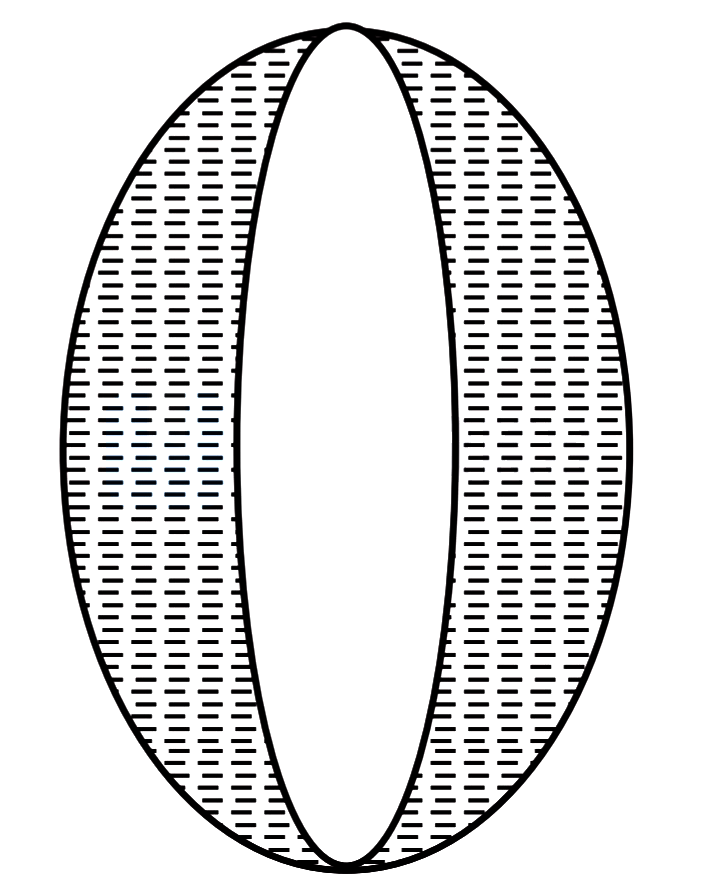
- A convex lens is made of 3 layers of glass of 3 different materials as in the figures. A point object is placed on its axis. The number of images of the object are
 KCET 2008 Hard
 - The value of \(\int_{-1}^1 \sin ^5 x \cos ^4 x d x\) isKCET 2025 Easy
- Which one of the following population attributes, contributes to increase in population density?KCET 2025 Easy