


KCET · Physics · Atomic Physics
A particle is dropped from a height ' \( H \) '. The de Broglie wavelength of the particle depends on
height as
- A \( \mathrm{H} \)
- B \( \mathrm{H}^{0} \)
- C \( \mathrm{H}^{\frac{1}{2}} \)
- D \( \mathrm{H}^{-\frac{1}{2}} \)
Answer & Solution
Correct Answer
(D) \( \mathrm{H}^{-\frac{1}{2}} \)
Step-by-step Solution
Detailed explanation
According to the de Broglie equation the wavelength of the particle is given as
\[
\lambda=\frac{h}{m v}
\]
For a particle dropped from height \( \mathrm{H} \) is given as
\[
\begin{array}{l}
v=\sqrt{2 g H} \\
\lambda=\frac{h}{m \sqrt{g H} \times 2} \\
\Rightarrow \lambda \propto \frac{1}{\sqrt{H}}
\end{array}
\]
Therefore, the de Broglie wavelength of particle depends on height as \( H^{-\frac{1}{2}} \)
\[
\lambda=\frac{h}{m v}
\]
For a particle dropped from height \( \mathrm{H} \) is given as
\[
\begin{array}{l}
v=\sqrt{2 g H} \\
\lambda=\frac{h}{m \sqrt{g H} \times 2} \\
\Rightarrow \lambda \propto \frac{1}{\sqrt{H}}
\end{array}
\]
Therefore, the de Broglie wavelength of particle depends on height as \( H^{-\frac{1}{2}} \)
See the Complete Solution
Get step-by-step explanations for this and 2.5 Lakh+ more JEE, NEET & CET questions.
- Unlock all solutions
- Practice the full chapter
- Track accuracy across PYQs
4.8 rated on Google Play · 14,000+ reviews
More questions from Physics
- Three point charges of \( +2 q,+2 q \) and \( -4 q \) are placed at the corners \( A, B \) and \( C \) of an equilateral triangle \( \mathrm{ABC} \) of side ' \( \mathrm{x} \) '. The magnitude of the electric dipole moment of this system isKCET 2017 Easy
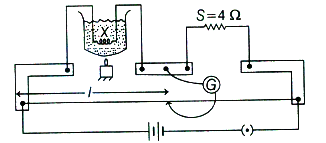
- In an experiment to determine the temperature coefficient of resistance of a conductor, a coil of wire \(X\) is immersed in a liquid. It is heated by an external agent. A meter bridge set up is used to determine resistance of the coil \(X\) at different temperatures. The balancing points measured at temperatures \(t_1=0^{\circ} \mathrm{C}\) and \(t_2=100^{\circ} \mathrm{C}\) are 50 cm and 60 cm respectively. If the standard resistance taken out is \(S=4 \Omega\) in both trials, the temperature coefficient of the coil is
 KCET 2024 Hard
 - One end of a string of length \(l\) is connected to a particle of mass \(m\) and the other to a small peg on a smooth horizontal table. If the particle moves in a circle with speed \(v\), the net force on the particle (directed towards the centre) is ( \(T\) is the tension in the string)KCET 2020 Easy
- The surface temperature of the sun which has maximum energy emission at \(500 \mathrm{~nm}\) is \(6000 \mathrm{~K}\). The temperature of a star which has maximum energy emission at \(400 \mathrm{~nm}\) will beKCET 2007 Easy
- A proton moves with a velocity of \(5 \times 10^6 \hat{\mathbf{j} \mathrm{ms}^{-1}}\) through the uniform electric field, \(\mathbf{E}=4 \times 10^6[2 \hat{\mathbf{i}}+0.2 \hat{\mathbf{j}}+0.1 \hat{\mathbf{k}}] \mathrm{Vm}^{-1}\) and the uniform magnetic field \(\mathbf{B}=0.2 \hat{\mathbf{i}}+0.2 \hat{\mathbf{j}}+\hat{\mathbf{k}}] \mathrm{T}\). The approximate net force acting on the proton isKCET 2022 Medium
- Match Column-I with Column - II related to an electric dipole of dipole moment \(\vec{p}\) that is placed in a uniform electric field \(\overrightarrow{\mathrm{E}}\).
Column - I Angle between \(\vec{p}\) and \(\vec{E}\) Column - II Potential energy of the dipole a. \(180^{\circ}\) i. \(-pE\) b. \(120^{\circ}\) ii. \(pE\) c. \(90^{\circ}\) iii. \(\frac{1}{2} \mathrm{pE}\) iv. \(0\) KCET 2025 Medium
More PYQs from KCET
- Match the hormone with its site of production:
Hormone Site of production A. hCG and hPL (i) Ovary B. Progesterone (ii) Placenta C. Androgens (iii) Corpus luteum D. Relaxin (iv) Leydig cells KCET 2025 Hard - When formic acid is heated with conc. \(\mathrm{H}_{2} \mathrm{SO}_{4}\), the gas evolved isKCET 2013 Medium
- If \(e^y+x y=e\) the ordered pair \(\left(\frac{d y}{d x}, \frac{d^2 y}{d x^2}\right)\) at \(x=0\) is equal toKCET 2022 Hard
- The direction of a ray of light incident on a concave mirror is shown by PQ, while direction in which the ray would travel after reflection is shown by four rays marked as A, B, C and D as shown in the figure. Which of the four rays correctly shows the direction of the reflected ray?
 KCET 2026 Easy
 - \(2 \cos ^{-1} x=\sin ^{-1}\left(2 x \sqrt{1-x^{2}}\right)\) is valid for all values of \(x\) satisfyingKCET 2012 Medium
- The moment of inertia of a circular ring of radius \(\mathrm{r}\) and mass \(\mathrm{M}\) about diameter isKCET 2009 Easy