


KCET · Physics · Motion In One Dimension
The velocity of a particle moving along \(x\)-axis is given as \(V = x^2 - 5x + 4\) (in m/s) where \(x\) denotes the \(x\)-coordinate of the particle in metres. The magnitude of the acceleration of the particle when the velocity of the particle zero is
- A \(2 \text{ m/s}^2\)
- B \(3 \text{ m/s}^2\)
- C Zero
- D \(1 \text{ m/s}^2\)
Answer & Solution
Correct Answer
(C) Zero
Step-by-step Solution
Detailed explanation
Given the velocity of the particle as a function of position:
\(V = x^2 - 5x + 4\)
The acceleration \(a\) of a particle is given by the chain rule:
\(a = \dfrac{dV}{dt} = \dfrac{dV}{dx} \dfrac{dx}{dt} = V \dfrac{dV}{dx}\)
We are asked to find the acceleration when the velocity is zero (\(V = 0\)).
First, find the positions where \(V = 0\):
\(x^2 - 5x + 4 = 0\)
\((x - 1)(x - 4) = 0 \Rightarrow x = 1 \text{ or } x = 4\)
Now, find the derivative of velocity with respect to \(x\):
\(\dfrac{dV}{dx} = 2x - 5\)
At \(x = 1\), \(\dfrac{dV}{dx} = 2(1) - 5 = -3\)
At \(x = 4\), \(\dfrac{dV}{dx} = 2(4) - 5 = 3\)
Substituting \(V = 0\) and \(\dfrac{dV}{dx}\) into the acceleration formula for either position:
\(a = 0 \times (\pm 3) = 0\)
Thus, the magnitude of the acceleration when the velocity is zero is \(0\).
Answer: Zero
\(V = x^2 - 5x + 4\)
The acceleration \(a\) of a particle is given by the chain rule:
\(a = \dfrac{dV}{dt} = \dfrac{dV}{dx} \dfrac{dx}{dt} = V \dfrac{dV}{dx}\)
We are asked to find the acceleration when the velocity is zero (\(V = 0\)).
First, find the positions where \(V = 0\):
\(x^2 - 5x + 4 = 0\)
\((x - 1)(x - 4) = 0 \Rightarrow x = 1 \text{ or } x = 4\)
Now, find the derivative of velocity with respect to \(x\):
\(\dfrac{dV}{dx} = 2x - 5\)
At \(x = 1\), \(\dfrac{dV}{dx} = 2(1) - 5 = -3\)
At \(x = 4\), \(\dfrac{dV}{dx} = 2(4) - 5 = 3\)
Substituting \(V = 0\) and \(\dfrac{dV}{dx}\) into the acceleration formula for either position:
\(a = 0 \times (\pm 3) = 0\)
Thus, the magnitude of the acceleration when the velocity is zero is \(0\).
Answer: Zero
See the Complete Solution
Get step-by-step explanations for this and 2.5 Lakh+ more JEE, NEET & CET questions.
- Unlock all solutions
- Practice the full chapter
- Track accuracy across PYQs
4.8 rated on Google Play · 14,000+ reviews
More questions from Physics
- The ratio of area of first excited state to ground state of orbit of hydrogen atom'isKCET 2024 Easy
- A proton and an \( \alpha \) particle are accelerated through the same potential difference \( V \). The ratio of
their de-Broglie's wavelength isKCET 2018 Easy - The ratio of the velocity of sound in hydrogen \(\left(\gamma=\frac{7}{5}\right)\) to that in helium \(\left(\gamma=\frac{5}{3}\right)\) at the same temperature isKCET 2007 Easy
- The ratio of the magnetic dipole moment to the angular momentum of the electron in the 1st orbit of hydrogen atom isKCET 2012 Easy
- If \( \alpha \)-current gain of a transistor is \( 0.98 . \) What is the value of \( \beta \)-current gain of the transistor ?KCET 2014 Easy
- Mobility of free electrons in a conductor isKCET 2016 Easy
More PYQs from KCET
- The mean of 100 observations is 50 and their standard deviation is 5 . Then, the sum of squares of all observations isKCET 2023 Easy
- A radioactive sample has half-life of 3 years. The time required for the activity of the sample to reduce to \(\frac{1}{5}\) th of its initial value is aboutKCET 2023 Easy
- A series of experiments were conducted by Frederick Griffifth in 1928, on transforming principle withKCET 2022 Easy
- In the given diagram identify the parts labelled as A, B, C and D.
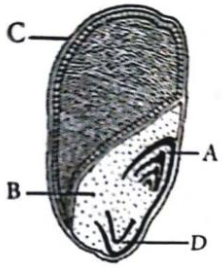 KCET 2021 Hard
 - An organic compound with molecular formula \(\mathrm{C}_7 \mathrm{H}_8 \mathrm{O}\) dissolves in \(\mathrm{NaOH}\) and gives a characteristic colour with \(\mathrm{FeCl}_3\). On treatment with bromine, it gives a tribromo derivative \(\mathrm{C}_7 \mathrm{H}_5 \mathrm{OBr}_3\). The compound isKCET 2022 Medium
- The brain capacity of Homo habilis isKCET 2019 Medium