


KCET · Physics · Nuclear Physics
A radioactive sample has half-life of 3 years. The time required for the activity of the sample to reduce to \(\frac{1}{5}\) th of its initial value is about
- A 10 years
- B 7 years
- C 15 years
- D 5 years
Answer & Solution
Correct Answer
(B) 7 years
Step-by-step Solution
Detailed explanation
Given, \(T_{1 / 2}=3\) years
We know that
\(R=R_0 e^{-\lambda t}\)
Here, \(R=\frac{R_0}{5}\)
\(\begin{aligned} & \Rightarrow \quad \frac{R_0}{5}=R_0 e^{-\lambda t} \Rightarrow \frac{1}{5}=e^{-\lambda t} \\ & \Rightarrow \ln \left(9^{-1}=\ln \left(e^{-\lambda t}\right)\right. \\ & \Rightarrow \quad t=\frac{\ln 5}{\lambda}=\frac{\ln 5}{\frac{0.693}{t_{1 / 2}}}=\frac{\ln 5}{0.693} \times t_{1 / 2}=\frac{\ln 5}{0.693} \times 3 \\ & \quad=6.96 \approx 7 \text { years }\end{aligned}\)
We know that
\(R=R_0 e^{-\lambda t}\)
Here, \(R=\frac{R_0}{5}\)
\(\begin{aligned} & \Rightarrow \quad \frac{R_0}{5}=R_0 e^{-\lambda t} \Rightarrow \frac{1}{5}=e^{-\lambda t} \\ & \Rightarrow \ln \left(9^{-1}=\ln \left(e^{-\lambda t}\right)\right. \\ & \Rightarrow \quad t=\frac{\ln 5}{\lambda}=\frac{\ln 5}{\frac{0.693}{t_{1 / 2}}}=\frac{\ln 5}{0.693} \times t_{1 / 2}=\frac{\ln 5}{0.693} \times 3 \\ & \quad=6.96 \approx 7 \text { years }\end{aligned}\)
See the Complete Solution
Get step-by-step explanations for this and 2.5 Lakh+ more JEE, NEET & CET questions.
- Unlock all solutions
- Practice the full chapter
- Track accuracy across PYQs
4.8 rated on Google Play · 14,000+ reviews
More questions from Physics
- Pick out the WRONG statements about magnetic substances.
(\(\chi\) = magnetic susceptibility)
(\(\mu_r\) = relative permeability).
I. Substances with \(-1 \leq \chi < 0\) are diamagnetic.
II. Substances with \(\chi \gg 1\) are paramagnetic.
III. Substances with \(\chi \ll 1\) are ferromagnetic.
IV. Substances with \(\mu_r \gg 1\) are ferromagnetic.KCET 2026 Medium - Variation of resistance of the conductor with temperature is as shown
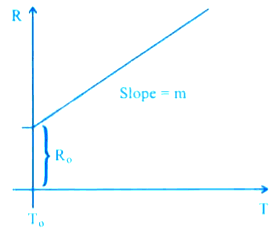
The temperature co-efficient \( (\alpha) \) of the conductor isKCET 2016 Easy - The maximum height attained by a projectile when thrown at an angle \(\theta\) with the horizontal is found to be half the horizontal range. Then \(\theta\) is equal toKCET 2007 Easy
- Magnetic susceptibility of Mg at 300 K is \(1.2 \times 10^{-5}\). What is its susceptibility at \(200 \mathrm{~K} ?\)KCET 2024 Easy
- Light of energy \(E\) falls normally on a metal of work function \(\frac{E}{3}\). The kinetic energies \(K\) of the photo electrons areKCET 2024 Easy
- In this circuit, when certain current flows, the heat produced in \(5 \Omega\) is \(4.05 \mathrm{~J}\) in a time t. The heat produced in \(2 \Omega\) coil in the same time interval is
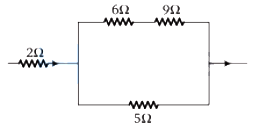 KCET 2012 Easy
More PYQs from KCET
- n-Propyl chloride reacts with sodium metal in dry ether to giveKCET 2018 Medium
- Histone proteins and positively charged because they are rich in basic amino acid residuesKCET 2023 Medium
- The power factor of \(R-L\) circuit is \(\frac{1}{\sqrt{3}}\). If the inductive reactance is \(2 \Omega\). The value of resistance isKCET 2020 Easy
- Lattice enthalpy for \(\mathrm{NaCl}\) is \(+788 \mathrm{~kJ} \mathrm{~mol}^{-1}\) and \(\Delta H_{\text {hyd }}^{\circ}=-784 \mathrm{~kJ} \mathrm{~mol}^{-1}\). Enthalpy of solution of \(\mathrm{NaCl}\) isKCET 2023 Hard
- Match List-I with List-II and select the correct option:
\begin{array}{|l|l|l|l|}\hline & \text{List-I (Molecule / ion} & & \text{List-II (Bond order)} \\\hline \text{1}. & \text{NO} & \text{(i)} & \text {15} \\\hline \text{2.} & \text{CO} & \text{(ii)} & \text{2.0} \\\hline \text{3.} & \mathrm{O}_2^{-} & \text{(iii)} & \text{2.5} \\\hline \text{4.} & \mathrm{O}_2 & \text{(iv)} & \text{3.0} \\\hline\end{array}KCET 2025 Medium - Identify the incorrect statements among the following:
(a) All enthalpies of fusion are positive
(b) The magnitude of enthalpy change does not depend on the strength of the intermolecular interactions in the substance undergoing phase transformations.
(c) When a chemical reaction is reversed, the value of \(\Delta \mathrm{rH}^{\circ}\) is reversed in sign.
(d) The change in enthalpy is dependent of path between initial state (reactants) and final state (products)
(e) For most of the ionic compounds, \(\Delta_{\text {sol }} \mathrm{H}^{\circ}\) is negativeKCET 2025 Medium