


KCET · Physics · Nuclear Physics
The ionisation energy of an electron in the ground state of helium atom is \(24.6 \mathrm{eV}\). The energy required to remove both the electron is
- A \(51.8 \mathrm{eV}\)
- B \(79 \mathrm{eV}\)
- C \(38.2 \mathrm{eV}\)
- D \(49.2 \mathrm{eV}\)
Answer & Solution
Correct Answer
(B) \(79 \mathrm{eV}\)
Step-by-step Solution
Detailed explanation
Ionisation energy in ground state \(=24.6 \mathrm{eV}\)
Energy required to remove \(2^{n}\) electron from \(\mathrm{He}^{2+}\)
Ionisation energy in ground state \(=24.6 \mathrm{eV}\)
Energy required to remove \(2^{n}\) electron from \(\mathrm{He}^{2+}\)
\(=Z^{2}(13.6) \mathrm{eV}=(2)^{2}(13.6)=54.4 \mathrm{eV}\)
\(=Z^{2}(13.6) \mathrm{eV}=(2)^{2}(13.6)=54.4 \mathrm{eV}\)
So, total energy required \(=24.6+54.4=79 \mathrm{eV}\)
Energy required to remove \(2^{n}\) electron from \(\mathrm{He}^{2+}\)
Ionisation energy in ground state \(=24.6 \mathrm{eV}\)
Energy required to remove \(2^{n}\) electron from \(\mathrm{He}^{2+}\)
\(=Z^{2}(13.6) \mathrm{eV}=(2)^{2}(13.6)=54.4 \mathrm{eV}\)
\(=Z^{2}(13.6) \mathrm{eV}=(2)^{2}(13.6)=54.4 \mathrm{eV}\)
So, total energy required \(=24.6+54.4=79 \mathrm{eV}\)
See the Complete Solution
Get step-by-step explanations for this and 2.5 Lakh+ more JEE, NEET & CET questions.
- Unlock all solutions
- Practice the full chapter
- Track accuracy across PYQs
4.8 rated on Google Play · 14,000+ reviews
More questions from Physics
- A magnetic dipole of magnetic moment \( 6 \times 10^{-2} \mathrm{Am}^{2} \) and moment of inertia
\( 12 \times 10^{-6} \mathrm{~kg} \mathrm{~m}^{2} \) performs oscillations in a magnetic field of \( 2 \times 10^{-2} \mathrm{~T} \). The time taken by
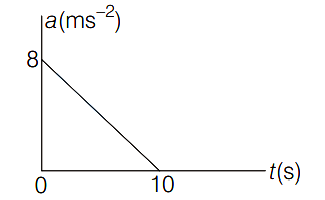
the dipole to complete \( 20 \) oscillations is \( (\pi \simeq 3) \)KCET 2017 Medium - A particle starts from rest. Its acceleration \(a\) versus time \(t\) is shown in the figure. The maximum speed of the particle will be
 KCET 2021 Hard
 - A solid cube of mass \(m\) at a temperature \(\theta_0\) is heated at a constant rate. It becomes liquid at temperature \(\theta_1\) and vapour at temperature \(\theta_2\). Let \(s_1\) and \(s_2\) be specific heats in its solid and liquid states respectively. If \(L_f\) and \(L_v\) are latent heats of fusion and vaporisation respectively, then the minimum heat energy supplied to the cube until it vaporises isKCET 2024 Medium
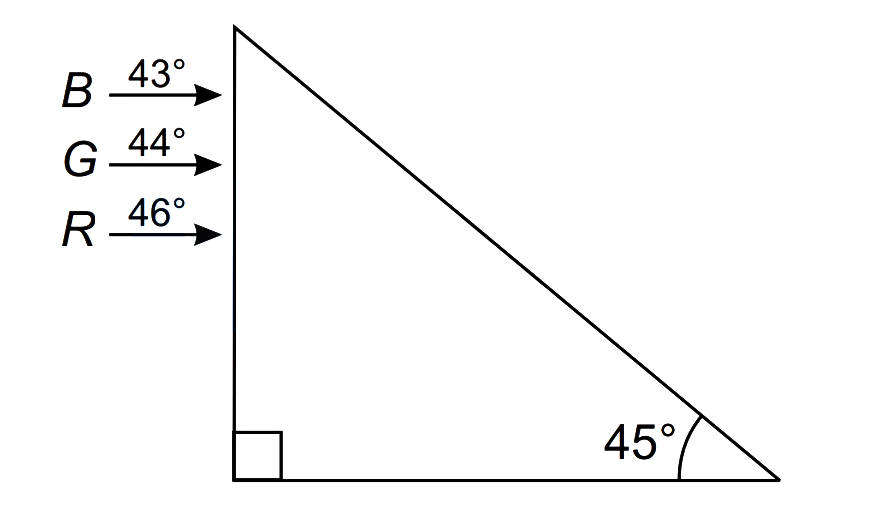
- Figure shows a mixture of blue, green and red coloured rays incident normally on a right angled prism. The critical angles of the material of the prism for red, green and blue are \(46^{\circ}, 44^{\circ}\) and \(43^{\circ}\) respectively. The arrangement will separate
 KCET 2008 Medium
 - How many times more intense is a \(60 \mathrm{~dB}\) sound than a \(30 \mathrm{~dB}\) sound?KCET 2008 Easy
- A convex lens made of glass has focal length \(0.15 \mathrm{~m}\) in air. If the refractive index of glass is \(\frac{3}{2}\) and that of water is \(\frac{4}{3}\), the focal length of lens when immersed in water isKCET 2009 Medium
More PYQs from KCET
- \(\text{C}-\text{Cl}\) bond in methyl chloride compared to \(\text{C}-\text{Cl}\) bond in chlorobenzene isKCET 2026 Medium
- Resonance effect is not observed inKCET 2019 Easy
- The contrapositive statement of the statement "If \( x \) is prime number, then \( x \) is odd" isKCET 2017 Easy
- The value of \(\lambda\) for which the vectors \(\vec{a} = 2\hat{i} + \lambda\hat{j} + \hat{k}\) and \(\vec{b} = \hat{i} + 2\hat{j} + 3\hat{k}\) are orthogonal isKCET 2026 Easy
- The integrating factor of the differential equation \( \left(2 x+3 y^{2}\right) d y=y d x(y>0) \) isKCET 2019 Easy
- The number of terms in the expansion of \( \left(x^{2}+y^{2}\right)^{25}-\left(x^{2}-y^{2}\right)^{25} \) after simplification isKCET 2019 Medium