


KCET · Physics · Magnetic Effects of Current
The equivalent resistance of two resistors connected in series is \( 6 \Omega \) and their parallel
equivalent resistance is \( \frac{4}{3} \Omega \) What are the values of resistances?
- A O \( 4 \Omega \)
- B \( 8 \Omega, 1 \Omega \)
- C \(4 \Omega, 2 \Omega\)
- D \( 6 \Omega, 2 \Omega \)
Answer & Solution
Correct Answer
(C) \(4 \Omega, 2 \Omega\)
Step-by-step Solution
Detailed explanation
Let the two resistances be \(R_{1}\) and \(R_{2}\)
When they are connected in series, equivalent resistance, \(R_{s}=6 \Omega\)
\(R_{1}+R_{2}=6 \rightarrow(1)\)
When they are connected in parallel, equivalent resistance,
\(R_{p}=\frac{4}{3} \Omega\)
\(\frac{1}{R_{p}}=\frac{1}{R_{1}}+\frac{1}{R_{2}} \Rightarrow \frac{1}{R_{1}}+\frac{1}{R_{2}}=\frac{3}{4} \rightarrow(2)\)
Solving Eq. (2), we get
\(\frac{R_{1}+R_{2}}{R_{1} R_{2}}=\frac{3}{4} \Rightarrow R_{1} R_{2}=\left(R_{1}+R_{2}\right) \times \frac{4}{3}\)
\(\Rightarrow R_{1} R_{2}=6 \times \frac{4}{3}\)
\(\Rightarrow R, R_{2}=2 \times 4=8 \Omega(\) Using Eq. \((1))\)
\(\Rightarrow R_{1} R_{2}=2 \times 4=8 \Omega \rightarrow(3)\)
From Eq. (1), we have \(R_{2}=6-R_{1}\)
\(\Rightarrow R_{1}\left(6-R_{1}\right)=8 \Rightarrow 6 R_{1}-R_{1}^{2}=8 \Rightarrow R_{1}^{2}-6 R_{1}+8=0\)
\(R_{1}=\frac{6 \pm \sqrt{36-32}}{2}=\frac{6 \pm \sqrt{4}}{2}=\frac{6 \pm 2}{2}=4\) or 2
Using Eq. (3), we get \(R_{2}=2\) or 4
Therefore, the two resistances are \(4 \Omega\) and \(2 \Omega\).
When they are connected in series, equivalent resistance, \(R_{s}=6 \Omega\)
\(R_{1}+R_{2}=6 \rightarrow(1)\)
When they are connected in parallel, equivalent resistance,
\(R_{p}=\frac{4}{3} \Omega\)
\(\frac{1}{R_{p}}=\frac{1}{R_{1}}+\frac{1}{R_{2}} \Rightarrow \frac{1}{R_{1}}+\frac{1}{R_{2}}=\frac{3}{4} \rightarrow(2)\)
Solving Eq. (2), we get
\(\frac{R_{1}+R_{2}}{R_{1} R_{2}}=\frac{3}{4} \Rightarrow R_{1} R_{2}=\left(R_{1}+R_{2}\right) \times \frac{4}{3}\)
\(\Rightarrow R_{1} R_{2}=6 \times \frac{4}{3}\)
\(\Rightarrow R, R_{2}=2 \times 4=8 \Omega(\) Using Eq. \((1))\)
\(\Rightarrow R_{1} R_{2}=2 \times 4=8 \Omega \rightarrow(3)\)
From Eq. (1), we have \(R_{2}=6-R_{1}\)
\(\Rightarrow R_{1}\left(6-R_{1}\right)=8 \Rightarrow 6 R_{1}-R_{1}^{2}=8 \Rightarrow R_{1}^{2}-6 R_{1}+8=0\)
\(R_{1}=\frac{6 \pm \sqrt{36-32}}{2}=\frac{6 \pm \sqrt{4}}{2}=\frac{6 \pm 2}{2}=4\) or 2
Using Eq. (3), we get \(R_{2}=2\) or 4
Therefore, the two resistances are \(4 \Omega\) and \(2 \Omega\).
See the Complete Solution
Get step-by-step explanations for this and 2.5 Lakh+ more JEE, NEET & CET questions.
- Unlock all solutions
- Practice the full chapter
- Track accuracy across PYQs
4.8 rated on Google Play · 14,000+ reviews
More questions from Physics
- In single slit experiment, the width of the slit is reduced. Then, the linear width of the principal maximaKCET 2012 Easy
- In the following network potential at 'O'
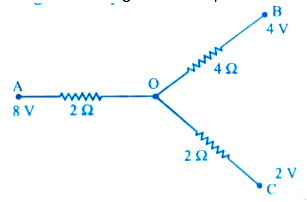 KCET 2016 Easy
 - A capacitor of \( 8 \mathrm{~F} \) is connected as shown. Charge on the plates of the capacitor
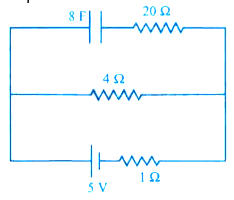 KCET 2016 Medium
 - An alternating current is given by \(i=i_1 \sin \omega t+i_2 \cos \omega t\). The rms current is given byKCET 2022 Easy
- The strength of Earth's magnetic field is :KCET 2018 Easy
- Moment of Inertia of a thin uniform rod rotating about the perpendicular axis passing through its centre is \( I \). If the same rod is bent into a ring and its moment of inertia about its diameter is \( I^{\prime} \) then the ratio \( \frac{I}{I^{\prime}} \) isKCET 2015 Easy
More PYQs from KCET
- Which of the following is a polyamide?KCET 2016 Easy
- The equilibrium constant of the reaction \(\mathrm{A}(\mathrm{s})+2 \mathrm{~B}^{2+}(\mathrm{aq}) \rightleftharpoons \mathrm{A}^{2+}(\mathrm{aq})+2 \mathrm{~B}(\mathrm{~s})\)
\(\mathrm{F}_{\text {cell }}^{\circ}=0.0295 \mathrm{~V}\) is \(\left[\frac{2.303 \mathrm{RT}}{\mathrm{F}}=0.059\right]\)KCET 2012 Medium - A pair of isoelectronic species having bond order of one isKCET 2024 Medium
- \(\frac{1}{2 \cdot 5}+\frac{1}{5 \cdot 8}+\) equal to
upto \(n\) terms isKCET 2008 Medium - Hypothyroidism is caused by the deficiency ofKCET 2020 Easy
- Find the co-ordinates of the foot of the perpendicular drawn from the origin to the plane \( 5 y+8 \)
\( =0 \) :KCET 2016 Hard