


KCET · Physics · Capacitance
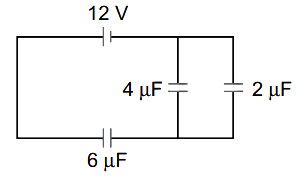
The charge deposited on \(4 \mu \mathrm{F}\) capacitor in the circuit is
- A \(6 \times 10^{-6} \mathrm{C}\)
- B \(12 \times 10^{-6} \mathrm{C}\)
- C \(24 \times 10^{-6} \mathrm{C}\)
- D \(36 \times 10^{-6} \mathrm{C}\)
Answer & Solution
Correct Answer
(C) \(24 \times 10^{-6} \mathrm{C}\)
Step-by-step Solution
Detailed explanation
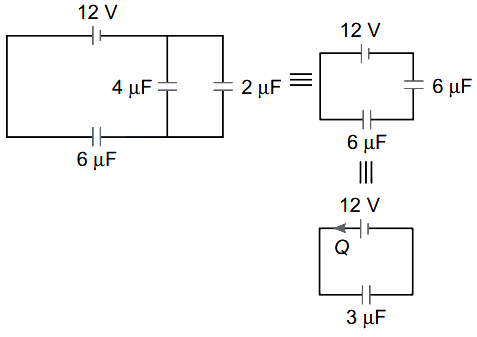
As the capacitors \(4 \mu \mathrm{F}\) and \(2 \mu \mathrm{F}\) are connected in parallel and are in series with \(6 \mu \mathrm{F}\) capacitor, their equivalent capacitance is
\(\frac{(2+4) \times 6}{2+4+6}=3 \mu \mathrm{F}\)
Charge in the circuit,
\(\mathrm{Q}=3 \mu \mathrm{F} \times 12 \mathrm{~V}=36 \mu \mathrm{C}\)
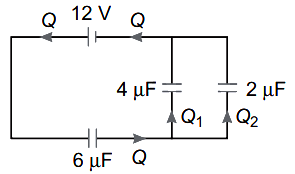
Since, the capacitors \(4 \mu \mathrm{F}\) and \(2 \mu \mathrm{F}\) are connected in parallel, therefore potential difference across them is same.
\(\Rightarrow \frac{\mathrm{Q}_{1}}{\mathrm{Q}_{2}}=\frac{\mathrm{C}_{1}}{\mathrm{C}_{2}}=\frac{4}{2} \text { or } \mathrm{Q}_{1}=2 \mathrm{Q}_{2}\)
\(\text {Also, } \quad Q_{1}=Q_{1}+Q_{2} \)
\(\therefore 36 \mu C=2 Q_{2}+Q_{2} \quad \text { or } \quad Q_{2}=\frac{36 \mu C}{3}=12 \mu C \)
\(Q_{1}=Q-Q_{2}=36 \mu C-12 \mu C \)
\(=24 \mu C=24 \times 10^{-6} C\)
See the Complete Solution
Get step-by-step explanations for this and 2.5 Lakh+ more JEE, NEET & CET questions.
- Unlock all solutions
- Practice the full chapter
- Track accuracy across PYQs
4.8 rated on Google Play · 14,000+ reviews
More questions from Physics
- The accurate measurement of emf can be obtained usingKCET 2009 Easy
- The ratio of area of first excited state to ground state of orbit of hydrogen atom'isKCET 2024 Easy
- In Young's double slit experiment, a third slit is made in between the double slits. ThenKCET 2008 Medium
- A force between two protons is same as the force between proton and neutron. The nature of the force isKCET 2014 Hard
- What will be the total electric flux through the faces of the cube as given in the figure with side of length '\(a\)' if a charge Q is placed at B midpoint of an edge of the cube (see figure)?
 KCET 2026 Medium
 - An electric dipole is kept in non-uniform electric field. It generally experiencesKCET 2019 Easy
More PYQs from KCET
- The negation of \(p \rightarrow(\sim p \vee q)\) isKCET 2011 Hard
- Sodium ethanoate on heating with soda lime gives ' \(X\) '. Electrolysis of aqueous solution of sodium ethanoate gives ' \(Y^{\prime}, X^{\prime}\) and ' \(Y^{\prime}\) respectively areKCET 2024 Hard
- Identify, the phylum which shows the following characteristics:
1. Animals are exclusively marine, radially symmetrical and diploblastic.
2. Body bears eight external rows of ciliated comb plates which help in locomotion.
3. Digestion is both extracellular and intracellular.
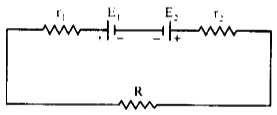
4. Reproduction only by sexual modes.KCET 2024 Medium - Two cells of emf \( E_{1} \) and \( E_{2} \) are joined in opposition (such that \( E_{1}>E_{2} \) ). If \( r_{1} \) and \( r_{2} \) be the internal resistance and \( R \) be the external resistance, then the terminal potential difference is
 KCET 2015 Hard
 - DNA, present in the nucleus, was named as 'Nuclein' byKCET 2018 Easy
- A smooth chain of length \(2 \mathrm{~m}\) is kept on a table such that its length of \(60 \mathrm{~cm}\) hangs frecly from the edge of the table. The total mass of the chain is \(4 \mathrm{~kg}\). The work done in pulling the entire chain on the table is (Take, \(g=10 \mathrm{~m} / \mathrm{s}^2\) )KCET 2022 Hard