


KCET · Physics · Electrostatics
What will be the total electric flux through the faces of the cube as given in the figure with side of length '\(a\)' if a charge Q is placed at B midpoint of an edge of the cube (see figure)?

- A \(\dfrac{Q}{8\varepsilon_0}\)
- B \(\dfrac{Q}{3\varepsilon_0}\)
- C \(\dfrac{Q}{4\varepsilon_0}\)
- D \(\dfrac{Q}{2\varepsilon_0}\)
Answer & Solution
Correct Answer
(C) \(\dfrac{Q}{4\varepsilon_0}\)
Step-by-step Solution
Detailed explanation
According to Gauss's Law, the total electric flux through a closed surface is given by \(\Phi = \dfrac{q_{\text{enclosed}}}{\varepsilon_0}\).
The charge \(Q\) is placed at the midpoint of an edge of the cube. This charge is not completely enclosed by the single cube. To completely enclose the charge symmetrically, we can imagine placing three additional identical cubes such that all four cubes share this common edge.
The total charge enclosed by this larger Gaussian surface (made of 4 cubes) is \(Q\). Therefore, the total electric flux through the combination of these 4 cubes is \(\dfrac{Q}{\varepsilon_0}\).
By symmetry, the flux is shared equally among the 4 cubes. Thus, the total electric flux passing through the faces of the given single cube is:
\(\Phi_{\text{cube}} = \dfrac{1}{4} \times \dfrac{Q}{\varepsilon_0} = \dfrac{Q}{4\varepsilon_0}\)
Answer: \(\dfrac{Q}{4\varepsilon_0}\)
The charge \(Q\) is placed at the midpoint of an edge of the cube. This charge is not completely enclosed by the single cube. To completely enclose the charge symmetrically, we can imagine placing three additional identical cubes such that all four cubes share this common edge.
The total charge enclosed by this larger Gaussian surface (made of 4 cubes) is \(Q\). Therefore, the total electric flux through the combination of these 4 cubes is \(\dfrac{Q}{\varepsilon_0}\).
By symmetry, the flux is shared equally among the 4 cubes. Thus, the total electric flux passing through the faces of the given single cube is:
\(\Phi_{\text{cube}} = \dfrac{1}{4} \times \dfrac{Q}{\varepsilon_0} = \dfrac{Q}{4\varepsilon_0}\)
Answer: \(\dfrac{Q}{4\varepsilon_0}\)
See the Complete Solution
Get step-by-step explanations for this and 2.5 Lakh+ more JEE, NEET & CET questions.
- Unlock all solutions
- Practice the full chapter
- Track accuracy across PYQs
4.8 rated on Google Play · 14,000+ reviews
More questions from Physics
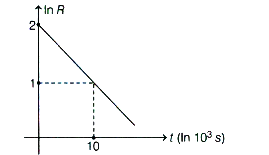
- The natural logarithm of the activity \(R\) of a radioactive sample varies with time \(t\) as shown. At \(t=0\), there are \(N_0\) undecayed nuclei. Then, \(N_0\) is equal to [Take \(e^2=7.5\) ]
 KCET 2024 Easy
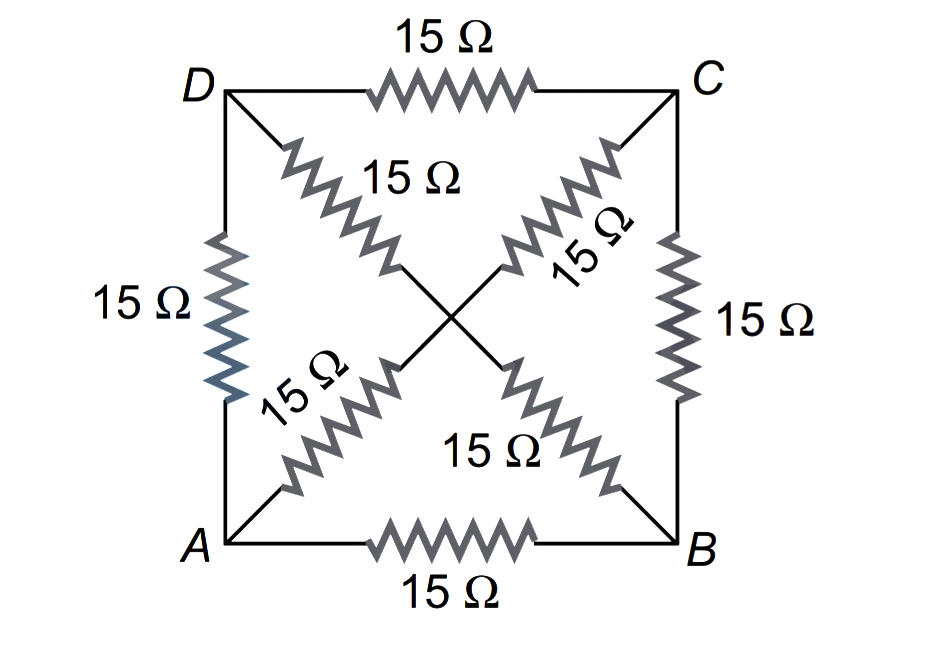
 - The equivalent resistance between the points and will be (each resistance is \(15 \Omega\) )
 KCET 2008 Hard
 - A wire of resistance \(3 \Omega\) is stretched to twice its original length. The resistance of the new wire will beKCET 2021 Easy
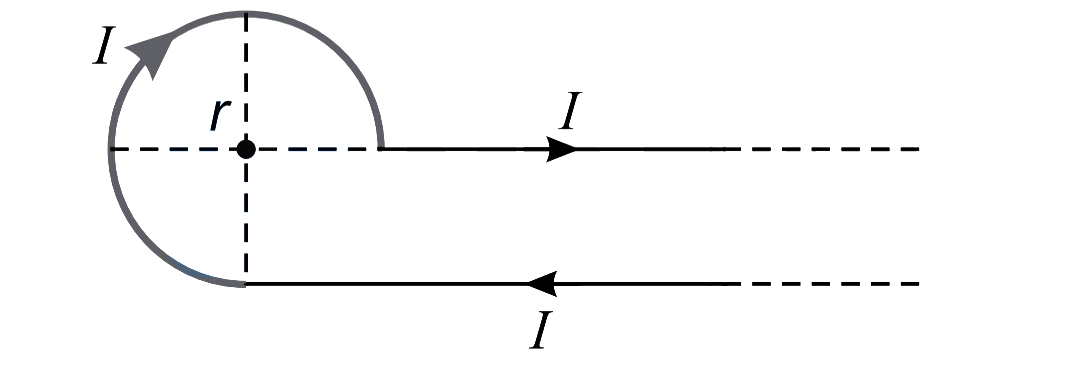
- Current \(I\) is flowing in conductor shaped as shown in the figure. The radius of the curved part is \(r\) and the length of straight portion is very large. The value of the magnetic field at the centre \(O\) will be
 KCET 2008 Hard
 - A monochromatic beam of light is travelling from medium \(A\) of refractive index \(n_{1}\) to a medium \(\mathrm{B}\) of refractive index \(\mathrm{n}_{2}\). In the medium \(A\), there are \(x\) number of waves in certain distance. In the medium B, there are \(y\) number of waves in the same distance. Then, refractive index of medium \(A\) with respect to medium \(B\) isKCET 2012 Hard
- When a planet revolves around the Sun, in general, for the planetKCET 2023 Easy
More PYQs from KCET
- Restriction endonucleases are isolated from some bacteria. Their role in bacteria isKCET 2017 Easy
- The difference between equivalent capacitances of two identical capacitors connected in parallel to that in series is \(6 \mu \mathrm{F}\). The value of capacitance of each capacitor isKCET 2020 Easy
- The composition of water gas isKCET 2023 Easy
- Match the following.
(A) VNTR p. Largest gene (B) Inrons and exons q. DNA fingerprinting (C) Dystrophin r. Bulk DNA (D) Satellite S. Splicing KCET 2015 Easy - The order and degree of the differential equation \(\left[1+\left(\frac{d y}{d x}\right)^{5}\right]^{\frac{1}{3}}=\frac{d^{2} y}{d x^{2}}\) are respectivelyKCET 2007 Easy
- Mass of \(0.1\) mole of methane isKCET 2008 Easy