


KCET · Physics · Dual Nature of Matter
The additional energy that should be given to an electron to reduce its de-Broglie wavelength from \(1 \mathrm{~nm}\) to \(0.5 \mathrm{~nm}\) is
- A 2 times the initial kinetic energy
- B 3 times the initial kinetic energy
- C \(0.5\) times the initial kinetic energy
- D 4 times the initial kinetic energy
Answer & Solution
Correct Answer
(B) 3 times the initial kinetic energy
Step-by-step Solution
Detailed explanation
The de-Broglie wavelength,
\(\lambda=\frac{h}{\sqrt{2 m E_{k}}} \quad \therefore \lambda \propto \frac{1}{\sqrt{E_{k}}}\)
( \(\because\) h and \(m\) remains constant)
Here, in given condition
\(\begin{array}{ll}
\frac{\lambda_{1}}{\lambda_{2}}=\sqrt{\frac{E_{k_{2}}}{E_{k_{1}}}}, \quad \frac{\lambda_{1}}{\lambda_{2}}=\sqrt{\frac{4 E}{E}} \\
\lambda_{1}=2 \lambda_{2}, & \lambda_{2}=\frac{\lambda_{1}}{2}
\end{array}\)
So, if \(E_{k}\) is increased by four times, then \(\lambda\) becomes half.
\(\therefore\) Additional kinetic energy that should be supplied to the electron
\(=4 E_{k}-E_{k}=3 E_{k}\)
\(\lambda=\frac{h}{\sqrt{2 m E_{k}}} \quad \therefore \lambda \propto \frac{1}{\sqrt{E_{k}}}\)
( \(\because\) h and \(m\) remains constant)
Here, in given condition
\(\begin{array}{ll}
\frac{\lambda_{1}}{\lambda_{2}}=\sqrt{\frac{E_{k_{2}}}{E_{k_{1}}}}, \quad \frac{\lambda_{1}}{\lambda_{2}}=\sqrt{\frac{4 E}{E}} \\
\lambda_{1}=2 \lambda_{2}, & \lambda_{2}=\frac{\lambda_{1}}{2}
\end{array}\)
So, if \(E_{k}\) is increased by four times, then \(\lambda\) becomes half.
\(\therefore\) Additional kinetic energy that should be supplied to the electron
\(=4 E_{k}-E_{k}=3 E_{k}\)
See the Complete Solution
Get step-by-step explanations for this and 2.5 Lakh+ more JEE, NEET & CET questions.
- Unlock all solutions
- Practice the full chapter
- Track accuracy across PYQs
4.8 rated on Google Play · 14,000+ reviews
More questions from Physics
- An electric dipole is kept in non-uniform electric field. It generally experiencesKCET 2019 Easy
- For the arrangement of capacitors as shown in the circuit, the effective capacitance between the points \( A \) and \( B \) is (capacitance of each capacitor is \( 4 \mu \mathrm{F} \) )
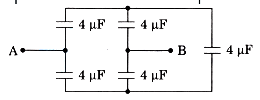 KCET 2018 Medium
 - In Young's double slit experiment, how many maxima can be seen on a screen (including central maxima) if \(d = \dfrac{5\lambda}{2}\) (where \(\lambda\) is wavelength of light and \(d\) is distance between the two slits).KCET 2026 Medium
- An engine moving towards a wall with a velocity \(50 \mathrm{~ms}^{-1}\) emits a note of \(1.2 \mathrm{kHz}\). Speed of sound in air is \(350 \mathrm{~ms}^{-1}\). The frequency of the note after reflection from the wall as heard by the driver of the engine isKCET 2007 Hard
- For a transformed, the turns ratio is 3 and its efficiency is \(0.75\). The current flowing in the primary coil is \(2 \mathrm{~A}\) and the voltage applied to it is \(100 \mathrm{~V}\). Then the voltage and the current flowing in the secondary coil are ... respectivelyKCET 2013 Easy
- A block rests on a rough inclined plane making an angle of \( 30^{\circ} \) with the horizontal. The coefficient of static friction between the block and the plane is \( 0.8 \). If the frictional force on the block is \( 10 \mathrm{~N} \), the mass of the block is \( \left(\mathrm{g}=10 \mathrm{~ms}^{-2}\right) \)KCET 2018 Hard
More PYQs from KCET
- If \(A\) and \(B\) have \(n\) elements in common, then the number of elements common to \(A \times B\) and \(B \times A\) isKCET 2012 Easy
- Select the correct statements from the following:KCET 2023 Medium
- Which of the following events would occur in 'Lac operon' of E. coli when the growth medium has high concentration of lactose?KCET 2014 Medium
- In the Young's double slit experiment, the intensity of light passing through each of
the two double slits is \(2 \times 10^{-2} \mathrm{Wm}^{-2}\). The screen-slit distance is very large in comparison with slit-slit distance. The fringe width is \(\beta\). The distance between the central maximum and a point \(P\) on the screen is \(x=\frac{\beta}{3}\). Then, the total light intensity at the point isKCET 2023 Hard - Which of the following is properly matched?KCET 2009 Medium
- \(\left(\mathrm{NH}_4\right)_2 \mathrm{Cr}_2 \mathrm{O}_7\) on heating liberates a gas. The same gas will be obtained byKCET 2022 Hard