


KCET · Physics · Wave Optics
In the Young's double slit experiment, the intensity of light passing through each of
the two double slits is \(2 \times 10^{-2} \mathrm{Wm}^{-2}\). The screen-slit distance is very large in comparison with slit-slit distance. The fringe width is \(\beta\). The distance between the central maximum and a point \(P\) on the screen is \(x=\frac{\beta}{3}\). Then, the total light intensity at the point is
- A \(8 \times 10^{-2} \mathrm{Wm}^{-2}\)
- B \(4 \times 10^{-2} \mathrm{Wm}^{-2}\)
- C \(2 \times 10^{-2} \mathrm{Wm}^{-2}\)
- D \(16 \times 10^{-2} \mathrm{Wm}^{-2}\)
Answer & Solution
Correct Answer
(C) \(2 \times 10^{-2} \mathrm{Wm}^{-2}\)
Step-by-step Solution
Detailed explanation
Given, \(x=\frac{\beta}{3}\)
\(I_0=2 \times 10^{-2} \mathrm{Wm}^{-2}\)
for YDSE where \(D \gg d, \Delta x=d \sin \theta\)
Also \(\sin \theta \approx \tan \theta \approx \frac{x}{D}=\frac{\beta}{3 D}=\frac{\lambda D}{d \times 3 D}=\frac{\lambda}{3 d}\)
\(\begin{aligned} & \therefore \Delta \phi=\frac{2 \pi}{\lambda} \Delta x=\frac{2 \pi}{\lambda} d \sin \theta=\frac{2 \pi}{\lambda} \times \frac{d \times \lambda}{3 d}=\frac{2 \pi}{3}=\Delta \phi \\ & I=4 I_0 \cos ^2\left(\frac{\Delta \phi}{2}\right)=4 I_0 \cos ^2\left(\frac{2 \pi}{3} \times \frac{1}{2}\right) \\ & =4 I_0 \cos ^2\left(\frac{\pi}{3}\right)=4 \times I_0 \times \frac{1}{4}\end{aligned}\)
\(\therefore I=I_0=2 \times 10^{-2} \mathrm{~W} \mathrm{~m}^{-2}\)
\(I_0=2 \times 10^{-2} \mathrm{Wm}^{-2}\)
for YDSE where \(D \gg d, \Delta x=d \sin \theta\)
Also \(\sin \theta \approx \tan \theta \approx \frac{x}{D}=\frac{\beta}{3 D}=\frac{\lambda D}{d \times 3 D}=\frac{\lambda}{3 d}\)
\(\begin{aligned} & \therefore \Delta \phi=\frac{2 \pi}{\lambda} \Delta x=\frac{2 \pi}{\lambda} d \sin \theta=\frac{2 \pi}{\lambda} \times \frac{d \times \lambda}{3 d}=\frac{2 \pi}{3}=\Delta \phi \\ & I=4 I_0 \cos ^2\left(\frac{\Delta \phi}{2}\right)=4 I_0 \cos ^2\left(\frac{2 \pi}{3} \times \frac{1}{2}\right) \\ & =4 I_0 \cos ^2\left(\frac{\pi}{3}\right)=4 \times I_0 \times \frac{1}{4}\end{aligned}\)
\(\therefore I=I_0=2 \times 10^{-2} \mathrm{~W} \mathrm{~m}^{-2}\)
See the Complete Solution
Get step-by-step explanations for this and 2.5 Lakh+ more JEE, NEET & CET questions.
- Unlock all solutions
- Practice the full chapter
- Track accuracy across PYQs
4.8 rated on Google Play · 14,000+ reviews
More questions from Physics
- If \(\gamma\) is the ratio of specific heats and \(R\) is the universal gas constant, then the molar specific heat at constant volume \(\mathrm{C}_{\mathrm{V}}\) is given byKCET 2008 Easy
- \(\lambda_{1}\) and \(\lambda_{2}\) are used to illuminate the slits. \(\beta_{1}\) and \(\beta_{2}\) are the corresponding fringe widths. The wavelength \(\lambda_{1}\) can produce photoelectric effect when incident on a metal. But the wavelength \(\lambda_{2}\) cannot produce photoelectric effect. The correct relation between \(\beta_{1}\) and \(\beta_{2}\) isKCET 2013 Easy
- A charge \(+Q\) is moving upwards vertically. It enters a magnetic field directed to north. The force on the charge will be towardsKCET 2010 Easy
- Two fly wheels are connected by a non-slipping belt as shown in the figure. \(I_1=4 \mathrm{~kg} \mathrm{~m}^2, r_1=20 \mathrm{~cm}\), \(\mathrm{I}_2=20 \mathrm{kgm}^2\) and \(\mathrm{r}_2=30 \mathrm{~cm}\). A torque of 10 Nm is applied on the smaller wheel. Then match the entries of column I with appropriate entries of column II.
Quantities Their numerical Values (in SI units) a. Angular acceleration of smaller wheel 1. \(\frac{5}{3}\) b. Torque on the larger wheel 2. \(\frac{100}{3}\) c. Angular acceleration of larger wheel 3. \(\frac{5}{2}\) 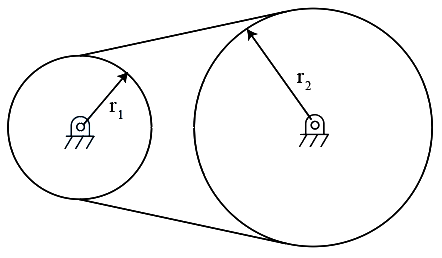 KCET 2025 Medium
 - A nuclear reactor delivers a power of \(10^9 \mathrm{~W}\), the amount of fuel consumed by the reactor in one hour isKCET 2022 Easy
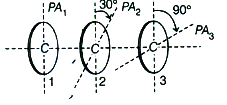
- Three polaroid sheets are co-axially placed as indicated in the diagram. Pass axes of the polaroids 2 and 3 make \(30^{\circ}\) and \(90^{\circ}\) with pass axis of polaroid sheet 1 . If \(I_0\) is the intensity of the incident unpolarised light entering sheet 1 , the intensity of the emergent light through sheet 3 is
 KCET 2024 Medium
More PYQs from KCET
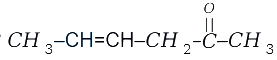
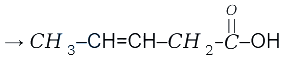
- Which is the most suitable reagent for the following conversion?
 KCET 2019 Medium
 - Identify the correct statements/regarding class aves.
I. Forelimbs are modified into wings and hindlimbs are modified for walking and swimming.
II. Heart is completely four chambered.
III. They are homeotherms.
IV. They are oviparous and development is direct.KCET 2021 Hard - The vector equation of the plane which is at a distance of \( \frac{3}{\sqrt{14}} \) from the origin and the normal
from the origin is \( 2 \hat{i}-3 \hat{j}+\hat{k} \) isKCET 2016 Medium - The least positive integer \(\mathrm{n}\), for which \(\frac{(1+i)^{n}}{(1-i)^{n-2}}\) is positive, isKCET 2010 Easy
- If ' \(a\) ' stands for the edge length of the cubic systems. The ratio of radii in simple cubic, body centred cubic and face centred cubic unit cells isKCET 2023 Medium
- Osmotic pressure of the solution can be increased by,KCET 2016 Easy