


KCET · Physics · Ray Optics
Light of two different frequencies whose photons have energies \( 1 \mathrm{eV} \) and \( 2.5 \mathrm{eV} \) respectively,
successively illuminate a metallic surface whose work function is \( 0.5 \mathrm{eV} \). Ratio of maximum
speeds of emitted electrons will be
- A \(1: 5\)
- B \( 1: 4 \)
- C \( 1: 2 \)
- D 1:1
Answer & Solution
Correct Answer
(C) \( 1: 2 \)
Step-by-step Solution
Detailed explanation
Kinetic energy, \( K h=f W \)
where \( W \) is work function; \( f \) is frequency of incident photon.
For photon of energy
\( 1 e V, K_{1}=1 e V-0.5 e V=0.5 e V \)
For photon of energy
\( 2.5 \mathrm{eV}, K_{2}=2.5 \mathrm{eV}-0.5 \mathrm{eV}=2.0 \mathrm{eV} \)
Taking ratio, \( \frac{K_{1}}{K_{2}}=\frac{0.5 \mathrm{eV}}{2.0 \mathrm{eV}} \)
\( \Rightarrow \frac{\frac{1}{2} m v_{1}^{2}}{\frac{1}{2} m v_{2}^{2}}=\frac{0.5}{2.0} \Rightarrow \frac{v_{1}^{2}}{v_{2}^{2}}=\frac{1}{4} \Rightarrow \frac{v_{1}}{v_{2}}=\frac{1}{2} \)
Therefore, ratio of maximum speeds of emitted electrons will be \( 1: 2 \).
where \( W \) is work function; \( f \) is frequency of incident photon.
For photon of energy
\( 1 e V, K_{1}=1 e V-0.5 e V=0.5 e V \)
For photon of energy
\( 2.5 \mathrm{eV}, K_{2}=2.5 \mathrm{eV}-0.5 \mathrm{eV}=2.0 \mathrm{eV} \)
Taking ratio, \( \frac{K_{1}}{K_{2}}=\frac{0.5 \mathrm{eV}}{2.0 \mathrm{eV}} \)
\( \Rightarrow \frac{\frac{1}{2} m v_{1}^{2}}{\frac{1}{2} m v_{2}^{2}}=\frac{0.5}{2.0} \Rightarrow \frac{v_{1}^{2}}{v_{2}^{2}}=\frac{1}{4} \Rightarrow \frac{v_{1}}{v_{2}}=\frac{1}{2} \)
Therefore, ratio of maximum speeds of emitted electrons will be \( 1: 2 \).
See the Complete Solution
Get step-by-step explanations for this and 2.5 Lakh+ more JEE, NEET & CET questions.
- Unlock all solutions
- Practice the full chapter
- Track accuracy across PYQs
4.8 rated on Google Play · 14,000+ reviews
More questions from Physics
- The resultant of two forces acting at an angle of \(120^{\circ}\) is \(10 \mathrm{~kg}\)-wt and is perpendicular to one of the forces. That force isKCET 2011 Easy
- For light diverging from a finite point source,KCET 2022 Easy
- A prism having refractive index \(1.414\) and refracting angle \(30^{\circ}\) has one of the refracting surfaces silvered. A beam of light incident on the other refracting surface will retrace its path, if the angle of incidence isKCET 2011 Hard
- The efficiency of a Carnot engine which operates between the two temperatures \( T_{1}=500 \mathrm{~K} \)
and \( T_{2}=300 \mathrm{~K} \) isKCET 2015 Medium - A toroid has \( 500 \) turns per metre length. If it carries a current of \( 2 \mathrm{~A} \), the magnetic energy density inside the toroid isKCET 2019 Medium
- An \(\alpha\)-particle and a proton moving with the same kinetic energy enter a region of uniform magnetic field at right angles to the field. The ratio of the radii of the paths of \(\alpha\)-particle to that of the proton isKCET 2012 Medium
More PYQs from KCET
- Match the plant growth hormones of Column-I with suit-able chemical derivatives present Column-II and choose the correct option given below:
Column-I Column-II A. Abscisic acid (i) Adenine derivative B. Gibberellins (ii) Indole acetic acid C. Kinetin (iii) Carotenoid derivative D. Auxin (iv) Terpenes KCET 2025 Easy - If \(y=\left(1+x^2\right) \tan ^{-1} x-x\), then \(\frac{d y}{d x}\) isKCET 2022 Medium
- The function \(f(x)=[x]\), where \([x]\) denotes the greatest integer not greater than \(x\), isKCET 2010 Easy
- The common impurity present in bauxite isKCET 2018 Medium
- Four charges \(+q,+2 q,+q\) and \(-2 q\) are placed at the corners of a square \(A B C D\) respectively. The force on a unit positive charge kept at the centre \(O\) isKCET 2022 Easy
- Variation of resistance of the conductor with temperature is as shown
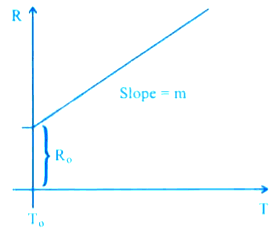
The temperature co-efficient \( (\alpha) \) of the conductor isKCET 2016 Easy