


KCET · Maths · Differentiation
If \(y=\left(1+x^2\right) \tan ^{-1} x-x\), then \(\frac{d y}{d x}\) is
- A \(2 x \tan ^{-1} x\)
- B \(\frac{\tan ^{-1} x}{x}\)
- C \(x^2 \tan ^{-1} x\)
- D \(x \tan ^{-1} x\)
Answer & Solution
Correct Answer
(A) \(2 x \tan ^{-1} x\)
Step-by-step Solution
Detailed explanation
Given,
\[
y=\left(1+x^2\right) \tan ^{-1} x-x
\]
Differentiating the given function w.r.t. \(x\)
\[
\begin{aligned}
\frac{d y}{d x} & =\left(1+x^2\right) \frac{d}{d x}\left(\tan ^{-1} x\right)+\tan ^{-1} x \frac{d}{d x}\left(1+x^2\right)-\frac{d}{d x}(x) \\
& =\left(1+x^2\right) \frac{1}{\left(1+x^2\right)}+\tan ^{-1} x(2 x)-1 \\
& =1+2 x \tan ^{-1} x-1=2 x \tan ^{-1} x
\end{aligned}
\]
\[
y=\left(1+x^2\right) \tan ^{-1} x-x
\]
Differentiating the given function w.r.t. \(x\)
\[
\begin{aligned}
\frac{d y}{d x} & =\left(1+x^2\right) \frac{d}{d x}\left(\tan ^{-1} x\right)+\tan ^{-1} x \frac{d}{d x}\left(1+x^2\right)-\frac{d}{d x}(x) \\
& =\left(1+x^2\right) \frac{1}{\left(1+x^2\right)}+\tan ^{-1} x(2 x)-1 \\
& =1+2 x \tan ^{-1} x-1=2 x \tan ^{-1} x
\end{aligned}
\]
See the Complete Solution
Get step-by-step explanations for this and 2.5 Lakh+ more JEE, NEET & CET questions.
- Unlock all solutions
- Practice the full chapter
- Track accuracy across PYQs
4.8 rated on Google Play · 14,000+ reviews
More questions from Maths
- \(|\mathbf{a} \times \mathbf{b}|^2+|\mathbf{a} \cdot \mathbf{b}|^2=144\) and \(|\mathbf{a}|=4\), then \(|\mathbf{b}|\) is equal toKCET 2023 Easy
- If \(\mathbf{a}, \mathbf{b}\) and \(\mathbf{c}\) are three non-coplanar vectors and \(p, q\) and \(r\) are vectors defined by
\(\mathbf{p}=\frac{\mathbf{a} \times \mathbf{c}}{[\mathbf{a} \mathbf{b} \mathbf{c}]}, \mathbf{q}=\frac{\mathbf{c} \times \mathbf{a}}{[\mathbf{a} \mathbf{b} \mathbf{c}]}, \mathbf{r}=\frac{\mathbf{a} \times \mathbf{b}}{[\mathbf{a} \mathbf{b} \mathbf{c}]}\), then
\((\mathbf{a}+\mathbf{b}) \cdot \mathbf{p}+(\mathbf{b}+\mathbf{c}) \cdot \mathbf{q}+(\mathbf{c}+\mathbf{a}) \cdot \mathbf{r}\) isKCET 2024 Medium - The equations of the two tangents from \((-5,-4)\) to the circle \(x^{2}+y^{2}+4 x+6 y+8=0\) areKCET 2012 Hard
- The equation of the normal to the hyperbola \(\frac{x^{2}}{16}-
\frac{y^{2}}{9}=1\) at \((-4,0)\) isKCET 2008 Medium - The length of latus rectum of the parabola \( 4 y^{2}+3 x+3 y+1=0 \) isKCET 2016 Medium
- The value of \( \tan \left(1^{\circ}\right)+\tan \left(89^{\circ}\right) \) isKCET 2015 Medium
More PYQs from KCET
- The converse of the contrapositive of the conditional \(\mathrm{p} \rightarrow \sim \mathrm{q}\) isKCET 2008 Easy
- The general solution of the differential equation \(x^{2} d y-2 x y d x=x^{4} \cos x d x\) isKCET 2020 Easy
- \(\tan ^{-1}\left[\frac{1}{\sqrt{3}} \sin \frac{5 \pi}{2}\right] +\sin ^{-1}\left[\cos \left(\sin ^{-} \frac{\sqrt{3}}{2}\right)\right]\) is equal toKCET 2021 Easy
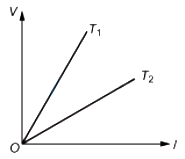
- The voltage \(V\) and current \(I\) graph for a conductor at two different temperatures \(T_{1}\) and \(T_{2}\) and shown in the figure. The relation between \(T_{1}\) and \(T_{2}\) is
 KCET 2011 Easy
 - From the given options, identify the correct combination of population interactions that correspond to the symbols given here.KCET 2019 Hard
- The correct statement/s about Galvanic cell is/are
(a) Current flows from cathode to anode
(b) Anode is positive terminal
(c) If \(\mathrm{E}_{\text {cell }} \lt 0\), then it is spontaneous reaction
(d) Cathode is positive terminalKCET 2025 Medium