


KCET · Physics · Dual Nature of Matter
Light emitted during the de excitation of electron from \(n=3\) to \(n=2\), when incident on a metal, photoelectrons are just emitted from that metal. In which of the following de excitations photoelectric effect is not possible?
- A From \(n=2\) to \(n=1\)
- B From \(n=3\) to \(n=1\)
- C From \(n=5\) to \(n=2\)
- D From \(n=4\) to \(n=3\)
Answer & Solution
Correct Answer
(D) From \(n=4\) to \(n=3\)
Step-by-step Solution
Detailed explanation
The photoelectric effect is possible when light of sufficient energy incident on metal surface. When electron de excites form \(n=3\) to \(n=2\), the light produces photoelectric effect. So for the given options, the photoelectric effect is not possible for that level in which energy of emitted light is less than that for \(n=3\) to \(n=2\).
\((h v)_{4-3} < (h v)_{3-2}\)
Hence, photoelectric effect is not possible.
\((h v)_{4-3} < (h v)_{3-2}\)
Hence, photoelectric effect is not possible.
See the Complete Solution
Get step-by-step explanations for this and 2.5 Lakh+ more JEE, NEET & CET questions.
- Unlock all solutions
- Practice the full chapter
- Track accuracy across PYQs
4.8 rated on Google Play · 14,000+ reviews
More questions from Physics
- Maximum velocity of the photoelectron emitted by a metal is \(1.8 \times 10^{6} \mathrm{~ms}^{-1}\). Take the value of specific charge of the electron is \(1.8 \times 10^{11} \mathrm{C} \mathrm{kg}^{-1}\). Then the stopping potential in volt isKCET 2013 Easy
- A ray of light is incident normally on one face of a right angled isosceles prism. It then grazes the hypotenuse. The refractive index of the material of the prism isKCET 2007 Medium
- A door \(1.6 \mathrm{~m}\) wide requires a force of \(1 \mathrm{~N}\) to be applied at the free end to open or close it. The force that is required at a point \(0.4 \mathrm{~m}\) distance from the hinges for opening or closing the door isKCET 2009 Medium
- The surface temperature of the sun which has maximum energy emission at \(500 \mathrm{~nm}\) is \(6000 \mathrm{~K}\). The temperature of a star which has maximum energy emission at \(400 \mathrm{~nm}\) will beKCET 2007 Easy
- In Young's double slit experiment, how many maxima can be seen on a screen (including central maxima) if \(d = \dfrac{5\lambda}{2}\) (where \(\lambda\) is wavelength of light and \(d\) is distance between the two slits).KCET 2026 Medium
- The de-Broglie wavelength associated with electron of hydrogen atom in this ground state isKCET 2020 Hard
More PYQs from KCET
- The system of equations \(x + 2y = 3\) and \(2x + 3y = 3\) hasKCET 2026 Easy
- The range of the function \(f(x)=\sin [x],-\frac{\pi}{4} < x < \frac{\pi}{4}\), where \([x]\) denotes the greatest integer \(\leq x\), isKCET 2013 Easy
- \(\int \frac{\sin x \cos x}{\sqrt{1-\sin ^{4} x}} d x\) is equal toKCET 2008 Medium
- Select the incorrect statement about contraceptives.KCET 2021 Medium
-
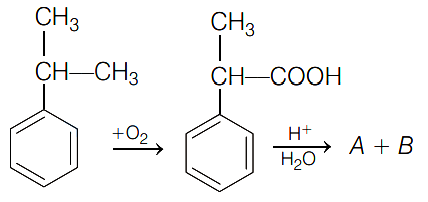
The product ' \(A\) ' gives white precipitate when treated with bromine water. The product ' \(B\) ' is treated with barium hydroxide to give the product \(C\). The compound \(C\) is heated strongly to form product \(D\). The product \(D\) isKCET 2021 Medium - A flow of liquid is streamline if the Reynold number isKCET 2014 Hard