


KCET · Physics · Laws of Motion
An object with mass \( 5 \mathrm{~kg} \) is acted upon by a force, \( \vec{F}=(-3 \hat{i}+4 \hat{j}) \mathrm{N} \). If its initial velocity at
\( \mathrm{t}=0 \) is \( \vec{v}=(6 \hat{i}-12 \hat{j}) \mathrm{ms}^{-1} \), the time at which it will just have a velocity along \( \mathrm{y} \)-axis is
- A \( 02 s \)
- B \( 05 s \)
- C \( 15 s \)
- D \( 10 s \)
Answer & Solution
Correct Answer
(D) \( 10 s \)
Step-by-step Solution
Detailed explanation
(D)
\(\vec{F}=(-3 \hat{i}+4 \hat{j})\)
\(m \vec{a}=(-3 \hat{i}+4 \hat{j})\)
\(M=5 \mathrm{~kg}\)
\(\vec{a}=\left(\frac{-3}{5} \hat{i}+\frac{4}{5} \hat{j}\right) \Rightarrow \vec{a}=a_{x} \hat{i}+a_{y} \hat{j}\)
\(a_{x}=\frac{-3}{5}\)
at \(\mathrm{t}=0\)
\(\vec{V}_{0}=(6 \hat{i}-12 \hat{j}) \Rightarrow\left(V_{o x} \hat{i}-V_{o y} \hat{j}\right)\)
\(V_{o x}=6\)
For the body to have velocity along y-axis only, x-component of velocity should be zero i.e., \(V_{x}=0\)
\(V_{x}=V_{o x}+a_{x} t\)
\(0=6+\left(\frac{-3}{5}\right) t\)
\(6=\frac{3}{5} t\)
\(t=\frac{6 \times 5}{3}=10 s\)
OR
\(A=\frac{F}{m}=\left(-\frac{3}{5} \hat{i}+\frac{4}{5} \hat{j}\right)\)
\(\mathrm{u}=(6 \hat{i}-12 \hat{j}) \mathrm{m} s^{-1}\)
\(\mathrm{v}=\mathrm{u}+\) at.
\(1 \hat{j}=(6 \hat{i}-12 \hat{j})+\left(-\frac{3}{5} \hat{i}+\frac{4}{5} \hat{j}\right) t\)
\(\vec{F}=(-3 \hat{i}+4 \hat{j})\)
\(m \vec{a}=(-3 \hat{i}+4 \hat{j})\)
\(M=5 \mathrm{~kg}\)
\(\vec{a}=\left(\frac{-3}{5} \hat{i}+\frac{4}{5} \hat{j}\right) \Rightarrow \vec{a}=a_{x} \hat{i}+a_{y} \hat{j}\)
\(a_{x}=\frac{-3}{5}\)
at \(\mathrm{t}=0\)
\(\vec{V}_{0}=(6 \hat{i}-12 \hat{j}) \Rightarrow\left(V_{o x} \hat{i}-V_{o y} \hat{j}\right)\)
\(V_{o x}=6\)
For the body to have velocity along y-axis only, x-component of velocity should be zero i.e., \(V_{x}=0\)
\(V_{x}=V_{o x}+a_{x} t\)
\(0=6+\left(\frac{-3}{5}\right) t\)
\(6=\frac{3}{5} t\)
\(t=\frac{6 \times 5}{3}=10 s\)
OR
\(A=\frac{F}{m}=\left(-\frac{3}{5} \hat{i}+\frac{4}{5} \hat{j}\right)\)
\(\mathrm{u}=(6 \hat{i}-12 \hat{j}) \mathrm{m} s^{-1}\)
\(\mathrm{v}=\mathrm{u}+\) at.
\(1 \hat{j}=(6 \hat{i}-12 \hat{j})+\left(-\frac{3}{5} \hat{i}+\frac{4}{5} \hat{j}\right) t\)
See the Complete Solution
Get step-by-step explanations for this and 2.5 Lakh+ more JEE, NEET & CET questions.
- Unlock all solutions
- Practice the full chapter
- Track accuracy across PYQs
4.8 rated on Google Play · 14,000+ reviews
More questions from Physics
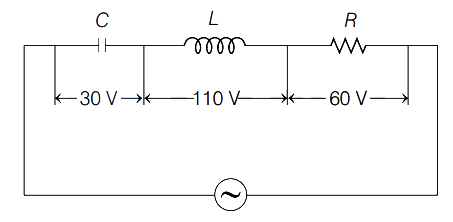
- In the given circuit the peak voltage across \(C\), \(L\) and \(R\) are \(30 \mathrm{~V}, 110 \mathrm{~V}\) and \(60 \mathrm{~V}\), respectively. The rms value of the applied voltage is
 KCET 2020 Easy
 - A \(p-n\) junction diode is connected to a battery of emf 5.7 V in series with a resistant \(5 \mathrm{k} \Omega\) such that it is forward biased. If the barrier potential of the diode is 0.7 V , neglecting the diode resistance, the current in the circuit isKCET 2024 Hard
- A spring is stretched by applying a load to its free end. The strain produced in the spring isKCET 2016 Easy
- A radioactive decay can form an isotope of the original nucleus with the emission of particlesKCET 2015 Medium
- A proton, a deuteron and an \( \alpha \) - particle are projected perpendicular to the direction of a
uniform magnetic field with same kinetic energy. The ratio of the radii of the circular paths
described by them isKCET 2017 Medium - When a planet revolves around the Sun, in general, for the planetKCET 2023 Easy
More PYQs from KCET
- If \( [x] \) represents the greatest integer function and \( f(x)=x-[x]-\cos x \) then \( f^{\prime}\left(\frac{I}{2}\right)= \)KCET 2019 Medium
- Which one of the following shows functional isomerism?KCET 2007 Easy
- The amplitude of \((1+i)^{5}\) isKCET 2007 Medium
- If a matrix \( \mathrm{A} \) is both symmetric and skewsymmetric, thenKCET 2017 Easy
- The resistance of the bulb filament is \( 100 \Omega \) at a temperature of \( 100^{\circ} \mathrm{C} \). If its temperature co-
efficient of resistance be \( 0.005 \) per \( { }^{\circ} \mathrm{C} \), its resistance will become \( 200 \Omega \) at a temperatureKCET 2015 Easy - \(\left(\mathrm{NH}_4\right)_2 \mathrm{Cr}_2 \mathrm{O}_7\) on heating liberates a gas. The same gas will be obtained byKCET 2022 Hard