


KCET · Physics · Thermal Properties of Matter
\(0.1 \mathrm{~m}^{3}\) of water at \(80^{\circ} \mathrm{C}\) is mixed with \(0.3 \mathrm{~m}^{3}\) of water at \(60^{\circ} \mathrm{C}\). The final temperature of the mixture is
- A \(65^{\circ} \mathrm{C}\)
- B \(70^{\circ} \mathrm{C}\)
- C \(60^{\circ} \mathrm{C}\)
- D \(75^{\circ} \mathrm{C}\)
Answer & Solution
Correct Answer
(A) \(65^{\circ} \mathrm{C}\)
Step-by-step Solution
Detailed explanation
Let the final temperature of the mixture be \(t\)
Heat lost by water at \(80^{\circ} \mathrm{C}\)
\(=\mathrm{ms} \Delta \mathrm{t} \)
\( =0.1 \times 10^{3} \times \mathrm{s}_{\text {water }} \times\left(80^{\circ}-\mathrm{t}\right) \)
\( \left(\because \mathrm{m}=\mathrm{V} \times \mathrm{d}=0.1 \times 10^{3} \mathrm{~kg}\right)\)
Heat gained by water at \(60^{\circ} \mathrm{C}\)
\(=0.3 \times 10^{3} \times \mathrm{s}_{\text {water }} \times\left(\mathrm{t}-60^{\circ}\right)\)
According to principle of calorimetry
Heat lost \(=\) Heat gained
\(\therefore 0.1 \times 10^{3} \times \mathrm{s}_{\text {water }} \times\left(80^{\circ}-\mathrm{t}\right)\)
\(=0.3 \times 10^{3} \times s_{\text {water }} \times\left(t-60^{\circ}\right)\)
or \(\quad\left(80^{\circ}-\mathrm{t}\right)=3 \times\left(\mathrm{t}-60^{\circ}\right)\)
or \(\quad 4 \mathrm{t}=260^{\circ}\)
or \(\quad \mathrm{t}=65^{\circ} \mathrm{C}\)
Heat lost by water at \(80^{\circ} \mathrm{C}\)
\(=\mathrm{ms} \Delta \mathrm{t} \)
\( =0.1 \times 10^{3} \times \mathrm{s}_{\text {water }} \times\left(80^{\circ}-\mathrm{t}\right) \)
\( \left(\because \mathrm{m}=\mathrm{V} \times \mathrm{d}=0.1 \times 10^{3} \mathrm{~kg}\right)\)
Heat gained by water at \(60^{\circ} \mathrm{C}\)
\(=0.3 \times 10^{3} \times \mathrm{s}_{\text {water }} \times\left(\mathrm{t}-60^{\circ}\right)\)
According to principle of calorimetry
Heat lost \(=\) Heat gained
\(\therefore 0.1 \times 10^{3} \times \mathrm{s}_{\text {water }} \times\left(80^{\circ}-\mathrm{t}\right)\)
\(=0.3 \times 10^{3} \times s_{\text {water }} \times\left(t-60^{\circ}\right)\)
or \(\quad\left(80^{\circ}-\mathrm{t}\right)=3 \times\left(\mathrm{t}-60^{\circ}\right)\)
or \(\quad 4 \mathrm{t}=260^{\circ}\)
or \(\quad \mathrm{t}=65^{\circ} \mathrm{C}\)
See the Complete Solution
Get step-by-step explanations for this and 2.5 Lakh+ more JEE, NEET & CET questions.
- Unlock all solutions
- Practice the full chapter
- Track accuracy across PYQs
4.8 rated on Google Play · 14,000+ reviews
More questions from Physics
- A particle is projected with a velocity \( v \) so that its horizontal range twice the greatest height
attained. The horizontal range isKCET 2015 Hard - A thermodynamic system undergoes a cyclic process \( A B C \) as shown in the diagram. The work done by the system per cycle is
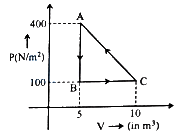 KCET 2019 Medium
 - The de-Broglie wavelength of a proton (charge \(=16 . \times 10^{-19} \mathrm{C}\), mass \(\left.=16 . \times 10^{-27} \mathrm{~kg}\right)\) accelerated through a potential difference of \(1 \mathrm{kV}\) isKCET 2007 Easy
- When a neutron is disintegrated to give a \(\beta\)-particle,KCET 2010 Easy
- Match the following types of nuclei with examples shown
\(\begin{array}{|l|l|}
\hline \text { Column-I } & \text { Column-II } \\
\hline \text { A. Isotopes } & \text { i. } \mathrm{Li}^7, \mathrm{Be}^7 \\
\hline \text { B. Isobars } & \text { ii. }{ }_8 \mathrm{O}^{18},{ }_9 \mathrm{~F}^{19} \\
\hline \text { C. Isotones } & \text { iii }{ }_1 \mathrm{H}^1,{ }_1 \mathrm{H}^2 \\
\hline
\end{array}\)KCET 2025 Easy - The figure gives the electric potential \( V \) as a function of distance through four regions on \( x- \) axis. Which of the following is true for the magnitude of the electric field \( E \) in these regions?
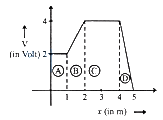 KCET 2019 Easy
More PYQs from KCET
- Read the statements given below and identify the incorrect statement.KCET 2012 Easy
- Identify the Phylum X.
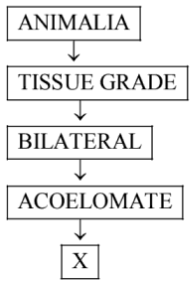 KCET 2015 Medium
 - A ceiling fan is rotating around a fixed axle as shown. The direction of angular velocity is along \(\qquad\)
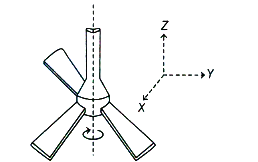 KCET 2024 Easy
 - A gas is taken from state A to state B along two different paths 1 and 2. The heat absorbed and work done by the system along these two paths are \(\mathrm{Q}_1\) and \(\mathrm{Q}_2\) and \(\mathrm{W}_1\) and \(\mathrm{W}_2\) respectively. ThenKCET 2025 Easy
- Which one of the following pairs will show positive deviation from Raoult's law?KCET 2024 Easy
- How do you differentiate a butterfly from a moth?KCET 2010 Easy