


KCET · Physics · Current Electricity
In a conducting region, \(10^{19}\) electrons and \(10^{19}\) protons move to the left, while \(10^{19}\) \(\alpha\)-particles move to the right per second. The resulting electric current is \((e = 1.6 \times 10^{-19}\text{ C})\) _________
- A \(3.2\) A towards left
- B \(3.2\) A towards right
- C \(1.6\) A towards left
- D \(1.6\) A towards right
Answer & Solution
Correct Answer
(B) \(3.2\) A towards right
Step-by-step Solution
Detailed explanation
The electric current is given by the rate of flow of positive charge. The direction of current is the direction of flow of positive charge, and opposite to the direction of flow of negative charge.
Current due to electrons moving left:
\(I_e = n_e e = 10^{19} \times 1.6 \times 10^{-19} = 1.6\) A towards right.
Current due to protons moving left:
\(I_p = n_p e = 10^{19} \times 1.6 \times 10^{-19} = 1.6\) A towards left.
Current due to \(\alpha\)-particles moving right:
\(I_{\alpha} = n_{\alpha} (2e) = 10^{19} \times 2 \times 1.6 \times 10^{-19} = 3.2\) A towards right.
Taking the rightward direction as positive, the net current is:
\(I_{net} = I_e - I_p + I_{\alpha}\)
\(I_{net} = 1.6 - 1.6 + 3.2 = 3.2\) A
The resulting electric current is \(3.2\) A towards right.
Answer: \(3.2\) A towards right
Current due to electrons moving left:
\(I_e = n_e e = 10^{19} \times 1.6 \times 10^{-19} = 1.6\) A towards right.
Current due to protons moving left:
\(I_p = n_p e = 10^{19} \times 1.6 \times 10^{-19} = 1.6\) A towards left.
Current due to \(\alpha\)-particles moving right:
\(I_{\alpha} = n_{\alpha} (2e) = 10^{19} \times 2 \times 1.6 \times 10^{-19} = 3.2\) A towards right.
Taking the rightward direction as positive, the net current is:
\(I_{net} = I_e - I_p + I_{\alpha}\)
\(I_{net} = 1.6 - 1.6 + 3.2 = 3.2\) A
The resulting electric current is \(3.2\) A towards right.
Answer: \(3.2\) A towards right
See the Complete Solution
Get step-by-step explanations for this and 2.5 Lakh+ more JEE, NEET & CET questions.
- Unlock all solutions
- Practice the full chapter
- Track accuracy across PYQs
4.8 rated on Google Play · 14,000+ reviews
More questions from Physics
- A small town with a demand of \(900\text{ kW}\) of electric power at \(220\text{ V}\) is situated \(20\text{ km}\) away from an electric power generating station. Each wire of the two-wire transmission line has a resistance per unit length of \(5 \times 10^{-4} \, \Omega\text{ m}^{-1}\). The town gets power from the line through a \(45000\text{ V}\) to \(220\text{ V}\) step-down transformer at a substation in the town. The line power loss in the form of heat is:KCET 2026 Medium
- The power of a equi-concave lens is \(-4.5 \mathrm{D}\) and is made of a material of refractive index 1.6, the radii of curvature of the lens isKCET 2022 Easy
- The charge deposited on \(4 \mu \mathrm{F}\) capacitor in the circuit is
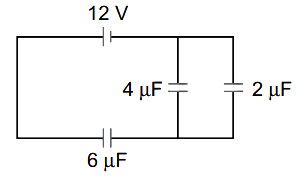 KCET 2009 Hard
 - In a series L.C.R. circuit an alternating emf (v) and current (i) are given by the equation \( v=v_{0} \sin \omega t, l=i_{0} \sin \left(\omega t+\frac{\Pi}{3}\right).\) The average power discipated in the circuit over a cycle of \( A C \) isKCET 2016 Medium
- To propagate both longitudinal and transverse waves, a material must haveKCET 2021 Easy
- Diameter of the objective of a telescope is \( 200 \mathrm{~cm} \). What is the resolving power of a telescope
\( ? \) Take wavelength of light \( =5000 \mathrm{~A} \).KCET 2014 Easy
More PYQs from KCET
- A radioactive nucleus has specific binding energy \(\mathrm{E}_{1}\). It emits an \(\alpha\)-particle. The resulting nucleus has specific binding energy \(\mathrm{E}_{2}\). ThenKCET 2012 Medium
- The difference between equivalent capacitances of two identical capacitors connected in parallel to that in series is \(6 \mu \mathrm{F}\). The value of capacitance of each capacitor isKCET 2020 Easy
- The correct statement isKCET 2015 Medium
- Eight drops of mercury of equal radii combine to form a big drop. The capacitance of a bigger drop as compared to each smaller drop isKCET 2021 Easy
- For \( \mathrm{Cr}_{2} \mathrm{O}_{7}{ }^{2-}+14 \mathrm{H}^{+}+6 e^{-} \rightarrow 2 \mathrm{Cr}^{3+}+7 \mathrm{H}_{2} \mathrm{O} ; \mathrm{E}^{\circ}=1.33 \mathrm{~V} \mathrm{At}\left[\mathrm{Cr}_{2} \mathrm{O}_{7}{ }^{2-}\right]=4.5 \)
millimole, \( \left[\mathrm{Cr}^{3+}\right]=15 \) millimole, \( \mathrm{E}^{\circ} \) is \( 1.067 \mathrm{~V} \). The \( \mathrm{pH} \) of the solution is nearly equal toKCET 2014 Medium - If \(f(x) = \begin{cases} x^2 - 1 & \text{if } x \geq 2 \\ x + 1 & \text{if } x < 2 \end{cases}\), then \(\lim\limits_{x \to 1} f(x) + \lim\limits_{x \to 2} f(x) = \)KCET 2026 Medium