


KCET · Physics · Ray Optics
An object is placed at \( 20 \mathrm{~cm} \) in front of a concave mirror produces three times magnified real
image. What is focal length of the concave mirror?
- A \( 15 \mathrm{~cm} \)
- B \( 6.6 \mathrm{~cm} \)
- C \( 10 \mathrm{~cm} \)
- D \( 7.5 \mathrm{~cm} \)
Answer & Solution
Correct Answer
(A) \( 15 \mathrm{~cm} \)
Step-by-step Solution
Detailed explanation
Given, position of object \( =u=20 \mathrm{~cm} \); image formed \( =3 \) times magnified and real
Using \( m=\frac{-v}{m} \), we get
\( 3=\frac{-v}{20} \Rightarrow v=-60 \mathrm{~cm} \)
Using mirror formula, \( \frac{1}{f}=\frac{1}{v}+\frac{1}{w} \), we get
\( \frac{1}{f}=\frac{1}{-60}+\frac{1}{-20}=\frac{-1-3}{60}=\frac{-4}{60}=\frac{-1}{15} \)
Therefore, focal length of concave mirror \( =15 \mathrm{~cm} \)
Using \( m=\frac{-v}{m} \), we get
\( 3=\frac{-v}{20} \Rightarrow v=-60 \mathrm{~cm} \)
Using mirror formula, \( \frac{1}{f}=\frac{1}{v}+\frac{1}{w} \), we get
\( \frac{1}{f}=\frac{1}{-60}+\frac{1}{-20}=\frac{-1-3}{60}=\frac{-4}{60}=\frac{-1}{15} \)
Therefore, focal length of concave mirror \( =15 \mathrm{~cm} \)
See the Complete Solution
Get step-by-step explanations for this and 2.5 Lakh+ more JEE, NEET & CET questions.
- Unlock all solutions
- Practice the full chapter
- Track accuracy across PYQs
4.8 rated on Google Play · 14,000+ reviews
More questions from Physics
- A resistor has a colour code of green, blue, brown and silver. What is its resistance?KCET 2011 Easy
- The equivalent resistance between the points \(A\) and \(B\) in the following circuit is
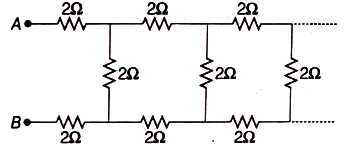 KCET 2023 Easy
 - A current of \(5 \mathrm{~A}\) is flowing at \(220 \mathrm{~V}\) in the primary coil of a transformer. If the voltage produced in the secondary coil is \(2200 \mathrm{~V}\) and \(50 \%\) of power is lost, then the current in secondary will beKCET 2008 Medium
- If the scattering intensity of a liquid is 8 units at a wavelength of \(500 \mathrm{~nm}\), then the scattering intensity at a wavelength of \(400 \mathrm{~nm}\) will be approximatelyKCET 2011 Hard
- A, B and C are the parallel sided transparent media of refractive indices \(\mathrm{n}_{1}, \mathrm{n}_{2}\) and \(\mathrm{n}_{3}\) respectively. They are arranged as shown in the figure. A ray is incident at an angle \(i\) on the surface of separation of A and B which is as shown in the figure. After the refraction into the medium \(B\), the ray grazes the surface of separation of the madia B and C. Then, \(\sin i\) equals to
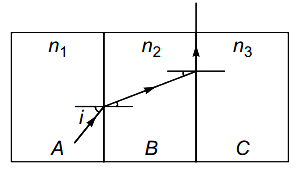 KCET 2010 Hard
 - The forbidden energy gap for Ge crystal at \(0 \mathrm{~K}\) isKCET 2022 Easy
More PYQs from KCET
- The oxidation state of \(\mathrm{Fe}\) in the brown ring complex: \(\left[\mathrm{Fe}\left(\mathrm{H}_{2} \mathrm{O}\right)_{5} \mathrm{NO}\right] \mathrm{SO}_{4}\) isKCET 2009 Easy
- An a-particle of energy \( 5 \mathrm{MeV} \) is scattered through \( 180^{\circ} \) by gold nucleus. The distance of closest approach is of the order ofKCET 2015 Easy
- \( \int_{0}^{\pi / 4} \log \left(\frac{\sin x+\cos x}{\cos x}\right) d x \)KCET 2015 Medium
- The Glycosidic linkage present in sucrose isbetweenKCET 2017 Medium
- The correct IUPAC name of
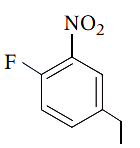 KCET 2021 Easy
 - Two tangent galvanometers \(A\) and \(B\) are identical except in their number of turns. They are connected in series. On passing a current through them, deflections of \(60^{\circ}\) and \(30^{\circ}\) are produced. The ratio of the number of turns in \(A\) and \(B\) isKCET 2008 Medium