


KCET · Physics · Atomic Physics
An electron transition takes place from excited state to ground state in hydrogen atom, then
- A Its kinetic energy increases but potential energy and total energy decrease
- B Its kinetic energy, potential energy and total energy decrease
- C Kinetic energy decreases, potential energy increases but total energy remains same
- D Kinetic energy and total energy decrease but potential energy increases
Answer & Solution
Correct Answer
(A) Its kinetic energy increases but potential energy and total energy decrease
Step-by-step Solution
Detailed explanation
The total energy of an electron in the \(n\)-th orbit of a hydrogen atom is given by \(E = -\dfrac{13.6}{n^2}\) eV.
The kinetic energy is \(K = -E = \dfrac{13.6}{n^2}\) eV.
The potential energy is \(U = 2E = -\dfrac{27.2}{n^2}\) eV.
When the electron transitions from an excited state to the ground state, the principal quantum number \(n\) decreases.
As \(n\) decreases, the value of \(\dfrac{1}{n^2}\) increases. Therefore, the kinetic energy \(K\) increases.
Since the total energy \(E\) and potential energy \(U\) are negative and their magnitudes increase, their actual values become more negative. Thus, both potential energy and total energy decrease.
Answer: Its kinetic energy increases but potential energy and total energy decrease
The kinetic energy is \(K = -E = \dfrac{13.6}{n^2}\) eV.
The potential energy is \(U = 2E = -\dfrac{27.2}{n^2}\) eV.
When the electron transitions from an excited state to the ground state, the principal quantum number \(n\) decreases.
As \(n\) decreases, the value of \(\dfrac{1}{n^2}\) increases. Therefore, the kinetic energy \(K\) increases.
Since the total energy \(E\) and potential energy \(U\) are negative and their magnitudes increase, their actual values become more negative. Thus, both potential energy and total energy decrease.
Answer: Its kinetic energy increases but potential energy and total energy decrease
See the Complete Solution
Get step-by-step explanations for this and 2.5 Lakh+ more JEE, NEET & CET questions.
- Unlock all solutions
- Practice the full chapter
- Track accuracy across PYQs
4.8 rated on Google Play · 14,000+ reviews
More questions from Physics
- A fringe width of a certain interference pattern is \( \beta=0.002 \mathrm{~cm} \). What is the distance of \( 5^{\text {th }} \) dark
fringe from center?KCET 2014 Easy - According to the quark model, it is possible to build all the hadrons usingKCET 2009 Medium
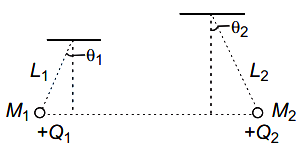
- Two small spheres of masses \(\mathrm{M}_{1}\) and \(\mathrm{M}_{2}\) are suspended by weightless insulating threads of lengths \(\mathrm{L}_{1}\) and \(\mathrm{L}_{2}\). The spheres carry charges \(Q_{1}\) and \(Q_{2}\) respectively. The spheres are suspended such that they are in level with one another and the threads are inclined to the vertical at angles of \(\theta_{1}\) and \(\theta_{2}\) as shown. Which one of the following conditions is essential, if \(\theta_{1}=\theta_{2}\) ?
 KCET 2010 Hard
 - The maximum range of a gun on horizontal plane is \(16 \mathrm{~km}\). If \(g=10 \mathrm{~ms}^{-2}\), then muzzle velocity of a shell isKCET 2021 Medium
- In thermodynamic processes, which of the following statements is not true?KCET 2026 Easy
- A piston is performing S.H.M. in the vertical direction with a frequency of \( 0.5 \mathrm{~Hz} \). A block of \( 10 \)
\( \mathrm{kg} \) is placed on the piston. The maximum amplitude of the system such that the block remains
in contact with the piston isKCET 2019 Easy
More PYQs from KCET
- A horizontal pipe carries water in a streamlined flow. At a point along the pipe, where the cross-sectional area is \(10 \mathrm{~cm}^{-2}\), the velocity of water is \(1 \mathrm{~ms}^{-1}\) and the pressure is 2000 Pa . What is the pressure of water at another point where the cross-sectional area is \(5 \mathrm{~cm}^2\) ?
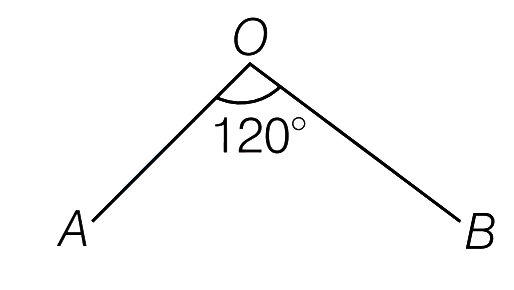
[Density of water \(=1000 \mathrm{kgm}^{-3}\) ]KCET 2025 Medium - \(O A\) and \(O B\) are two roads enclosing an angle of \(120^{\circ} . X\) and \(Y\) start from ' \(O\) ' at the same time. \(X\) travels along \(O A\) with a speed of \(4 \mathrm{~km} / \mathrm{h}\) and \(Y\) travels along \(O B\) with a speed of \(3 \mathrm{~km} / \mathrm{h}\). The rate at which the shortest distance between \(X\) and \(Y\) is increasing after \(1 \mathrm{~h}\) is
 KCET 2007 Hard
 - Match the column-I with column-II and choose the correct option from the following:
Column I (Plant groups) Column II (Examples) 1. Bryophyta p. Pinus 2 Gymnosperm q. Adiantum 3. Algae r. Sphagnum 4. Pteridophyta s. Ectocarpus KCET 2023 Hard - Match the column-I with column-II. Choose the correct option given below.
Column-I Column-II A. Streptococcus (i) Free living nitrogen fixing bacteria B. Penicillium (ii) Colt buster C. Methanogens (iii) Source of antibiotic D. Anabaena (iv) Biogas production KCET 2025 Medium - The number of protons, neutrons and electrons in the ion \({ }_{16}^{32} \mathrm{~S}^{2-}\) respectively areKCET 2023 Easy
- A square loop of side 2 m lies in the \(Y-Z\) plane in a region having a magnetic field \(\vec{B}=(5 \hat{\mathrm{i}}+3 \hat{\mathrm{j}}-4 \hat{\mathrm{k}}) \mathrm{T}\). The magnitude of magnetic flux through the square loop isKCET 2025 Easy