


KCET · Physics · Electrostatics
An electron falls through a distance \(1.5\) cm in \(2.0 \times 10^4\) N/C from rest. The time taken to cover this distance in second is ____
\((e = 1.6 \times 10^{-19}\text{ C}, m_e = 9.11 \times 10^{-31}\text{ kg})\)
- A \(2.9 \times 10^{-9}\)
- B \(2.9 \times 10^{9}\)
- C \(4 \times 10^{-6}\)
- D \(4 \times 10^{6}\)
Answer & Solution
Correct Answer
(A) \(2.9 \times 10^{-9}\)
Step-by-step Solution
Detailed explanation
Force on the electron is \(F = eE\)
Acceleration of the electron is \(a = \dfrac{eE}{m_e}\)
Using the equation of motion \(s = ut + \dfrac{1}{2}at^2\)
Since the electron starts from rest, \(u = 0\)
\(s = \dfrac{1}{2} \left( \dfrac{eE}{m_e} \right) t^2\)
\(t = \sqrt{\dfrac{2sm_e}{eE}}\)
Substituting the given values:
\(t = \sqrt{\dfrac{2 \times 1.5 \times 10^{-2} \times 9.11 \times 10^{-31}}{1.6 \times 10^{-19} \times 2.0 \times 10^4}}\)
\(t = \sqrt{\dfrac{27.33 \times 10^{-33}}{3.2 \times 10^{-15}}}\)
\(t = \sqrt{8.54 \times 10^{-18}}\)
\(t \approx 2.9 \times 10^{-9} \text{ s}\)
Answer: \(2.9 \times 10^{-9}\)
Acceleration of the electron is \(a = \dfrac{eE}{m_e}\)
Using the equation of motion \(s = ut + \dfrac{1}{2}at^2\)
Since the electron starts from rest, \(u = 0\)
\(s = \dfrac{1}{2} \left( \dfrac{eE}{m_e} \right) t^2\)
\(t = \sqrt{\dfrac{2sm_e}{eE}}\)
Substituting the given values:
\(t = \sqrt{\dfrac{2 \times 1.5 \times 10^{-2} \times 9.11 \times 10^{-31}}{1.6 \times 10^{-19} \times 2.0 \times 10^4}}\)
\(t = \sqrt{\dfrac{27.33 \times 10^{-33}}{3.2 \times 10^{-15}}}\)
\(t = \sqrt{8.54 \times 10^{-18}}\)
\(t \approx 2.9 \times 10^{-9} \text{ s}\)
Answer: \(2.9 \times 10^{-9}\)
See the Complete Solution
Get step-by-step explanations for this and 2.5 Lakh+ more JEE, NEET & CET questions.
- Unlock all solutions
- Practice the full chapter
- Track accuracy across PYQs
4.8 rated on Google Play · 14,000+ reviews
More questions from Physics
- Two equal and opposite charges of masses \( \mathrm{m}_{1} \) and \( \mathrm{m}_{2} \) are accelerated in an uniform electric field through the same distance. What is the ratio of their accelerations if their mi ratio of masses is \( \frac{\mathrm{m}_{1}}{\mathrm{~m}_{2}}=0.5 \) ?KCET 2014 Medium
- The maximum kinetic energy of the photo-electrons depends only onKCET 2014 Easy
- An electric bulb has a rated power of \(50 \mathrm{~W}\) at \(100 \mathrm{~V}\). If it is used on an AC source \(200 \mathrm{~V}, 50\) \(\mathrm{Hz}\), a choke has to be used in series with it. This choke should have an inductance ofKCET 2007 Medium
- In the situation shown in the diagram, magnitude, if \(q<<|Q|\) and \(r \gg a\). The net force on the free charge \(-q\) and net torque on it about \(O\) at the instant shown are respectively. ( \(p=2 a Q\) is the dipole moment)
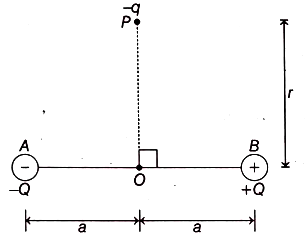 KCET 2023 Medium
 - In Young's double slit experiment, a third slit is made in between the double slits. ThenKCET 2008 Medium
- A cylindrical container containing water has a small hole at height of \( \mathrm{H}=8 \mathrm{~cm} \) from the bottom and at a depth of \( 2 \mathrm{~cm} \) from the top surface of the liquid. The maximum horizontal distance travelled by the water before it hits the ground \( (x) \) is
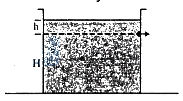 KCET 2019 Medium
More PYQs from KCET
- The mean and standard deviation of \(100\) items are \(50\) and \(4\), respectively then the sum of all squares of the items isKCET 2026 Easy
- A Point object is moving uniformly towards the pole of a concave mirror of focal length \( 25 \mathrm{~cm} \)
along its axis as shown below. The speed of the object is \( 1 \mathrm{~ms}^{-1} \). At \( \mathrm{t}=0 \), the distance of the
object from the mirror is \( 50 \mathrm{~cm} \). The average velocity of theimage formed by the mirror
between time \( t=0 \) and \( t=0.25 \mathrm{~s} \) is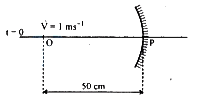 KCET 2019 Easy
 - In the Bohr model of hydrogen atom, the electron is pictured to rotate in a circular orbit of radius \(5 \times 10^{-11} \mathrm{~m}\), at a speed \(2.2 \times 10^{6} \mathrm{~m} / \mathrm{s}\). What is the current associated with electron motion?KCET 2008 Medium
- If
\(y=\tan ^{-1}\left(\frac{1}{1+x+x^{2}}\right)+\tan ^{-1}\left(\frac{1}{x^{2}+2 x+3}\right)\)
\(+\tan ^{-1}\left(\frac{1}{x^{2}+5 x+7}\right)+\ldots+n\) terms, then \(y^{\prime}(0)\) isKCET 2012 Hard - According to Cartesian sign convention, in ray opticsKCET 2017 Easy
- Which of the following semi-conducting devices is used as voltage regulator?KCET 2017 Medium