


KCET · Physics · Magnetic Properties of Matter
An aircraft with a wingspan of \( 40 \mathrm{~m} \) flies with a speed of \( 1080 \mathrm{~km} \mathrm{~h}^{-1} \) in the eastward
direction at a constant altitude in the northern hemisphere, where the vertical component of the
earth's magnetic field \( 1.75 \times 10^{-5} \mathrm{~T} \). Then the emf developed between the tips of the wings is
- A \( 0.5 \mathrm{~V} \)
- B \( 0.34 \mathrm{~V} \)
- C \( 0.21 \mathrm{~V} \)
- D \( 2.1 \mathrm{~V} \)
Answer & Solution
Correct Answer
(C) \( 0.21 \mathrm{~V} \)
Step-by-step Solution
Detailed explanation
Given, length of wing, \(l=40 \mathrm{~m}\); speed, \(v=1080 \mathrm{kmh}^{-1}\)
\(=1080 \times \frac{5}{18} \mathrm{~ms}^{-1}\)
Earth's magnetic field,\(B=1.75 \times 10^{-5} \mathrm{~T}\)
Then emf
\(E=B l v=\left(1.75 \times 10^{-5}\right) \times 40 \times 1080 \times \frac{5}{18}\)
\(=21000 \times 10^{-5}=0.21 \mathrm{~V}\)
Therefore, the emf developed between the tips of the wing is \(0.21 \mathrm{~V}\)
\(=1080 \times \frac{5}{18} \mathrm{~ms}^{-1}\)
Earth's magnetic field,\(B=1.75 \times 10^{-5} \mathrm{~T}\)
Then emf
\(E=B l v=\left(1.75 \times 10^{-5}\right) \times 40 \times 1080 \times \frac{5}{18}\)
\(=21000 \times 10^{-5}=0.21 \mathrm{~V}\)
Therefore, the emf developed between the tips of the wing is \(0.21 \mathrm{~V}\)
See the Complete Solution
Get step-by-step explanations for this and 2.5 Lakh+ more JEE, NEET & CET questions.
- Unlock all solutions
- Practice the full chapter
- Track accuracy across PYQs
4.8 rated on Google Play · 14,000+ reviews
More questions from Physics
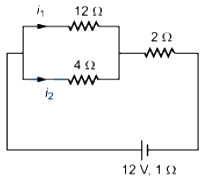
- In the circuit shown, the currents \(i_{1}\) and \(i_{2}\) are
 KCET 2011 Easy
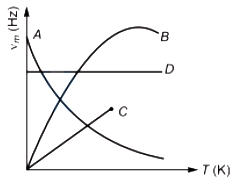
 - Which one of the following is \(v_{m}-T\) graph for perfectly black body? \(v_{m}\) is the frequency of radiation with maximum intensity. \(T\) is the absolute temperature.
 KCET 2011 Medium
 - How many \(6 \mu \mathrm{F}, 200 \mathrm{~V}\) condensers are needed to make a condenser of \(18 \mu \mathrm{F}, 600 \mathrm{~V}\) ?KCET 2008 Medium
- The efficiency of Carnot's heat engine is \(0.5\) when the temperature of the source is \(\mathrm{T}_{1}\) and that of \(\operatorname{sink}\) is \(\mathrm{T}_{2}\). The efficiency of another Carnot's heat engine is also 0.5. The temperatures of source and sink of the second engine are respectivelyKCET 2010 Medium
- A truck accelerates from speed \(v\) to \(2 v\). Work done in during this isKCET 2013 Medium
- A proton and an alpha-particle moving with the same velocity enter a uniform magnetic field with their velocities perpendicular to the magnetic field. The ratio of radii of their circular paths isKCET 2023 Easy
More PYQs from KCET
- The sum of the first \(n\) terms of \(\frac{1^{2}}{1}+\frac{1^{2}+2^{2}}{1+2}+\frac{1^{2}+2^{2}+3^{2}}{1+2+3}+\ldots\) isKCET 2011 Easy
- Gram molecular volume of oxygen at STP isKCET 2007 Medium
- A ray of light is incident on a surface of glass slab at an angle \(45^{\circ}\). If the lateral shift produced per unit thickness is \(\frac{1}{\sqrt{3}} \mathrm{~m}\), the angle of refraction produced isKCET 2009 Hard
- If voltage across a bulb rated \(220 \mathrm{~V}, 100 \mathrm{~W}\) drops by \(2.5 \%\) of its rated value, then the percentage of the rated value by which the power would decrease isKCET 2022 Hard
- 'Young's modulus' is defined as the ratio ofKCET 2017 Medium
- The respiratory quotient during cellular respiration would depend onKCET 2009 Medium