


KCET · Physics · Work Power Energy
A tray of mass \(12 \mathrm{~kg}\) is supported by two identical springs as shown in figure. When the tray is pressed down slightly and then released, it executes SHM with a time period of \(1.5 \mathrm{~s}\). The spring constant of each spring is
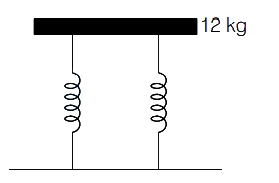
- A \(50 \mathrm{Nm}^{-1}\)
- B 0
- C \(105 \mathrm{Nm}^{-1}\)
- D \(\infty\)
Answer & Solution
Correct Answer
(C) \(105 \mathrm{Nm}^{-1}\)
Step-by-step Solution
Detailed explanation
Mass of tray, \(m=12 \mathrm{~kg}\)
Time period, \(T=1.5 \mathrm{~s}\)
If \(k\) be the spring constant of each spring, then
\(k_{1}=k_{2}=k\)
Since, springs are connected in parallel, hence
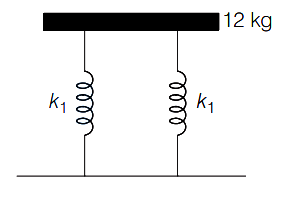
\(k_{\text {net }}=k+k \)
\( \text {Time period, } T=2 \pi \sqrt{\frac{m}{k_{\text {net }}}}=2 \pi \sqrt{\frac{m}{k_{1}+k_{2}}} \)
\( \Rightarrow 1.5=2 \pi \sqrt{\frac{12}{k+k}} \Rightarrow 1.5=2 \pi \sqrt{\frac{12}{2 k}} \)
\( \Rightarrow 1.5=2 \pi \sqrt{\frac{6}{k}}\)
Squaring both side, we have
\(2.25 =4 \pi^{2} \cdot \frac{6}{k} \)
\( \Rightarrow k =\frac{4 \pi^{2} \times 6}{2.25} \)
\( =105.17 \mathrm{Nm}^{-1} \simeq 105 \mathrm{Nm}^{-1}\)
Time period, \(T=1.5 \mathrm{~s}\)
If \(k\) be the spring constant of each spring, then
\(k_{1}=k_{2}=k\)
Since, springs are connected in parallel, hence
\(k_{\text {net }}=k+k \)
\( \text {Time period, } T=2 \pi \sqrt{\frac{m}{k_{\text {net }}}}=2 \pi \sqrt{\frac{m}{k_{1}+k_{2}}} \)
\( \Rightarrow 1.5=2 \pi \sqrt{\frac{12}{k+k}} \Rightarrow 1.5=2 \pi \sqrt{\frac{12}{2 k}} \)
\( \Rightarrow 1.5=2 \pi \sqrt{\frac{6}{k}}\)
Squaring both side, we have
\(2.25 =4 \pi^{2} \cdot \frac{6}{k} \)
\( \Rightarrow k =\frac{4 \pi^{2} \times 6}{2.25} \)
\( =105.17 \mathrm{Nm}^{-1} \simeq 105 \mathrm{Nm}^{-1}\)
See the Complete Solution
Get step-by-step explanations for this and 2.5 Lakh+ more JEE, NEET & CET questions.
- Unlock all solutions
- Practice the full chapter
- Track accuracy across PYQs
4.8 rated on Google Play · 14,000+ reviews
More questions from Physics
- If the mass of a body is \( M \) on the surface of the earth, the mass of the same body on the
surface of the moon isKCET 2015 Medium - The following figure shows a beam of light converging at point \(P\). When a concave lens of focal length \(16 \mathrm{~cm}\) is introduced in the path of the beam at a place shown by dotted line such that \(O P\) becomes the axis of the lens, the beam converges at a distance \(x\) from the lens. The value of \(x\) will be equal to
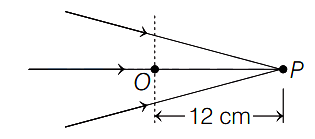 KCET 2020 Easy
 - E is the electric field inside a conductor whose material has conductivity \(\sigma\) and resistivity \(\rho\). The current density inside the conductor is \(\mathbf{J}\). The correct form of Ohm's law isKCET 2024 Easy
- The maximum range of a gun on horizontal plane is \(16 \mathrm{~km}\). If \(g=10 \mathrm{~ms}^{-2}\), then muzzle velocity of a shell isKCET 2021 Medium
- Two slabs are of the thicknesses \(d_{1}\) and \(d_{2}\). Their thermal conductivities are \(\mathrm{K}_{1}\) and \(\mathrm{K}_{2}\) respectively. They are in series. The free ends of the combination of these two slabs are kept at temperatures \(\theta_{1}\) and \(\theta_{2}\). Assume \(\theta_{1}>\theta_{2}\). The temperature \(\theta\) of their common junction isKCET 2010 Hard
- In an experiment to determine the temperature coefficient of resistance of a conductor, a coil of wire \(X\) is immersed in a liquid. It is heated by an external agent. A meter bridge set up is used to determine resistance of the coil \(X\) at different temperatures. The balancing points measured at temperatures \(t_1=0^{\circ} \mathrm{C}\) and \(t_2=100^{\circ} \mathrm{C}\) are 50 cm and 60 cm respectively. If the standard resistance taken out is \(S=4 \Omega\) in both trials, the temperature coefficient of the coil is
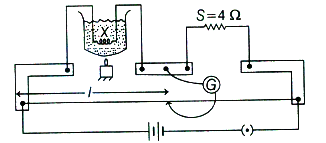 KCET 2024 Hard
More PYQs from KCET
- If \(\alpha\) and \(\beta\) are the roots of \(x^{2}+x+1=0\), then \(\alpha^{16}+\beta^{16}\) is equal toKCET 2009 Easy
- The maximum number of possible optical isomers in 1-bromo-2-methyl cyclobutane isKCET 2011 Hard
- If \(y=2 x^{3 x}\), then \(d y / d x\) at \(x=1\) isKCET 2024 Medium
- In a conducting region, \(10^{19}\) electrons and \(10^{19}\) protons move to the left, while \(10^{19}\) \(\alpha\)-particles move to the right per second. The resulting electric current is \((e = 1.6 \times 10^{-19}\text{ C})\) _________KCET 2026 Medium
- \( \mathrm{H}_{2} \mathrm{O}_{2} \) isKCET 2018 Medium
- The length of perpendicular drawn from the point \((3,-1,11)\) to the line \(\frac{x}{2}=\frac{y-2}{3}=\frac{z-3}{4}\) isKCET 2023 Easy