


KCET · Physics · Ray Optics
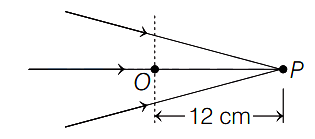
The following figure shows a beam of light converging at point \(P\). When a concave lens of focal length \(16 \mathrm{~cm}\) is introduced in the path of the beam at a place shown by dotted line such that \(O P\) becomes the axis of the lens, the beam converges at a distance \(x\) from the lens. The value of \(x\) will be equal to
- A \(12 \mathrm{~cm}\)
- B \(24 \mathrm{~cm}\)
- C \(36 \mathrm{~cm}\)
- D \(48 \mathrm{~cm}\)
Answer & Solution
Correct Answer
(D) \(48 \mathrm{~cm}\)
Step-by-step Solution
Detailed explanation
As the beam of light is converging at point \(P\), so it will act as a virtual object for concave lens.
\(\therefore\) Objective distance, \(u=12 \mathrm{~cm}\)
Focal length of concave lens, \(f=-16 \mathrm{~cm}\)
Using lens formula,
\(\frac{1}{v}-\frac{1}{u}=\frac{1}{f}\)
\(\begin{array}{ll}\Rightarrow & \frac{1}{v}=\frac{1}{f}+\frac{1}{u}=-\frac{1}{16}+\frac{1}{12}=\frac{-3+4}{48}=\frac{1}{48} \\ \text { or } & v=48 \mathrm{~cm} \\ \text { Given, } & v=x \mathrm{~cm} \\ \therefore & x=48 \mathrm{~cm}\end{array}\)
\(\therefore\) Objective distance, \(u=12 \mathrm{~cm}\)
Focal length of concave lens, \(f=-16 \mathrm{~cm}\)
Using lens formula,
\(\frac{1}{v}-\frac{1}{u}=\frac{1}{f}\)
\(\begin{array}{ll}\Rightarrow & \frac{1}{v}=\frac{1}{f}+\frac{1}{u}=-\frac{1}{16}+\frac{1}{12}=\frac{-3+4}{48}=\frac{1}{48} \\ \text { or } & v=48 \mathrm{~cm} \\ \text { Given, } & v=x \mathrm{~cm} \\ \therefore & x=48 \mathrm{~cm}\end{array}\)
See the Complete Solution
Get step-by-step explanations for this and 2.5 Lakh+ more JEE, NEET & CET questions.
- Unlock all solutions
- Practice the full chapter
- Track accuracy across PYQs
4.8 rated on Google Play · 14,000+ reviews
More questions from Physics
- The ratio of magnetic field at the centre of a current carrying circular coil to its magnetic moment is \(x\), if the current and the radius both are doubled. The new ratio will becomeKCET 2020 Easy
- A solenoid has length \( 0.4 \mathrm{~cm} \), radius \( 1 \mathrm{~cm} \) and \( 400 \) turns of wire. If a current of \( 5 \mathrm{~A} \) is passed through this solenoid, what is the magnetic field inside the solenoid?KCET 2014 Easy
- A pan filled with hot food cools from \( 94^{\circ} \mathrm{C} \) to \( 86^{\circ} \mathrm{C} \) in \( 2 \) minutes. When the room
temperature'is \( 20^{\circ} \mathrm{C} \). How long will it cool from \( 74^{\circ} \mathrm{C} \) to \( 66{ }^{\circ} \mathrm{C} \) ?KCET 2016 Medium - A radioactive nucleus has specific binding energy \(\mathrm{E}_{1}\). It emits an \(\alpha\)-particle. The resulting nucleus has specific binding energy \(\mathrm{E}_{2}\). ThenKCET 2012 Medium
- If \( \vec{A}=2 \hat{i}+3 \hat{j}+8 \hat{k} \) is perpendicular to \( \vec{B}=4 \hat{j}-4 \hat{i}+\alpha \hat{k} \), then the value of ' \( \alpha \) ' isKCET 2017 Easy
- A current of \(5 \mathrm{~A}\) is passing through a metallic wire of cross-sectional area \(4 \times 10^{-6} \mathrm{~m}^{2}\) If the density of charge carriers of the wire is \(5 \times 10^{26} \mathrm{~m}^{-3}\) the drift velocity of the electronswill beKCET 2007 Easy
More PYQs from KCET
- Which of the following electrolytic solutions has the least specific conductance?KCET 2008 Easy
- \(+I\) effect is shown byKCET 2007 Easy
- Which of the following types of RNA carries amino acids towards ribosome during translation?KCET 2020 Hard
- Which of the following monomers can undergo condensation polymerisation?KCET 2020 Easy
- The value of \(\int \frac{d x}{(x+1)(x+2)}\) isKCET 2025 Easy
- If \(A, B, C\) are three mutually exclusive and exhaustive events of an experiment such that \(P(A)=2 P(B)=3 P(C)\), then \(P(B)\) is equal toKCET 2020 Easy