


KCET · Maths · Differentiation
If \(e^y+x y=e\) the ordered pair \(\left(\frac{d y}{d x}, \frac{d^2 y}{d x^2}\right)\) at \(x=0\) is equal to
- A \(\left(\frac{1}{e}, \frac{1}{e^2}\right)\)
- B \(\left(\frac{-1}{e}, \frac{-1}{e^2}\right)\)
- C \(\left(\frac{1}{e}, \frac{-1}{e^2}\right)\)
- D \(\left(\frac{-1}{e}, \frac{1}{e^2}\right)\)
Answer & Solution
Correct Answer
(D) \(\left(\frac{-1}{e}, \frac{1}{e^2}\right)\)
Step-by-step Solution
Detailed explanation
Given, \(c^{\prime}+x y=c\)
Differentiating w.r.t. \(x\), we get
\[
\begin{aligned}
& e^y \frac{d y}{d x}+x \frac{d y}{d x}+1 \cdot y=0 \\
\Rightarrow \quad & \frac{d y}{d x}=\frac{-y}{\left(e^y+x\right)}
\end{aligned}
\]
Again, differentiating Eq. (ii) w.r.t. \(x\), we get
\[
\begin{aligned}
& e^y \frac{d^2 y}{d x^2}+e^v\left(\frac{d y}{d x}\right)^2+x \frac{d^2 y}{d x^2}+\frac{d y}{d x}+\frac{d y}{d x}=0 \\
\Rightarrow \quad & \left(e^y+x\right) \frac{d^2 y}{d x^2}+e^y\left(\frac{d y}{d x}\right)^2+2 \frac{d y}{d x}=0
\end{aligned}
\]
Now, on putting \(x=0\) in Eq. (i), we get
\[
e^y+0 \cdot y=e \Rightarrow e^y=e^1 \Rightarrow y=1
\]
On putting \(x=0, y=1\) in Eq. (iii), we get
\[
\frac{d y}{d x}=\frac{-1}{e+0}=-\frac{1}{e}
\]
Now, putting \(x=0, y=1\) and \(\frac{d y}{d x}=\frac{-1}{e}\) in
Eq. (iv), we get
\[
\begin{aligned}
& \left(e^1+0\right) \frac{d^2 y}{d x^2}+e^{\prime}\left(-\frac{1}{e}\right)^2+2\left(-\frac{1}{e}\right)=0 \\
\Rightarrow \quad & e \frac{d^2 y}{d x^2}+\frac{1}{e}-\frac{2}{e}=0 \Rightarrow \frac{d^2 y}{d x^2}=\frac{1}{e^2}
\end{aligned}
\]
Hence, \(\left(\frac{d y}{d x}, \frac{d^2 y}{d x^2}\right)\) at \(x=0\) is \(\left(-\frac{1}{e}, \frac{1}{e^2}\right)\).
Differentiating w.r.t. \(x\), we get
\[
\begin{aligned}
& e^y \frac{d y}{d x}+x \frac{d y}{d x}+1 \cdot y=0 \\
\Rightarrow \quad & \frac{d y}{d x}=\frac{-y}{\left(e^y+x\right)}
\end{aligned}
\]
Again, differentiating Eq. (ii) w.r.t. \(x\), we get
\[
\begin{aligned}
& e^y \frac{d^2 y}{d x^2}+e^v\left(\frac{d y}{d x}\right)^2+x \frac{d^2 y}{d x^2}+\frac{d y}{d x}+\frac{d y}{d x}=0 \\
\Rightarrow \quad & \left(e^y+x\right) \frac{d^2 y}{d x^2}+e^y\left(\frac{d y}{d x}\right)^2+2 \frac{d y}{d x}=0
\end{aligned}
\]
Now, on putting \(x=0\) in Eq. (i), we get
\[
e^y+0 \cdot y=e \Rightarrow e^y=e^1 \Rightarrow y=1
\]
On putting \(x=0, y=1\) in Eq. (iii), we get
\[
\frac{d y}{d x}=\frac{-1}{e+0}=-\frac{1}{e}
\]
Now, putting \(x=0, y=1\) and \(\frac{d y}{d x}=\frac{-1}{e}\) in
Eq. (iv), we get
\[
\begin{aligned}
& \left(e^1+0\right) \frac{d^2 y}{d x^2}+e^{\prime}\left(-\frac{1}{e}\right)^2+2\left(-\frac{1}{e}\right)=0 \\
\Rightarrow \quad & e \frac{d^2 y}{d x^2}+\frac{1}{e}-\frac{2}{e}=0 \Rightarrow \frac{d^2 y}{d x^2}=\frac{1}{e^2}
\end{aligned}
\]
Hence, \(\left(\frac{d y}{d x}, \frac{d^2 y}{d x^2}\right)\) at \(x=0\) is \(\left(-\frac{1}{e}, \frac{1}{e^2}\right)\).
See the Complete Solution
Get step-by-step explanations for this and 2.5 Lakh+ more JEE, NEET & CET questions.
- Unlock all solutions
- Practice the full chapter
- Track accuracy across PYQs
4.8 rated on Google Play · 14,000+ reviews
More questions from Maths
- The general solution of the differential equation \( \frac{d y}{d x}+\frac{y}{x}=3 x \) isKCET 2014 Easy
- If \(\sin 3 \theta=\sin \theta\), how many solutions exist such that \(-2 \pi < \theta < 2 \pi\) ?KCET 2007 Medium
- If \( \alpha \leq 2 \sin ^{-1} x+\cos ^{-1} x \leq \beta \), thenKCET 2015 Easy
- Which of the following is false ?KCET 2008 Medium
- The value of \( \sqrt{24.99} \) isKCET 2019 Medium
- Mean and standard deviation of \( 100 \) items are \( 50 \) and \( 4 \) respectively. The sum of all squares of
the items isKCET 2019 Medium
More PYQs from KCET
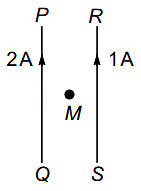
- \(\mathrm{PQ}\) and RS are long parallel conductors separated by certain distance. \(M\) is the midpoint between them (see the figure). The net magnetic field at \(M\) is B. Now, the current 2 A is switched off. The field at \(M\) now becomes
 KCET 2010 Medium
 - The offspring produced from a marriage have only O or A blood groups. Of the genotypes given below, the possible genotypes of the parents would beKCET 2009 Hard
- If \(I_{n}=\int_{0}^{\frac{\pi}{4}} \tan ^{n} x d x\), where \(n\) is positive integer, then \(I_{10}+I_{8}\) is equal toKCET 2021 Hard
- A \(20 \mathrm{~cm}\) length of a certain solution causes right handed rotation of \(38^{\circ}\). A \(30 \mathrm{~cm}\) length of another solution causes left handed rotation of \(24^{\circ}\). The optical rotation caused by \(30 \mathrm{~cm}\) length of a mixture of the above solutions in the volume ratio \(1: 2\) isKCET 2007 Hard
- \( \int \frac{\sin 2 x}{\left(\sin ^{2} x+2 \cos ^{2} x\right.} d x= \)KCET 2014 Medium
- A wire of resistance \(R\) is connected across a cell of emf \((\varepsilon)\) and internal resistance \((r)\). The current through the circuit is \(I\). In time \(t\), the work done by the battery to establish the current \(I\) isKCET 2023 Easy