


KCET · Physics · Waves and Sound
A closed organ pipe and an open organ pipe of same length produce 2 beats/second while vibrating in their fundamental modes. The length of the open organ pipe is halved and that of closed pipe is doubled. Then the number of beats produced per second while vibrating in the fundamental mode is
- A 2
- B 6
- C 8
- D 7
Answer & Solution
Correct Answer
(D) 7
Step-by-step Solution
Detailed explanation
Given, \(\quad \mathrm{f}_{\mathrm{o}}-\mathrm{f}_{\mathrm{c}}=2 \quad \text{...(i)}\)
Frequency of fundamental mode for a closed Frequency of fundar organ pipe, \(f_{c}=\frac{v}{4 L_{c}}\)
Similarly frequency of fundamental mode for an open organ pipe, \(\mathrm{f}_{\mathrm{o}}=\frac{\mathrm{V}}{2 \mathrm{~L}_{\mathrm{o}}}\)
Given \(\quad \mathrm{L}_{\mathrm{c}}=\mathrm{L}_{\mathrm{o}}\)
\(\Rightarrow\) \(f_{0}=2 f_{c} \quad \text{...(ii)}\)
From Eqs. (i) and (ii), we get
\(\mathrm{f}_{\mathrm{o}}=2 \mathrm{f}_{\mathrm{c}}\) \(\mathrm{f}_{\mathrm{o}}=4 \mathrm{~Hz}\) and \(\mathrm{f}_{\mathrm{c}}=2 \mathrm{~Hz}\)
When the length of the open pipe is halved, frequency of fundamental mode is \( \mathrm{f}_{\mathrm{o}}^{\prime}=\frac{\mathrm{v}}{2\left[\frac{\mathrm{L}_{\mathrm{o}}}{2}\right]}=2 \mathrm{f}_{\mathrm{o}}=2 \times 4 \mathrm{~Hz}=8 \mathrm{~Hz} \)
When the length of the closed pipe is doubled, its frequency of fundamental mode is
\(\mathrm{f}_{\mathrm{o}}^{\prime}=\frac{\mathrm{v}}{4\left(2 \mathrm{~L}_{\mathrm{c}}\right)}=\frac{1}{2} \mathrm{f}_{\mathrm{c}}=\frac{1}{2} \times 2=1 \mathrm{~Hz}\)
Hence, number of beats produced per second is
\(\mathrm{f}_{\mathrm{o}}^{\prime}-\mathrm{f}_{\mathrm{c}}^{\prime}=8-1=7\)
Frequency of fundamental mode for a closed Frequency of fundar organ pipe, \(f_{c}=\frac{v}{4 L_{c}}\)
Similarly frequency of fundamental mode for an open organ pipe, \(\mathrm{f}_{\mathrm{o}}=\frac{\mathrm{V}}{2 \mathrm{~L}_{\mathrm{o}}}\)
Given \(\quad \mathrm{L}_{\mathrm{c}}=\mathrm{L}_{\mathrm{o}}\)
\(\Rightarrow\) \(f_{0}=2 f_{c} \quad \text{...(ii)}\)
From Eqs. (i) and (ii), we get
\(\mathrm{f}_{\mathrm{o}}=2 \mathrm{f}_{\mathrm{c}}\) \(\mathrm{f}_{\mathrm{o}}=4 \mathrm{~Hz}\) and \(\mathrm{f}_{\mathrm{c}}=2 \mathrm{~Hz}\)
When the length of the open pipe is halved, frequency of fundamental mode is \( \mathrm{f}_{\mathrm{o}}^{\prime}=\frac{\mathrm{v}}{2\left[\frac{\mathrm{L}_{\mathrm{o}}}{2}\right]}=2 \mathrm{f}_{\mathrm{o}}=2 \times 4 \mathrm{~Hz}=8 \mathrm{~Hz} \)
When the length of the closed pipe is doubled, its frequency of fundamental mode is
\(\mathrm{f}_{\mathrm{o}}^{\prime}=\frac{\mathrm{v}}{4\left(2 \mathrm{~L}_{\mathrm{c}}\right)}=\frac{1}{2} \mathrm{f}_{\mathrm{c}}=\frac{1}{2} \times 2=1 \mathrm{~Hz}\)
Hence, number of beats produced per second is
\(\mathrm{f}_{\mathrm{o}}^{\prime}-\mathrm{f}_{\mathrm{c}}^{\prime}=8-1=7\)
See the Complete Solution
Get step-by-step explanations for this and 2.5 Lakh+ more JEE, NEET & CET questions.
- Unlock all solutions
- Practice the full chapter
- Track accuracy across PYQs
4.8 rated on Google Play · 14,000+ reviews
More questions from Physics
- The frequency of the second overtone of the open pipe is equal to the frequency of the first overtone of the closed pipe. The ratio of the lengths of the open pipe and the closed pipe isKCET 2013 Easy
- Hydrogen atom does not emit -rays becauseKCET 2008 Medium
- A small conducting sphere of radius is lying concentrically inside a bigger hollow conducting sphere of radius The bigger and smaller spheres are charged with and \((Q>q)\) and are insulated from each other. The potential difference between the spheres will beKCET 2008 Hard
- Two particles which are initially at rest move towards each other under the action of their
mutual attraction. If their speeds are \( v \) and \( 2 v \) at any instant, then the speed of center of mass
of the system is,KCET 2019 Easy - In anomalous expansion of water, at what temperature, the density of water is maximum ?KCET 2014 Medium
- The volume of a nucleus is directly proportional toKCET 2007 Easy
More PYQs from KCET
- The voltage \(V\) and current \(I\) graph for a conductor at two different temperatures \(T_{1}\) and \(T_{2}\) and shown in the figure. The relation between \(T_{1}\) and \(T_{2}\) is
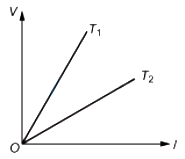 KCET 2011 Easy
 - Temperature coefficient of a reaction is 2 . When temperature is increased from \(30^{\circ} \mathrm{C}\) to \(90^{\circ} \mathrm{C}\), the rate of reaction is increased byKCET 2013 Hard
- Chloroacetic acid is a stronger acid than acetic acid. This can be explained usingKCET 2010 Easy
- A parallel plate capacitor is charged and then isolated. The effect of increasing the plate separation on charge, potential and capacitance respectively areKCET 2015 Easy
- If \(\hat{\mathbf{i}}, \hat{\mathbf{j}}, \hat{\mathbf{k}}\) are unit vectors along the positive direction of \(\mathrm{x}, \mathrm{y}\) and \(\mathrm{z}\)-axes, then a false statement in the following isKCET 2010 Medium
- The IUPAC name for
 KCET 2022 Easy