


KCET · Physics · Work Power Energy
A ball of mass \(0.2 \mathrm{~kg}\) is thrown vertically down from a height of \(10 \mathrm{~m}\). It collides with the floor and loses \(50 \%\) of its energy and then rises back to the same height. The value of its initial velocity is
- A Zero
- B \(14 \mathrm{~ms}^{-1}\)
- C \(196 \mathrm{~ms}^{-1}\)
- D \(20 \mathrm{~ms}^{-1}\)
Answer & Solution
Correct Answer
(B) \(14 \mathrm{~ms}^{-1}\)
Step-by-step Solution
Detailed explanation
Given, mass of the ball, \(m=0.2 \mathrm{~kg}\)
Height from the surface of floor, \(h=10 \mathrm{~m}\)
Let initial velocity be \(u\).
Total energy as initial point \(\mathrm{TE}=\frac{1}{2} m v^2+m g h\)
After collision, remaining energy
\(=\frac{\frac{1}{2} m u^2+m g h}{2}\)
With this remaining energy the ball bounces upto height \(h\)
Therefore, \(\frac{\frac{1}{2} m u^2+m g h}{2}=m g h\)
\(\begin{aligned} & \Rightarrow \frac{1}{2} m u^2+m g h=2 m g h \\ & \Rightarrow \begin{aligned} u^2 & =\sqrt{2 g h} \\ & =\sqrt{2 \times 10 \times 10}=14 \mathrm{~m} / \mathrm{s}\end{aligned}\end{aligned}\)
Height from the surface of floor, \(h=10 \mathrm{~m}\)
Let initial velocity be \(u\).
Total energy as initial point \(\mathrm{TE}=\frac{1}{2} m v^2+m g h\)
After collision, remaining energy
\(=\frac{\frac{1}{2} m u^2+m g h}{2}\)
With this remaining energy the ball bounces upto height \(h\)
Therefore, \(\frac{\frac{1}{2} m u^2+m g h}{2}=m g h\)
\(\begin{aligned} & \Rightarrow \frac{1}{2} m u^2+m g h=2 m g h \\ & \Rightarrow \begin{aligned} u^2 & =\sqrt{2 g h} \\ & =\sqrt{2 \times 10 \times 10}=14 \mathrm{~m} / \mathrm{s}\end{aligned}\end{aligned}\)
See the Complete Solution
Get step-by-step explanations for this and 2.5 Lakh+ more JEE, NEET & CET questions.
- Unlock all solutions
- Practice the full chapter
- Track accuracy across PYQs
4.8 rated on Google Play · 14,000+ reviews
More questions from Physics
- A particle of specific charge \(q / m=\pi \mathrm{C} \mathrm{kg}^{-1}\) is projected the origin towards positive \(X\)-axis with the velocity \(10 \mathrm{~ms}^{-1}\) in a uniform magnetic field \(\mathbf{B}=-2 \hat{\mathbf{k}}\) T. The velocity \(\mathbf{v}\) of particle after time \(t=\frac{1}{12} \mathrm{~s}\) will be (in \(\mathrm{ms}^{-1}\) )KCET 2024 Hard
- If \(\gamma\) is the ratio of specific heats and \(R\) is the universal gas constant, then the molar specific heat at constant volume \(\mathrm{C}_{\mathrm{V}}\) is given byKCET 2008 Easy
- At certain place, the horizontal component of earth's magnetic field is \( 3.0 \mathrm{G} \) and the angle dip
at that place is \( 30^{\circ} \). The magnetic field of earth at that locationKCET 2016 Easy - Four charges \(+q,+2 q,+q\) and \(-2 q\) are placed at the corners of a square \(A B C D\) respectively. The force on a unit positive charge kept at the centre \(O\) isKCET 2022 Easy
- The horizontal component of Earth's magnetic field at a place is \(3 \times 10^{-5} \mathrm{~T}\). If the dip at that place is \(45^{\circ}\), the resultant magnetic field at that place isKCET 2023 Easy
- The temperature of a gas contained in a closed vessel of constant volume increases by \(1^{\circ} \mathrm{C}\) when the pressure of the gas is increased by \(1 \%\). The initial temperature of the gas isKCET 2010 Easy
More PYQs from KCET
- The allele frequency of 'A' and 'a' in a population are 0.6 and 0.4 respectively. the expected frequency of heterozygous individuals isKCET 2018 Easy
- In a reverse biased diode when the applied voltage changes by \(1 \mathrm{~V}\), the current is found to change by \(0.5 \mu \mathrm{A}\). The reverse bias resistance of the diode isKCET 2007 Medium
- Potential difference between \( A \) and \( B \) in the following circuit
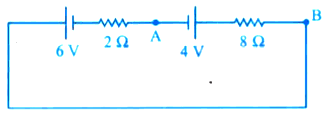 KCET 2016 Medium
 - Kranz anatomy can be seen inKCET 2022 Hard
- The value of entropy of solar system isKCET 2013 Easy
- The equation of the line joining the points \((-3,4,11)\) and \((1,-2,7)\) isKCET 2021 Easy