


KCET · Maths · Circle
\(x^{2}+y^{2}-6 x-6 y+4=0, \quad x^{2}+y^{2}-2 x\) \(-4 y+3=0, x^{2}+y^{2}+2 k x+2 y+1=0\). If the radical centre of the above three circles exists, then which of the following cannot be the value of \(k\) ?
- A 2
- B 1
- C 5
- D 4
Answer & Solution
Correct Answer
(C) 5
Step-by-step Solution
Detailed explanation
Given equation of circles are
\(S_{1} \equiv x^{2}+y^{2}-6 x-6 y+4=0\) \(\quad S_{2} \equiv x^{2}+y^{2}-2 x-4 y+3=0\) and \(S_{3} \equiv x^{2}+y^{2}+2 k x+2 y+1=0\) Now, radical axis of circle \(S_{1}\) and \(S_{2}\) is \[ S_{1}-S_{2}=0 \] \(\Rightarrow x^{2}+y^{2}-6 x-6 y+4-x^{2}-y^{2}+2 x\) \(\Rightarrow \quad-4 x-2 y+1=0\) \(\Rightarrow \quad 4 x+2 y-1=0\) Radical axis of circle \(S_{2}\) and \(S_{3}\) is \(-3=0\) \(\quad S_{2}-S_{3}=0\) \(\Rightarrow x^{2}+y^{2}-2 x-4 y+3-x^{2}-y^{2}-2 k x\) \(\Rightarrow \quad-(2+2 k) x-6 y+2=0\) \(\Rightarrow \quad(2+2 k) x+6 y-2=0\)
\[
\begin{array}{lr}
\Rightarrow & 24-4-4 k \neq 0 \\
\Rightarrow & 20-4 k \neq 0 \\
\Rightarrow & k \neq 5
\end{array}
\]
\(S_{1} \equiv x^{2}+y^{2}-6 x-6 y+4=0\) \(\quad S_{2} \equiv x^{2}+y^{2}-2 x-4 y+3=0\) and \(S_{3} \equiv x^{2}+y^{2}+2 k x+2 y+1=0\) Now, radical axis of circle \(S_{1}\) and \(S_{2}\) is \[ S_{1}-S_{2}=0 \] \(\Rightarrow x^{2}+y^{2}-6 x-6 y+4-x^{2}-y^{2}+2 x\) \(\Rightarrow \quad-4 x-2 y+1=0\) \(\Rightarrow \quad 4 x+2 y-1=0\) Radical axis of circle \(S_{2}\) and \(S_{3}\) is \(-3=0\) \(\quad S_{2}-S_{3}=0\) \(\Rightarrow x^{2}+y^{2}-2 x-4 y+3-x^{2}-y^{2}-2 k x\) \(\Rightarrow \quad-(2+2 k) x-6 y+2=0\) \(\Rightarrow \quad(2+2 k) x+6 y-2=0\)
\[
\begin{array}{lr}
\Rightarrow & 24-4-4 k \neq 0 \\
\Rightarrow & 20-4 k \neq 0 \\
\Rightarrow & k \neq 5
\end{array}
\]
See the Complete Solution
Get step-by-step explanations for this and 2.5 Lakh+ more JEE, NEET & CET questions.
- Unlock all solutions
- Practice the full chapter
- Track accuracy across PYQs
4.8 rated on Google Play · 14,000+ reviews
More questions from Maths
- If \(\quad 2 x^{2}+2 y^{2}+4 x+5 y+1=0 \quad\) and \(3 x^{2}+3 y^{2}+6 x-7 y+3 k=0 \quad\) are orthogonal, then value of \(k\) isKCET 2011 Hard
- The range of the function \(f(x)=\sin [x],-\frac{\pi}{4} < x < \frac{\pi}{4}\), where \([x]\) denotes the greatest integer \(\leq x\), isKCET 2013 Easy
- \(P\) is the point of contact of the tangent form the origin to the curve \(y=\log _{e} x\). The length of the perpendicular drawn form the origin to the normal at \(P\) isKCET 2010 Hard
- If \(\left(\begin{array}{ll}2 & 1 \\ 3 & 2\end{array}\right) A=\left(\begin{array}{ll}1 & 0 \\ 0 & 1\end{array}\right)\), then the matrix \(a\) isKCET 2020 Medium
- Consider an infinite geometric series with first term ' \( a \) ' and common ratio ' \( r \) '. If the sum is \( 4 \) and
the second term is \( \frac{3}{4} \), thenKCET 2014 Hard - In \(P(X)\), the power set of a non-empty set \(X\), an binary operation * is defined by \(\mathrm{A}{ }^{*} \mathrm{~B}=\mathrm{A} \cup \mathrm{B}, \forall \mathrm{A}, \mathrm{B} \in \mathrm{P}(\mathrm{x})\) under \(*\), a true statement isKCET 2010 Easy
More PYQs from KCET
- If \(\frac{1}{(3-5 x)(2+3 x)}=\frac{A}{3-5 x}+\frac{B}{2+3 x}\), then A : \(B\) isKCET 2010 Easy
- A mature mRNA consists of 900 bases without any stop codon in between. Calculate the number of amino acids coded by this mRNA during translation.KCET 2019 Hard
- The half-life period of a \( 1^{s t} \) order reaction is \( 60 \) minutes. What percentage will be left over after
\( 240 \) minutes?KCET 2016 Hard - During scattering of light, the amount of scattering is inversely proportional to of wavelength of light.KCET 2017 Medium
- Which logic gate is represented by the following combination of logic gates ?
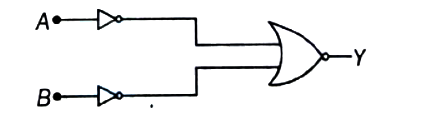 KCET 2022 Easy
 - \( \int_{0}^{\pi / 4} \log \left(\frac{\sin x+\cos x}{\cos x}\right) d x \)KCET 2015 Medium