


KCET · Maths · Mathematical Reasoning
In \(P(X)\), the power set of a non-empty set \(X\), an binary operation * is defined by \(\mathrm{A}{ }^{*} \mathrm{~B}=\mathrm{A} \cup \mathrm{B}, \forall \mathrm{A}, \mathrm{B} \in \mathrm{P}(\mathrm{x})\) under \(*\), a true statement is
- A identity law is not satisfied
- B inverse law is not satisfied
- C commutative law is not satisfied
- D associative law is not satisfied
Answer & Solution
Correct Answer
(B) inverse law is not satisfied
Step-by-step Solution
Detailed explanation
Under the binary operation,
\(\mathrm{A} * \mathrm{~B}=\mathrm{A} \cup \mathrm{B}, \forall \mathrm{A}, \mathrm{B} \in \mathrm{P}(\mathrm{x})=\) Power set
Inverse of 'A' does not exists because
\[
A * B \neq \phi \text {, for any } B \in P(x)
\]
Where \(\phi\) is the identity element in \(P(x)\).
While under the binary operation \(A * B=A \cup B\), the commutative law, associative law and identity elements are exists.
\(\mathrm{A} * \mathrm{~B}=\mathrm{A} \cup \mathrm{B}, \forall \mathrm{A}, \mathrm{B} \in \mathrm{P}(\mathrm{x})=\) Power set
Inverse of 'A' does not exists because
\[
A * B \neq \phi \text {, for any } B \in P(x)
\]
Where \(\phi\) is the identity element in \(P(x)\).
While under the binary operation \(A * B=A \cup B\), the commutative law, associative law and identity elements are exists.
See the Complete Solution
Get step-by-step explanations for this and 2.5 Lakh+ more JEE, NEET & CET questions.
- Unlock all solutions
- Practice the full chapter
- Track accuracy across PYQs
4.8 rated on Google Play · 14,000+ reviews
More questions from Maths
- If \(\overrightarrow{\mathbf{a}}\) and \(\overrightarrow{\mathbf{b}}\) are unit vectors and \(|\overrightarrow{\mathbf{a}}+\overrightarrow{\mathbf{b}}|=1\), then \(|\overrightarrow{\mathbf{a}}-\overrightarrow{\mathbf{b}}|\) is equal toKCET 2008 Medium
- The value of \(\cos \left(\sin ^{-1} \frac{\pi}{3}+\cos ^{-1} \frac{\pi}{3}\right)\) isKCET 2020 Medium
- A tangent is drawn to the circle \(2 x^{2}+2 y^{2}-3 x+4 y=0\) at point \(A\) and it meets the line \(x+y=3\) at \(B(2,1)\), then \(A B\) is equal toKCET 2013 Easy
- The least and the greatest distances of the point \((10,7)\) from the circle
\[
x^{2}+y^{2}-4 x-2 y-20=0 \text { are }
\]KCET 2012 Medium - Solve for \( x \)
\[
\tan ^{-1}\left(\frac{1-x}{1+x}\right)=\frac{1}{2} \tan ^{-1} x, x>0
\]KCET 2015 Easy - The conjugate of the complex number \(\frac{(1+i)^{2}}{1-i}\) isKCET 2007 Easy
More PYQs from KCET
- Four charges \(+q,+2 q,+q\) and \(-2 q\) are placed at the corners of a square \(A B C D\) respectively. The force on a unit positive charge kept at the centre \(O\) isKCET 2022 Easy
- The source of electromagnetic wave can be a chargeKCET 2021 Easy
- In Young's double slit experiment with sodium vapour lamp of wavelength \(589 \mathrm{~nm}\) and the slits \(0.589 \mathrm{~mm}\) apart, the half angular width of the central maximum isKCET 2007 Medium
- If \(A\) and \(B\) have \(n\) elements in common, then the number of elements common to \(A \times B\) and \(B \times A\) isKCET 2012 Easy
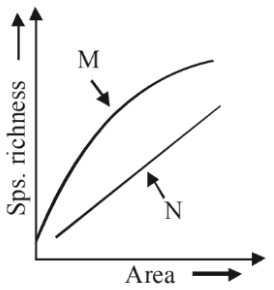
- Match for M and N with species-area relationship shown in the graphic representation below and choose the correct option.
 KCET 2018 Hard
 - Identify the products \(A\) and \(B\) in the reactions :
\[
\begin{aligned}
& R-X+\mathrm{AgCN} \longrightarrow A+\mathrm{Ag} X \\
& R-X+\mathrm{KCN} \longrightarrow B+\mathrm{KX}
\end{aligned}
\]KCET 2022 Medium