


KCET · Maths · Parabola
The length of latus rectum of the parabola \( 4 y^{2}+3 x+3 y+1=0 \) is
- A \( \frac{4}{3} \)
- B \( 07 \)
- C \( 12 \)
- D \( \frac{3}{4} \)
Answer & Solution
Correct Answer
(D) \( \frac{3}{4} \)
Step-by-step Solution
Detailed explanation
Given parabola
\[
\begin{array}{l}
4 y^{2}+3 x+3 y+1=0 \\
\Rightarrow y^{2}+\frac{3}{4} y+\frac{1}{4}=\frac{-3}{4} x \\
\Rightarrow\left(y+\frac{3}{8}\right)^{2}-\left(\frac{3}{8}\right)^{2}+\frac{1}{4}=\frac{-3}{4} x \\
\Rightarrow\left(y+\frac{3}{8}\right)^{2}+\frac{7}{64}=\frac{-3}{4} x \\
\Rightarrow\left(y+\frac{3}{8}\right)^{2}=-\frac{3}{4} x-\frac{7}{64} \\
\Rightarrow\left(y+\frac{3}{8}\right)^{2}=\frac{-3}{4}\left(x+\frac{7}{48}\right) \\
\Rightarrow\left(y+\frac{3}{8}\right)^{2}=\frac{-3}{4}\left(x+\frac{7}{48}\right) \rightarrow(1)
\end{array}
\]
Comparing Eq. (1) with standard equation of parabola,
\( y^{2}=4 a X \)
Therefore, length of latus rectum is \( \frac{3}{4} \)
\[
\begin{array}{l}
4 y^{2}+3 x+3 y+1=0 \\
\Rightarrow y^{2}+\frac{3}{4} y+\frac{1}{4}=\frac{-3}{4} x \\
\Rightarrow\left(y+\frac{3}{8}\right)^{2}-\left(\frac{3}{8}\right)^{2}+\frac{1}{4}=\frac{-3}{4} x \\
\Rightarrow\left(y+\frac{3}{8}\right)^{2}+\frac{7}{64}=\frac{-3}{4} x \\
\Rightarrow\left(y+\frac{3}{8}\right)^{2}=-\frac{3}{4} x-\frac{7}{64} \\
\Rightarrow\left(y+\frac{3}{8}\right)^{2}=\frac{-3}{4}\left(x+\frac{7}{48}\right) \\
\Rightarrow\left(y+\frac{3}{8}\right)^{2}=\frac{-3}{4}\left(x+\frac{7}{48}\right) \rightarrow(1)
\end{array}
\]
Comparing Eq. (1) with standard equation of parabola,
\( y^{2}=4 a X \)
Therefore, length of latus rectum is \( \frac{3}{4} \)
See the Complete Solution
Get step-by-step explanations for this and 2.5 Lakh+ more JEE, NEET & CET questions.
- Unlock all solutions
- Practice the full chapter
- Track accuracy across PYQs
4.8 rated on Google Play · 14,000+ reviews
More questions from Maths
- The number of solutions of the equation \(\mathrm{z}^{2}+\overline{\mathrm{z}}=0\), where \(\mathrm{z} \in \mathrm{C}\), areKCET 2012 Easy
- The simplified form of \( i^{n}+i^{n+1}+i^{n+2}+i^{n+3} \) isKCET 2016 Easy
- If \( x y z \) are not equal and \( \neq 0, \neq 1 \) the value of \( \left|\begin{array}{ccc}\log x & \log y & \log z \\ \log 2 x & \log 2 y & \log 2 z \\ \log 3 x & \log 3 y & \log 3 z\end{array}\right| \) is equal toKCET 2016 Medium
- If \(\quad 2 x^{2}+2 y^{2}+4 x+5 y+1=0 \quad\) and \(3 x^{2}+3 y^{2}+6 x-7 y+3 k=0 \quad\) are orthogonal, then value of \(k\) isKCET 2011 Hard
- Let X be a matrix of order \(2 \times n\) and Z be a matrix of order \(2 \times p\). If \(n = p\), then the order of the matrix \(8X - 9Z\) is:KCET 2026 Easy
- The feasible region of an LPP is shown in the figure. If \( z=3 x+9 y \), then the minimum value of
z occurs at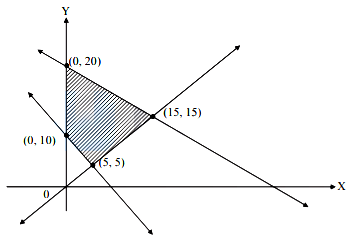 KCET 2018 Easy
More PYQs from KCET
- The value of \(\int \frac{x^{2} d x}{\sqrt{x^{6}+a^{6}}}\) is equal toKCET 2021 Medium
- Choose the correct sequence of events occur in human reproduction.KCET 2016 Easy
- Match the following list of animals with their level of organisation and choose the correct sequence.
Column I Column II A. Organ level p. Pheretima B Cellular aggregate level q. Fasciola C Tissue level r. Spongilla D. Organ system level s. Obelia KCET 2013 Easy - For the curve \(4 x^{5}=5 y^{4}\), the ratio of the cube of the subtangent at a point on the curve the square of the subnormal at the same point isKCET 2010 Hard
- \(\frac{1}{2 \cdot 5}+\frac{1}{5 \cdot 8}+\frac{1}{8 \cdot 11}+\ldots \frac{1}{(3 n-1)(3 n+2)}\) is equal toKCET 2007 Hard
- In Prokaryotes the glycocalyx when it is thick is calledKCET 2015 Hard