


KCET · Maths · Determinants
If \( x y z \) are not equal and \( \neq 0, \neq 1 \) the value of \( \left|\begin{array}{ccc}\log x & \log y & \log z \\ \log 2 x & \log 2 y & \log 2 z \\ \log 3 x & \log 3 y & \log 3 z\end{array}\right| \) is equal to
- A \( \log (x y z) \)
- B \( \log (6 \times y z) \)
- C \( 00 \)
- D \( \log (x+y+z) \)
Answer & Solution
Correct Answer
(C) \( 00 \)
Step-by-step Solution
Detailed explanation
Given that, \(x, y, z \neq 0 \neq 1\)
As we know, \(\log 2 x-\log x=\log 2\)
and \(\log 3 x-\log x=\log 3\)
Given that \(\left|\begin{array}{ccc}\log x & \log y & \log z \\ \log 2 x & \log 2 y & \log 2 z \\ \log 3 x & \log 3 y & \log 3 z\end{array}\right|\)
\(R_{2} \rightarrow R_{2}-R_{1}\) and \(R_{3} \rightarrow R_{3}-R_{1}\)
\(\mid \begin{array}{ll}\log x & \log y & \log z \\ \log 2 & \log 2 & \log 2 \\ \log 3 & \log 3 & \log 3 & \\ = & \log 2 \log 3 \\ \text { When the two rows of determinants are identical the value of determinant is equal to } 0 & \begin{array}{ccc}\log x & \log y & \log z \\ 1 & 1 & 1 \\ 1 & 1 & 1\end{array} \mid\end{array}\)
As we know, \(\log 2 x-\log x=\log 2\)
and \(\log 3 x-\log x=\log 3\)
Given that \(\left|\begin{array}{ccc}\log x & \log y & \log z \\ \log 2 x & \log 2 y & \log 2 z \\ \log 3 x & \log 3 y & \log 3 z\end{array}\right|\)
\(R_{2} \rightarrow R_{2}-R_{1}\) and \(R_{3} \rightarrow R_{3}-R_{1}\)
\(\mid \begin{array}{ll}\log x & \log y & \log z \\ \log 2 & \log 2 & \log 2 \\ \log 3 & \log 3 & \log 3 & \\ = & \log 2 \log 3 \\ \text { When the two rows of determinants are identical the value of determinant is equal to } 0 & \begin{array}{ccc}\log x & \log y & \log z \\ 1 & 1 & 1 \\ 1 & 1 & 1\end{array} \mid\end{array}\)
See the Complete Solution
Get step-by-step explanations for this and 2.5 Lakh+ more JEE, NEET & CET questions.
- Unlock all solutions
- Practice the full chapter
- Track accuracy across PYQs
4.8 rated on Google Play · 14,000+ reviews
More questions from Maths
- If \(A\) and \(B\) are symmetric matrices of the same order, then which one of the following is not true?KCET 2011 Hard
- If \(A = \{1, 2, 3, 4, \ldots, 10\}\), then the number of non-empty subsets of A containing only even number isKCET 2026 Easy
- The equation of the normal to the hyperbola \(\frac{x^{2}}{16}-
\frac{y^{2}}{9}=1\) at \((-4,0)\) isKCET 2008 Medium - The 13 th term in the expansion of \(\left(x^{2}+\frac{2}{x}\right)^{n}\) is independent of \(x\), then the sum of the divisors of \(n\) isKCET 2012 Easy
- The sides of an equilateral triangle are increasing at the rate of \( 4 \mathrm{~cm} / \mathrm{sec} \). The rate at which its
area is increasing, when the side is \( 14 \mathrm{~cm} \)KCET 2019 Medium - The angle between the lines \( 2 x=3 y=-z \) and \( 6 x=-y=-4 z \) isKCET 2018 Easy
More PYQs from KCET
- An organic compound \( A \) on reduction gives compound \( B \), which on reaction with trichloro
methane and caustic potash forms \( C \). The compound ' \( C \) ' on catalytic reduction gives \( N \)-methyl
benzenamine, the compound ' \( \mathrm{A} \) ' is,KCET 2016 Hard - A die has two face each with number ' 1 ', three faces each with number ' 2 ' and one face with number ' 3 '. If the die is rolled once, then \(\mathrm{P}(1\) or 3\()\) isKCET 2025 Easy
- A coil of inductive reactance \( \frac{1}{\sqrt{3}} \Omega \) and resistance \( 1 \Omega \) is connected to a \( 200 \mathrm{~V}, 50 \mathrm{~Hz} \) ac.
supply. The time lag between maximum voltage and current isKCET 2017 Easy - The minimum area of the triangle formed by the variable line \(3 \cos \theta \cdot x+4 \sin \theta \cdot y=12\) and the coordinate axes isKCET 2013 Hard
- For the arrangement of capacitors as shown in the circuit, the effective capacitance between the points \( A \) and \( B \) is (capacitance of each capacitor is \( 4 \mu \mathrm{F} \) )
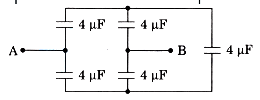 KCET 2018 Medium
 - A square loop of side 2 m lies in the \(Y-Z\) plane in a region having a magnetic field \(\vec{B}=(5 \hat{\mathrm{i}}+3 \hat{\mathrm{j}}-4 \hat{\mathrm{k}}) \mathrm{T}\). The magnitude of magnetic flux through the square loop isKCET 2025 Easy