


KCET · Maths · Probability
The distance of the point \( (-2,4,-5) \) from the line
\( \frac{x+3}{3}=\frac{y-4}{5}=\frac{z+8}{6} \) is
- A \( \frac{\sqrt{37}}{10} \)
- B \( \sqrt{\frac{37}{10}} \)
- C \( \frac{37}{\sqrt{10}} \)
- D \( \frac{37}{10} \)
Answer & Solution
Correct Answer
(B) \( \sqrt{\frac{37}{10}} \)
Step-by-step Solution
Detailed explanation
Given line, \( \frac{x+3}{3}=\frac{y-4}{5}=\frac{z+8}{6} \rightarrow(1) \)
and point \( \mathrm{P}(-2,4,-5) \)
Let \( \frac{x+3}{3}=\frac{y-4}{5}=\frac{z+8}{6}=\lambda \)
So, point on line is \( Q(3 \lambda-3,5 \lambda+4,6 \lambda-8) \)
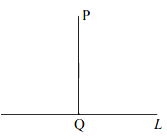
Since, \( P Q \) line is perpendicular to line of Eq. (1). SO,
\[
\begin{array}{l}
l_{1} l_{2}+m_{1} m_{2}+n_{1} n_{2}=0 \\
\Rightarrow(3 \lambda-1) 3+5 \lambda(5+0)+(6 \lambda-3) 6=0 \\
\Rightarrow 9 \lambda-3+25 \lambda+36 \lambda-18=0 \\
\Rightarrow 70 \lambda=21 \Rightarrow \lambda=\frac{3}{10}
\end{array}
\]
Therefore, \( Q\left(-\frac{21}{10}, \frac{55}{10},-\frac{62}{10}\right) \)
So,
\[
\begin{array}{l}
P Q=\sqrt{\left(-\frac{21}{10}-(-2)\right)^{2}+\left(\frac{55}{10}-4\right)^{2}+\left(-\frac{62}{10}-(-5)\right)^{2}} \\
=\sqrt{\frac{1}{100}+\frac{225}{100}+\frac{144}{100}}=\sqrt{\frac{370}{100}}=\sqrt{\frac{37}{10}}
\end{array}
\]
and point \( \mathrm{P}(-2,4,-5) \)
Let \( \frac{x+3}{3}=\frac{y-4}{5}=\frac{z+8}{6}=\lambda \)
So, point on line is \( Q(3 \lambda-3,5 \lambda+4,6 \lambda-8) \)
Since, \( P Q \) line is perpendicular to line of Eq. (1). SO,
\[
\begin{array}{l}
l_{1} l_{2}+m_{1} m_{2}+n_{1} n_{2}=0 \\
\Rightarrow(3 \lambda-1) 3+5 \lambda(5+0)+(6 \lambda-3) 6=0 \\
\Rightarrow 9 \lambda-3+25 \lambda+36 \lambda-18=0 \\
\Rightarrow 70 \lambda=21 \Rightarrow \lambda=\frac{3}{10}
\end{array}
\]
Therefore, \( Q\left(-\frac{21}{10}, \frac{55}{10},-\frac{62}{10}\right) \)
So,
\[
\begin{array}{l}
P Q=\sqrt{\left(-\frac{21}{10}-(-2)\right)^{2}+\left(\frac{55}{10}-4\right)^{2}+\left(-\frac{62}{10}-(-5)\right)^{2}} \\
=\sqrt{\frac{1}{100}+\frac{225}{100}+\frac{144}{100}}=\sqrt{\frac{370}{100}}=\sqrt{\frac{37}{10}}
\end{array}
\]
See the Complete Solution
Get step-by-step explanations for this and 2.5 Lakh+ more JEE, NEET & CET questions.
- Unlock all solutions
- Practice the full chapter
- Track accuracy across PYQs
4.8 rated on Google Play · 14,000+ reviews
More questions from Maths
- The set \( A=\{x ;|2 x+3| < 7\} \) is equal to the set.KCET 2014 Easy
- \(\int \frac{\sin x \cos x}{\sqrt{1-\sin ^{4} x}} d x\) is equal toKCET 2008 Medium
- If \(\sin ^{-1} a\) is the acute angle between the curves \(x^{2}+y^{2}=4 x\) and \(x^{2}+y^{2}=8\) at \((2,2)\), then \(a\) is equal toKCET 2013 Hard
- If \( \mathrm{A} \) is a square matrix of order \( 3 \times 3 \), then \( |\mathrm{KA}| \) is equal toKCET 2017 Easy
- The value of \(\int e^{x}\left[\frac{1+\sin x}{1+\cos x}\right] d x\) is equal toKCET 2021 Hard
- Let \(\boldsymbol{f}: \boldsymbol{R} \rightarrow \boldsymbol{R}\) be defined by \(f(x)=3 x^2-5\) and \(g: R \rightarrow R\) by \(g(x)=\frac{x}{x^2+1}\), then \(g \circ f\) isKCET 2023 Easy
More PYQs from KCET
- The component of a vector \( \vec{r} \) along \( x \) - axis will have a maximum value ifKCET 2016 Easy
- Two thin biconvex lenses have focal lengths \(f_{1}\) and \(f_{2}\). A third thin biconcave lens has focal length of \(f_{3}\). If the two biconvex lenses are in contact, then the total power of the lenses is \(P_{1}\). If the first convex lens is in contact with the third lens, then the total power is \(P_{2}\). If the second lens is in contact with the third lens, the total power is \(P_{3}\), thenKCET 2021 Hard
- If the straight line \(2 x-3 y+17=0\) is perpendicular to the line passing through the points \((7,17)\) and \((15, \beta)\), then \(\beta\) equalsKCET 2022 Medium
- \[
f(x)=\frac{1}{2}-\tan \left(\frac{\Pi x}{2}\right)-1 < x < 1 \text { and } g(x)=\sqrt{\left(3+4 x-4 x^{2}\right)}
\]
Find domain of \( (f+g) \)KCET 2015 Easy - A die has two face each with number ' 1 ', three faces each with number ' 2 ' and one face with number ' 3 '. If the die is rolled once, then \(\mathrm{P}(1\) or 3\()\) isKCET 2025 Easy
- The range in which \(y=-x^{2}+6 x-3\) is increasing isKCET 2007 Easy