


KCET · Maths · Functions
Let \(\boldsymbol{f}: \boldsymbol{R} \rightarrow \boldsymbol{R}\) be defined by \(f(x)=3 x^2-5\) and \(g: R \rightarrow R\) by \(g(x)=\frac{x}{x^2+1}\), then \(g \circ f\) is
- A \(\frac{3 x^2-5}{9 x^4-6 x^2+26}\)
- B \(\frac{3 x^2}{x^4+2 x^2-4}\)
- C \(\frac{3 x^2}{9 x^4+30 x^2-2}\)
- D \(\frac{3 x^2-5}{9 x^4-30 x^2+26}\)
Answer & Solution
Correct Answer
(D) \(\frac{3 x^2-5}{9 x^4-30 x^2+26}\)
Step-by-step Solution
Detailed explanation
Given that \(f(x)=3 x^2-5\)
and \(g(x)=\frac{x}{x^2+1}\)
\(g o t=g\{f(x)\}=g\left(3 x^2-5\right)\)
\(\begin{aligned} & =\frac{3 x^2-5}{\left(3 x^2-5\right)^2+1}=\frac{3 x^2-5}{9 x^4-30 x^2+25+1} \\ & =\frac{3 x^2-5}{9 x^4-30 x^2+26}\end{aligned}\)
and \(g(x)=\frac{x}{x^2+1}\)
\(g o t=g\{f(x)\}=g\left(3 x^2-5\right)\)
\(\begin{aligned} & =\frac{3 x^2-5}{\left(3 x^2-5\right)^2+1}=\frac{3 x^2-5}{9 x^4-30 x^2+25+1} \\ & =\frac{3 x^2-5}{9 x^4-30 x^2+26}\end{aligned}\)
See the Complete Solution
Get step-by-step explanations for this and 2.5 Lakh+ more JEE, NEET & CET questions.
- Unlock all solutions
- Practice the full chapter
- Track accuracy across PYQs
4.8 rated on Google Play · 14,000+ reviews
More questions from Maths
- If \( \tan x=\frac{3}{4}, \Pi < x < \frac{3 \Pi}{2} \), then the value of \( \cos \frac{x}{2} \) isKCET 2014 Medium
- If \(n(A) = 2\) and the number of relations from set A to set B is \(1024\), then \(n(B)\) isKCET 2026 Easy
- The corner points of the feasible region determined by the system of linear constraints are \((0, 10), (5, 5), (15, 15), (0, 20)\). Let \(z = px + qy\) where \(p, q > 0\). The relation between \(p\) and \(q\), so that the maximum \(z\) occurs at both points \((15, 15)\) and \((0, 20)\) isKCET 2026 Medium
- A unit vector perpendicular to the plane containing the vectors \( \hat{i}+2 \hat{j}+\hat{k} \) and
\( -2 \hat{i}+\hat{j}+3 \hat{k} \) isKCET 2019 Hard - If \( y=(1+x)\left(1+x^{2}\right)\left(1+x^{4}\right) \), then \( \frac{d y}{d x} \) at \( x=1 \) isKCET 2014 Easy
- If \(m\) and \(n\) are order and degree of the differential equation
\(\left(y^{\prime \prime}\right)^{5}+4 \cdot \frac{\left(y^{\prime \prime}\right)^{3}}{y^{\prime \prime \prime}}+y^{\prime \prime \prime}=\sin x\), thenKCET 2013 Medium
More PYQs from KCET
- X-rays, gamma rays and microwaves travelling in vacuum haveKCET 2012 Easy
- A radio-active sample of half-life \( 10 \) days contains \( 1000 \times \) nuclei. Number of original nuclei
present after \( 5 \) days isKCET 2016 Medium - What is the value of shunt resistance required to convert a galvanometer of resistance \( 100 \Omega \)
into an ammeter of range \( 1 \mathrm{~A} \)?
Given : Full scale deflection of the galvanometer is \( 5 \mathrm{~mA} \).KCET 2014 Medium - The compound on dehydrogenation gives a ketone. The original compound isKCET 2008 Medium
- If \( \left(\frac{1+i}{1-i}\right)^{\mathrm{m}} \), then the least positive integralvalue of \( \mathrm{m} \) isKCET 2017 Easy
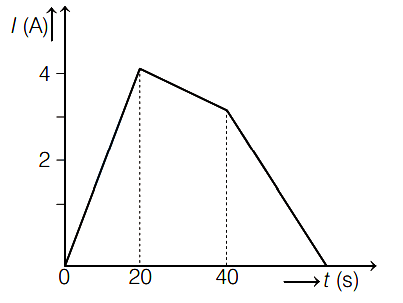
- The current following through an inductance coil of self-inductance \(6 \mathrm{mH}\) at different time instants is as shown. The emf induced between \(t=20 \mathrm{~s}\) and \(t=40 \mathrm{~s}\) is nearly
 KCET 2021 Hard