


KCET · Maths · Matrices
The characteristic equation of a matrix \(\mathrm{A}\) is \(\lambda^{3}-5 \lambda^{2}-3 \lambda+2=0\), then \(\mid\) adj (A) \(\mid\) is equal to
- A 9
- B 25
- C \(\frac{1}{2}\)
- D 4
Answer & Solution
Correct Answer
(D) 4
Step-by-step Solution
Detailed explanation
We know that, \(\left[\begin{array}{ccc}0 & 0 & -\mathrm{c} \\ 1 & 0 & -\mathrm{b} \\ 0 & 1 & -\mathrm{a}\end{array}\right]\) iff
\[
\lambda^{3}+\mathrm{a} \hat{\lambda}^{2}+\mathrm{b} \lambda+\mathrm{c}=0
\]
But given that,
\(\therefore\)
\(\lambda^{3}-5 \lambda^{2}-3 \lambda+2=0\)
\(A=\left[\begin{array}{rrr}0 & 0 & -2 \\ 1 & 0 & 3 \\ 0 & 1 & 5\end{array}\right]\)
\(|A|=\left[\begin{array}{rrr}0 & 0 & -2 \\ 1 & 0 & 3 \\ 0 & 1 & 5\end{array}\right]\)
\(=0+0-2(1-0)=-2\)
\(\therefore \mid\) adj \(\left.\mathrm{A}|=| \mathrm{A}\right|^{2}=(-2)^{2}=4\)
\[
\lambda^{3}+\mathrm{a} \hat{\lambda}^{2}+\mathrm{b} \lambda+\mathrm{c}=0
\]
But given that,
\(\therefore\)
\(\lambda^{3}-5 \lambda^{2}-3 \lambda+2=0\)
\(A=\left[\begin{array}{rrr}0 & 0 & -2 \\ 1 & 0 & 3 \\ 0 & 1 & 5\end{array}\right]\)
\(|A|=\left[\begin{array}{rrr}0 & 0 & -2 \\ 1 & 0 & 3 \\ 0 & 1 & 5\end{array}\right]\)
\(=0+0-2(1-0)=-2\)
\(\therefore \mid\) adj \(\left.\mathrm{A}|=| \mathrm{A}\right|^{2}=(-2)^{2}=4\)
See the Complete Solution
Get step-by-step explanations for this and 2.5 Lakh+ more JEE, NEET & CET questions.
- Unlock all solutions
- Practice the full chapter
- Track accuracy across PYQs
4.8 rated on Google Play · 14,000+ reviews
More questions from Maths
- The negation of the statement "All continuous functions are differentiable"KCET 2019 Easy
- Let \((g \circ f)(x)=\sin x\) and \(f \circ g(x)=(\sin \sqrt{x})^2\) Then,KCET 2024 Easy
- \(\int \sqrt{\operatorname{cosec} x-\sin x} d x\) is equals toKCET 2023 Medium
- If \(\sin x-\sin y=\frac{1}{2}\) and \(\cos x-\cos y=1\), then \(\tan (x+y)\) is equal toKCET 2013 Hard
- The value of \(\int \frac{x e^{x} d x}{(1+x)^{2}}\) is equal toKCET 2021 Hard
- The diagonals of a parallelogram are the vectors \(3 \hat{\mathbf{i}}+6 \hat{\mathbf{j}}-2 \hat{\mathbf{k}}\). and \(-\hat{\mathbf{i}}-2 \hat{\mathbf{j}}-8 \hat{\mathbf{k}}\). Then the length of the shorter side of parallelogram isKCET 2021 Medium
More PYQs from KCET
- If \(y=\sin ^{n} x \cos n x\), then \(\frac{d y}{d x}\) isKCET 2009 Easy
- If \( \left[\begin{array}{cc}1 & 1 \\ -1 & 1\end{array}\right]\left[\begin{array}{l}\mathrm{x} \\ \mathrm{y}\end{array}\right]=\left[\begin{array}{c}2 \\ 4\end{array}\right] \), then the values of \( \mathrm{x} \) and \( \mathrm{y} \) respectively areKCET 2018 Easy
- Out of the compounds below the vapour pressure of (B) at a particular temperature is
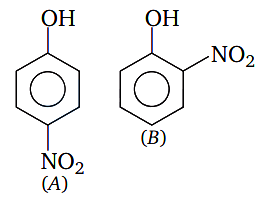 KCET 2010 Medium
 - The oxidation state of \(\mathrm{Fe}\) in the brown ring complex: \(\left[\mathrm{Fe}\left(\mathrm{H}_{2} \mathrm{O}\right)_{5} \mathrm{NO}\right] \mathrm{SO}_{4}\) isKCET 2009 Easy
- The ratio of area of first excited state to ground state of orbit of hydrogen atom'isKCET 2024 Easy
- The de-Broglie wavelength of a particle of kinetic energy \(K\) is \(\lambda\), the wavelength of the particle, if its kinetic energy \(\frac{K}{4}\) isKCET 2022 Easy